Handbook of Parliament
The System of Elections in Sri Lanka
How Parliament Works
Business of Parliament
Engage with your Parliament by logging in
2022-12-14
News Categories : Committee News
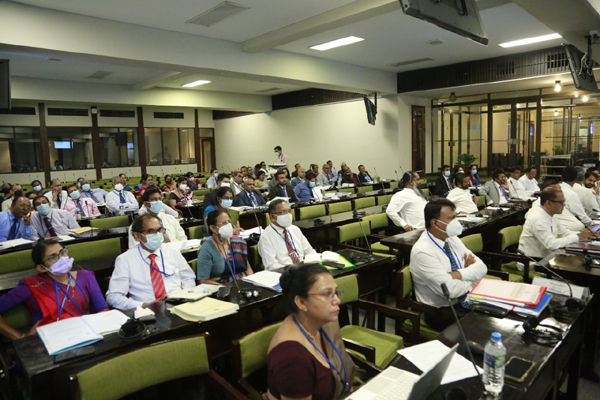
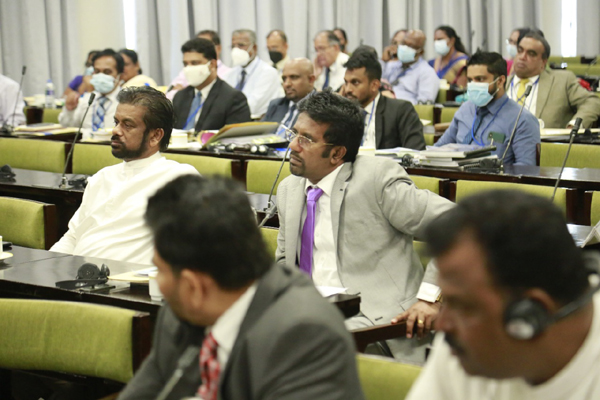
The Ministerial Consultative Committee on Environment recently discussed at length whether the Sinhala name of the national flower of Sri Lanka is ‘Mahanel’ or ‘Nil Mahanel’.
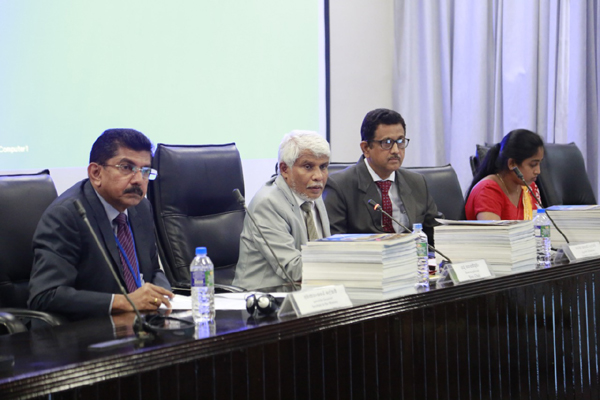
This was discussed at the Ministerial Consultative Committee on Environment, chaired by the Minister of Environment Hon. Nasir Ahmed recently in Parliament.
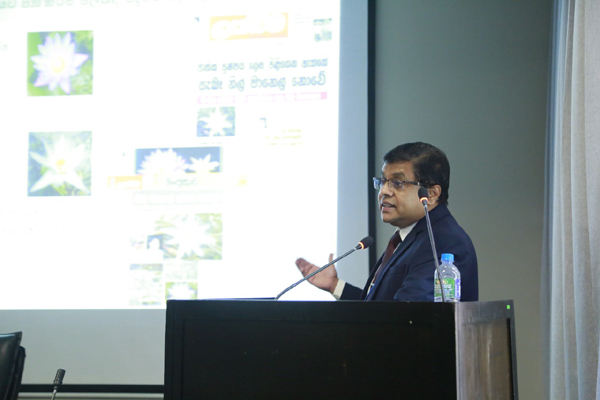
Mrs. Deepthi Yakandawala, Senior Professor of the Department of Botany, University of Peradeniya and Mr. Kapila Yakandawala, Senior Professor of the Faculty of Agriculture and Plantation Management, University of Wayamba, delivered a lengthy presentation on the unresolved and controversial issue of what is the national flower of Sri Lanka for many years.
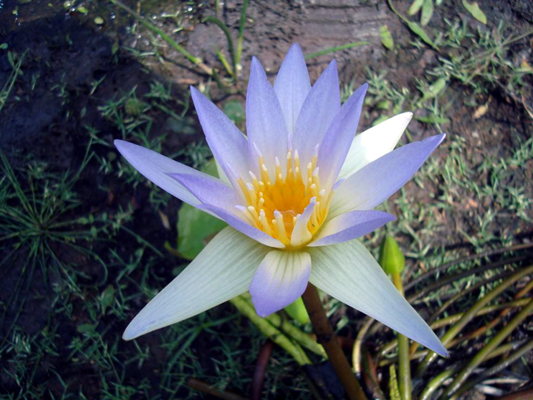
As presented by Professor Yakandawala, the national flower of Sri Lanka was announced on February 26, 1986. The national flower has been officially declared as the ‘Blue Water Lily’ by a cabinet paper. But the professor said that a photo of a ‘Purple Water Lily’ is used to depict the ‘Blue water Lily’.
Accordingly, in 2010, the professor and others informed the President, the Minister of Environment, the Secretary to the Ministry of Environment, and the Director of the Biodiversity Secretariat of this mistake that made in 1986. Accordingly, in 2015, an accurate photo of the national flower has been included. But in 2015, the Ministry of Environment published a photo of the correct flower, while declaring the Sinhala name of Sri Lanka's national flower is ‘Manel’, the English name is ‘Blue Water Lily’ and the Tamil name is ‘Nilothpalam’.
The Ministry of Environment pointed out that the reason for the change of the name ‘Nil Manel’ to ‘Manel’ was based on the opinion expressed by the veteran Sinhala language expert, Prof. Wimal G. Balagalle on the national flower. According to his opinion, it has been suggested that the Sinhala name of the national flower should be used as ‘Manel’, since the meaning of ‘Manel’ is the noblest blue flower.
Prof. Yakandawala emphasized that according to the globally accepted standards of plant classification, the scientific name may be subject to change, but the common names used in the general public, which have a very long history, should not be changed.
Both Professors pointed out that ‘Manel’ is a common name and since there are many types of ‘Manel’ (Water Lilies) in Sri Lanka, such as Purple Water Lilies, White Water Lilies, Blue Water Lilies, etc., the Sinhala name of national flower of Sri Lanka should be chosen as ‘Nil Manel’ (Blue Water Lily).
The professor pointed out that the Blue Water Lily has met all the criteria considered by the National Flower Selection Committee in 1986, such as endemicity, utility, historical and cultural significance, etc.
Prof. Deepti Yakandawala mentioned that the ‘Sri Lanka Philatelic Bureau’ has issued a stamp with a picture of the Blue Water Lily and it is not the real flower but a picture of a wrong flower. She also pointed out that the text books contain an image of a wrong flower and not only in schools but also in some higher education institutes, they are teaching by showing the picture of a wrong flower.
Also, these two researchers are of the opinion that not only in books but also those sold as Blue Water Lilies near religious places are not real Blue Water Lilies.
Addressing the committee the Minister emphasized that an expert committee has been appointed by the Prime Minister to consider this matter and to present recommendations. The Members of Parliament who spoke about the matter pointed out that it is a matter of national importance that a definite decision should be taken soon.
Apart from this, the activities of the institutions affiliated to the Ministry of Environment were also discussed at length in the Consultative Committee.
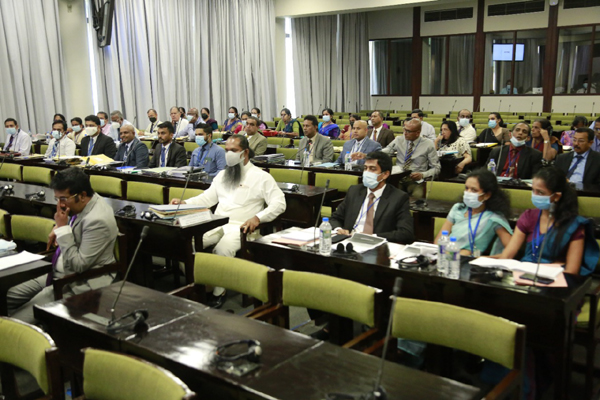
Several Parliamentarians also participated in this meeting and a group of officials including Dr. Anil Jasinghe, Secretary to the Ministry of Environment were also present.
An image of a Blue Water Lilly which was included in the Cabinet Paper in 2015, sent by Prof. Yakandawala is attached for your reference.

2026-04-09
The Committee on Public Finance (CoPF) met on 07th April 2026 under the chairmanship of Hon Member of Parliament Dr. Harsha de Silva.The Governor of the Central Bank of Sri Lanka (CBSL) Dr. Nandalal Weerasinghe, along with members of the Governing Board, the Monetary Policy Board, and senior officials, attended the meeting as part of the Central Bank’s statutory presentation to Parliament conducted once every four months.Hon. Deputy Ministers Chathuranga Abeysinghe, (Dr.) (Ms.) Kaushalya Ariyarathnea and Nishantha Jayaweera, Hon. Members of parliament Rauff Hakeem, Attorney at Law, Ravi Karunanayake, M.K.M. Aslam, Nimal Palihena, Chithral Fernando, Attorney at Law, Wijesiri Basnayake, Thilina Samarakoon, Champika Hettiarachchi and (Ms.) Lakmali Hemachandra, Attorney at Law were also present at the meeting.During the meeting, the Committee took up as a matter of priority the alleged fraud at NDB Bank. The Committee initiated a focused discussion with the Central Bank, underscoring the seriousness of the issue and the need for urgent attention.The Governor informed the Committee that an initial investigation in this regard is currently underway. He further assured that the Central Bank will report back to the Committee at the earliest possible opportunity once the necessary information has been gathered.The Committee observed with serious concern that there appear to have been considerable lapses in corporate governance at the bank, deficiencies in supervision by the relevant departments of the Central Bank of Sri Lanka, and undue delays in the reporting of material information.The Committee firmly underscored that such shortcomings are unacceptable and directed that immediate corrective measures be undertaken. It further emphasized that it will continue to closely monitor this matter and exercise stringent oversight to ensure full accountability, transparency, and the safeguarding of public confidence in the financial system.
2026-04-02
The Committee on High Posts has approved the appointments of four Ministry Secretaries.The approval was granted when the Committee met in Parliament recently (Mar. 20) under the chairmanship of Hon. Prime Minister Dr. Harini Amarasuriya.Accordingly, the Committee approved the appointments of Air Vice Marshall H.S.S Thuyyacontha (Retd.) as the Secretary to the Ministry of Defence, Mr. L Mohamed Navavi as the Secretary to the Ministry of Science and Technology, Mrs. W.M.D.T Wickramasinghe as the Secretary to the Ministry of Women and Child Affairs and Mr. W.W.S Mangala as the Secretary to the Ministry of Ports and Civil Aviation.
2026-03-31
A Parliamentary delegation from the Sectoral Oversight Committee on Infrastructure and Strategic Development of the Parliament of Sri Lanka, led by Hon. S. M. Marikkar, Member of Parliament and Chairman of the Committee, undertook a Parliamentary Study Tour to New Delhi and Mumbai from 22nd to 27th March 2026, following an invitation extended by the High Commission of India.The Sri Lankan delegation comprised the Chief Opposition Whip Hon. Gayantha Karunathilleka, Members of Parliament Hon. Nalin Bandara Jayamaha, Hon. Manjula Suraweera Arachchi, Hon. K. Ilankumaran, Hon. Chathura Galappaththi, Hon. Ravindra Bandara, Hon. Asitha Niroshana Egoda Vithana, Hon. Shantha Pathma Kumara Subasingha, Hon. (Mrs.) Geetha Herath, Attorney at Law, Hon. Kins Nelson and Hon. Dharmapriya Wijesinghe. Parliament staff members attached to the office of the Sectoral Oversight Committees who were also present included Assistant Director (Administration) Mr. K. P. Chandana, Principal Officer Ms. S. W. T. R. De Silva and Parliamentary Officer Ms. W. K. A. M. M. M. Arthanayaka. The delegation arrived in New Delhi on 22nd March 2026 and commenced official engagements on the following day. The programme included a meeting with the Foreign Secretary of India and a floral tribute at Prerna Sthal in the Parliament House Complex. The delegation also paid a courtesy call on the Hon. Om Birla, Speaker of the Lok Sabha.An orientation session on the Indian Parliamentary system was conducted, providing valuable insights into institutional structures and legislative processes. The delegation further held productive interactions with the Standing Committee on Transport, Tourism and Culture, as well as the Standing Committee on Housing and Urban Affairs.On 24th March 2026, the delegation participated in a series of technical and policy-focused engagements, including a session on India’s “PM Gati Shakti” National Master Plan. Visits were made to the National Highways Authority of India and the Solar Energy Corporation of India, alongside discussions with the Confederation of Indian Industry. The delegation also engaged with the India-Sri Lanka Parliamentary Friendship Group, further strengthening bilateral Parliamentary relations.Continuing its programme on 25th March 2026, the delegation visited the Delhi Metro Rail Corporation to study urban mass transit systems and best practices in public transportation. This was followed by an interaction with the New Delhi Municipal Council on Smart City initiatives, focusing on urban governance, digital infrastructure, and sustainable urban development. The delegation also met with officials of the Jal Jeevan Mission under the Ministry of Jal Shakti to discuss large-scale water supply management and rural infrastructure development.The programme in Mumbai included visits to key infrastructure and development sites such as the Atal Setu Bridge and the Jawaharlal Nehru Port Trust, as well as the Navi Mumbai Airport. The delegation also visited the Power Exchange India Limited and met with the Hon. Chief Minister of Maharashtra.On 27th March 2026, the delegation visited prominent locations including the Gateway of India and Elephanta Caves. The programme also included a meeting with the Hon. Speaker of the Maharashtra Vidhan Sabha and discussions with senior officials responsible for investment promotion and industries, prior to their departure to Colombo.Sri Lanka’s participation in this Parliamentary Study Tour underscored its continued commitment to strengthening bilateral cooperation with India and advancing institutional capacity, knowledge exchange, and best practices in infrastructure and strategic development through sustained Parliamentary engagement.
2026-03-30
Progress on the implementation of recommendations issued by the COPA on 06th January 2026 was reviewed Matters relating to the 2024 Auditor General’s Report and current performance were also examined The Department of Archaeology was summoned before the Committee on Public Accounts (COPA), where attention was drawn to the progress made in implementing the recommendations issued at the COPA meeting held on 06th January 2026, as well as to the current performance of the Department.These matters were discussed at the COPA meeting held in Parliament on 19th March 2026 under the chairmanship of Hon. Member of Parliament Kabir Hashim, to examine the Auditor General’s triennial report for the years 2021–2023, the 2024 Auditor General’s Report, and the current performance of the Department of Archaeology.At its meeting on 06th January 2026, it was recommended that a report on the gazetted and ungazetted antiquities identified by the Department of Archaeology be submitted to the Committee within a month. However, the Auditor General’s Department pointed out that data relating to antiquities not declared by Gazette had still not been submitted to the Committee. Accordingly, the Chair of the Committee instructed that a report be submitted within two weeks, including details of such antiquities, reasons for not publishing them by Gazette, and a proposed timeline for their gazetting.The Committee also focused on the lack of progress in implementing the recommendation to establish a centralized data system for the Department of Archaeology, and instructed that a progress report on this matter be submitted to the Committee.Furthermore, it was revealed that although Cabinet approval stipulates that 25% of the revenue generated by the Central Cultural Fund should be allocated to the Ministry of National Heritage, the Department of Archaeology has been requesting a lower allocation annually. Officials who appeared before the Committee stated that funds allocated through Cabinet approval had remained unutilized, and that there are plans to reduce future allocations requested from the Treasury accordingly.The shortage of vehicles available to the Department was also discussed, with officials noting that this has significantly affected the institution’s performance. The Committee stated that it would take steps to raise this matter with the relevant authorities.The meeting was attended by Committee Member Hon. Deputy Minister Dinindu Saman Hennayake and Hon. Members of Parliament (Dr.) M.L.A.M. Hizbullah, Hector Appuhamy, Chanaka Madugoda, Chandana Sooriyaarachchi, and Ruwanthilaka Jayakody.
Handbook of Parliament
The System of Elections in Sri Lanka
How Parliament Works
Business of Parliament
Copyright © The Parliament of Sri Lanka.
All Rights Reserved.
Design & Developed by TekGeeks