logo

01

සි   |     |  

2025-09-02

News Categories : Committee News 

The Sectoral Oversight Committee on Economic Development and International Relations reviews the performance of the Ministry of Industry and Entrepreneurship Development and the five institutions under its purview

  • Special focus on the formulation of a systematic mechanism for the allocation of land for industries under a national plan
  • For the first time in its 192-year history, B.C.C. Lanka Limited products to receive quality certification


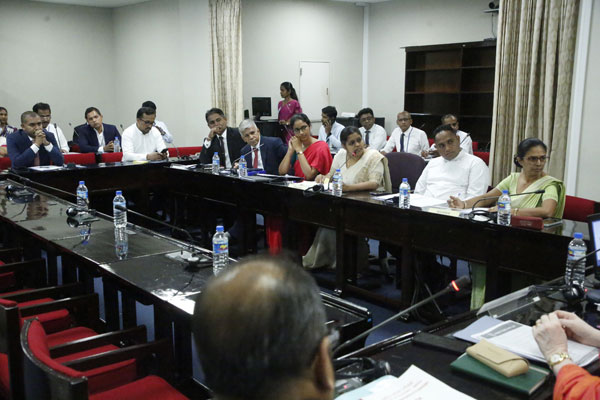
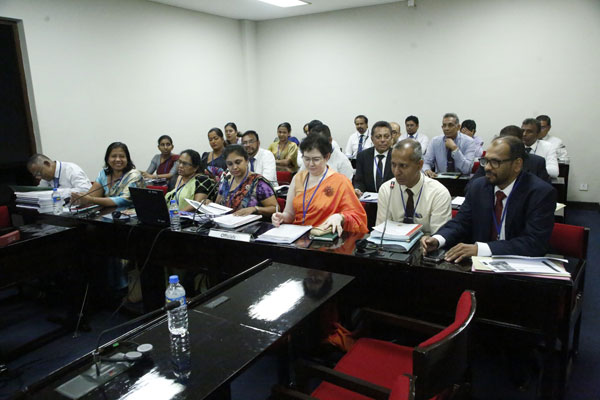
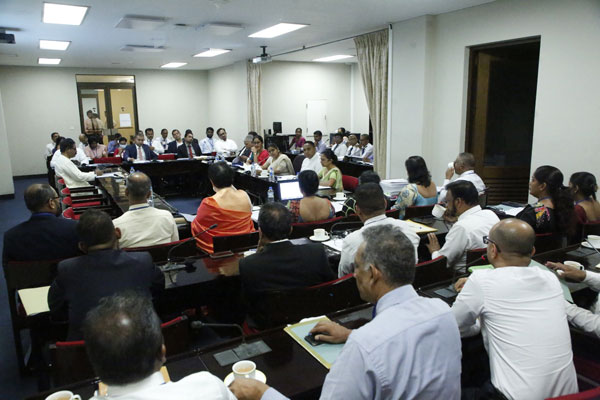
The Sectoral Oversight Committee on Economic Development and International Relations reviewed the performance of the Ministry of Industry and Entrepreneurship Development and the performance of the five institutions under it.

This took place recently in Parliament under the Chairmanship of Hon. Member of Parliament Ms. Lakmali Hemachandra, Attorney at Law. Hon. Minister of Industry and Entrepreneurship Development Sunil Handunnetti and Hon. Deputy Minister of Industry and Entrepreneurship Development Chathuranga Abeysinghe also participated in the Committee meeting held.

Accordingly, the performance reports of the Ministry of Industry and Entrepreneurship Development for the years 2023 and 2024, the annual reports of the National Gem and Jewellery Authority for the years 2022 and 2023, the annual report of the Gem and Jewellery Research and Training Institute for the year 2023, the annual reports of the Sri Lanka Export Development Board for the years 2021, 2022, and 2023, the annual reports of B.C.C. Lanka Limited for the financial years 2021/2022 and 2022/2023, and the annual reports and accounts of the National Salt Company for the financial years 2021/2022 and 2022/2023 were reviewed and subsequently approved.

Attention was drawn to the issues prevailing in the country’s industrial sector. The Secretary to the Ministry of Industry and Entrepreneurship Development pointed out that several issues, including the allocation of land to investors according to existing procedures, have persisted for a long time. Accordingly, it was revealed that the process of allocating land for a new industry could take more than 4 years. The Secretary also stated that, according to international concepts, generally 3% of a country’s land area should be allocated for industries, whereas in Sri Lanka this figure stands at only 0.01%.

It was also discussed that in the past, land was not allocated for industries in accordance with a national plan, but rather due to political or other reasons, resulting in various problematic situations. Accordingly, officials revealed that plans are now in place to allocate 50,000 acres of suitable land for industries across the island. The Committee recommended that a report be submitted, in consultation with the Land Reforms Commission, the Urban Development Authority, and the Sri Lanka Export Development Board, on the steps that could be taken and the future plan in this regard.

Attention was also drawn towards the current performance and issues of the National Gem and Jewellery Authority. Officials stated that steps will be taken in the future to merge the National Gem and Jewellery Authority with the Gem and Jewellery Research and Training Institute.

The current performance of the Sri Lanka Export Development Board was also taken into consideration. Officials stated that this is the only institution in the country responsible for promoting and developing exports, and that 5-year plans have been prepared covering sectors including apparel, tea, rubber, spices, information technology, gems, and jewellery. They further revealed that successfully managing U.S. taxation policies, the country’s largest export market, has been a significant achievement, and that with an export income of around USD 15 billion in 2023, the target is to increase this to USD 28 billion by 2028.

Officials stated that the production activities of the National Salt Company are being carried out with high efficiency. They pointed out that due to changes in climatic conditions, natural salt production has decreased in recent times. Accordingly, it was revealed that plans are in place to establish a facility in the Elephant Pass area to artificially produce salt using modern technology instead of the natural process. Officials further stated that the revenue target of the National Salt Company for this year is Rs. 1 billion, which is a 50% increase compared to the previous year.
It was also revealed that although B.C.C. Lanka Limited, a 192-year-old institution, produces high-quality coconut oil, the company has not obtained quality certifications. The current Chairman of the company informed the Committee that many export opportunities have been lost due to this situation, and that immediate steps have now been taken to obtain SLS, ISO, and other quality certifications.

Members of Parliament Hon. Anuradha Jayaratne, Attorney at Law, Hon. Sivagnanam Shritharan, Hon. Nilanthi Kottahachchi, Attorney at Law, Hon. Kanthasamy Prabu, Hon. Wijesiri Basnayake, Hon. Suranga Rathnayaka, and Hon. Thilina Samarakoon participated in this Committee meeting.


Related News

2026-08-13

Committee on Public Finance Focuses on Security Sticker System Used on Liquor Bottles

The Committee on Public Finance stressed the need to make the security sticker system used on liquor bottles more efficient and cost-effective.The Committee on Public Finance, Chaired by Hon. Member of Parliament (Dr.) Harsha de Silva, met recently in Parliament. The Committee discussed the security sticker system used on liquor bottles, the Regulations issued under the Imports and Exports (Control) Act, No. 1 of 1969, and matters relating to the dissolution of the Shrama Vasana Fund under the Finance Act, No. 38 of 1971. Hon. Deputy Ministers Chathuranga Abeysinghe and Nishantha Jayaweera, Dr. Kaushalya Ariyarathne and Hon. Members of Parliament Ravi Karunanayake, Harshana Rajakaruna and Attorney at Law Lakmali Hemachandra, participated in the meeting. Hon. Wijesiri Basnayake and Hon. Attorney at Law Chithral Fernando, participated online. The Committee paid extensive attention to the cost of the security sticker system, its technical standards and the economic benefits to the Government. It was revealed that the system was introduced in accordance with the 2016 Budget proposals to reduce the use of untaxed liquor, safeguard excise revenue and prevent the circulation of counterfeit liquor. The contract for the system was awarded in 2017 to the Indian company Madras Security Printers (MSP).The Committee also discussed the practical difficulties of using physical stickers in high-speed liquor production processes. Accordingly, permission was granted in 2021 to use digital (inkjet) code printing. The Committee noted that the same fee of US$ 5.99 charged for 1,000 printed paper stickers is also being charged for digital code printing.While the initial infrastructure costs for sticker printing machines at bottling plants need to be considered, a digital sticker would generally cost less than a paper sticker. Therefore, the Committee stressed the need to review the existing cost structure and the benefits received by the Government.The Committee also discussed the need to adequately adopt international ISO standards for the security sticker system, introduce a Track and Trace system to monitor the movement of liquor products from production to the consumer, and provide a facility for consumers to verify the authenticity of products through a mobile application.The Committee further stressed that the new tender process should consider not only the price but also quality, data security and technical standards. It was also emphasized that officers with the necessary technical expertise should be involved in the tender evaluation process to prevent counterfeit stickers and imitation.The Excise Department was instructed to study global best practices followed by other countries and prepare a report for submission to the Committee.Meanwhile, the Committee also considered the new Regulations issued under the Imports and Exports (Control) Act, No. 1 of 1969. The Regulations, published in Extraordinary Gazette Notification No. 2496/38 dated 10 July 2026, prohibit the importation into Sri Lanka of goods manufactured wholly or partly using forced labour. The objective is to strengthen the legal framework for responsible trade and compliance with international labour standards.The relevant Gazette Notification has been submitted to Parliament for approval in terms of Section 20 of the Act. It was also noted that the Gazette Notification prohibiting the importation of goods manufactured using forced labour enabled Sri Lanka to be included in the lowest and more favourable 10% category, instead of the initially applicable 12.5% category, under the United States’ forced-labour-related tariff measures implemented under Section 301, which were concluded on 23 July 2026.The Committee also considered matters relating to the dissolution of the Shrama Vasana Fund established under the Finance Act, No. 38 of 1971. It was stated that the Fund, established under the Act of 1998 and amended by the Act of 2019, had been identified for dissolution due to its lack of relevance to the present context, poor performance and underutilisation of its assets.Officials explained to the Committee that following the closure of the Fund, its essential services would continue to be provided through the Ministry of Labour. This is expected to reduce the cost of maintaining a separate institutional structure and enable public resources to be utilized more effectively.


2026-08-13

Employment of Women, Young Persons and Children (Amendment) Bill Considered by the Sectoral Oversight Committee on Education, Manpower and Human Capital

The Employment of Women, Young Persons and Children (Amendment) Bill, which is scheduled to be debated in Parliament on the 20th (Second Reading), was recently considered by the Sectoral Oversight Committee on Education, Manpower and Human Capital.The matter was discussed when the Committee met recently under the chairmanship of Hon. Member of Parliament Sunil Rajapaksa. The meeting was chaired by Hon. MP Sunil Rajapaksa as the Chairman of the Sectoral Oversight Committee on Education, Manpower and Human Capital, Hon. Attorney-at-Law Hesha Withanage, was absent on that occasion.Officials of the Ministry of Labour stated that the Employment of Women, Young Persons and Children (Amendment) Bill has been introduced to increase the fines imposed for offences under the Women, Young Persons and Children (Employment) Act No. 47 of 1956, from Rs. 10,000 to Rs. 100,000.The Employment of Women, Young Persons and Children Act No. 47 of 1956 completely prohibits the employment of children below the age of 16. The Act also sets out regulations that employers must follow when employing young persons above the age of 16 but below 18. Under the Act and the regulations issued under it, employing children and young persons within these age groups in hazardous occupations that could adversely affect their health, safety or morals constitutes a punishable offence.An amendment made to the Act in 2003 introduced provisions allowing a person convicted of an offence under the Act to be punished by a fine not exceeding Rs. 10,000, imprisonment for a period not exceeding 12 months, or either of these penalties, as well as both the fine and imprisonment. The court may also, at its discretion, order compensation to be paid to the affected child. However, it has been observed that the existing fines are no longer adequate.Accordingly, it is proposed to update and amend the minimum fines specified in Sections 7(3), 13(2) and 20(a)(3) of the Employment of Women, Young Persons and Children Act No. 47 of 1956, while also bringing the legislation into conformity with the conventions of the International Labour Organization (ILO) ratified by Sri Lanka.In view of the above, the Committee Chairman stated that the proposed amendment is a timely necessity, and the Committee subsequently approved the Bill.The Committee also considered the annual performance reports of the Ministry of Labour for 2024 and 2025; the annual performance report of the Department of Labour for 2024; the annual performance report of the Department of Manpower and Employment for 2024; the annual report of the National Institute of Occupational Safety and Health for 2023; and the annual reports of the National Institute of Labour Studies for 2023 and 2024.A number of Committee members, as well as officials from the Ministry of Labour and several institutions under its purview, participated in the Committee meeting.


2026-08-11

Sectoral Oversight Committee Focuses on Digitizing Land Administration to Make It More Transparent, Efficient and Modern

The need to modernize Sri Lanka’s land administration system to make it more transparent and efficient through digital technology was emphasized at the Sectoral Oversight Committee on Environment, Agriculture and Resource Sustainability.The Committee, which met recently at Parliament under the chairmanship of Hon. Member of Parliament Hector Appuhamy, held an extensive discussion on the roles of institutions responsible for the country’s land sector, the challenges they face, and the reforms required in the field of land administration.During the meeting, the need to network all land-related data through an integrated digital system was emphasized in order to minimize the misuse of state land and fraud involving forged deeds. Officials pointed out that land administration could be made more systematic by maintaining information on the ownership, boundaries and other relevant details of state lands under a single data system. They further noted that land fraud could be minimized by establishing a national digital land information system based on GPS coordinates.Attention was also drawn to coordination issues relating to land ownership and boundary demarcation among government institutions, including the Land Reform Commission and the Mahaweli Authority. The Committee emphasized that transparency and efficiency in the land administration sector could be further enhanced by implementing the necessary legal and administrative reforms, introducing digital data systems, and strengthening coordination among government institutions.Meanwhile, the Committee also considered and approved a Bill to amend the Animals Act No. 29 of 1958. The proposed amendments are intended to bring the transportation of goats, pigs and sheep within the regulatory framework of the Act and to facilitate measures to control animal diseases such as foot-and-mouth disease through the proper regulation of animal transportation.A proposal to amend the Survey Act No. 17 of 2002 was also considered. Discussions focused on establishing the necessary legal framework for depositing private survey plans prepared by licensed surveyors in the archives of the Survey Department of Sri Lanka, protecting intellectual property rights, and enabling members of the public to obtain certified copies of such plans.Committee members Hon. Members of Parliament Upul Kithsiri, Roshan Akmeemana, Susantha Kumara Nawarathna, Kitnan Selvaraj, Attorney-at-Law Bhagya Sri Herath and Gnanamuttu Srinesan participated in the meeting. With the permission of the Chairperson of the Committee, Hon. Members of Parliament Ajith P. Perera and Ruwanthilaka Jayakody also participated. A number of government officials, including Secretaries of the relevant ministries, were also present.


2026-08-11

COPE Focuses on Administrative, Financial and Digital Management Processes of the University of Peradeniya

The Committee on Public Enterprises (COPE) of Parliament focused its attention on the Auditor General’s Reports for the years 2023 and 2024 and the current performance of the University of Peradeniya.The matter was discussed when the Committee on Public Enterprises (COPE) met recently (Aug. 05) at Parliament under the Chairmanship of Hon. Member of Parliament (Dr.) Nishantha Samaraweera.Extensive discussions were held on several matters including the administrative and financial management of the University, corporate governance, the internal audit process, digital systems management, disciplinary inquiries, bond agreements of academic staff who obtained foreign study leave, and the University’s international rankings.It was revealed before the Committee that although the University of Peradeniya holds a high position in local university rankings, it has shown a decline in international rankings. However, university officials explained that this does not indicate a decline in the quality of the University, but is mainly due to the increasing level of international competition.The Committee also paid special attention to the University’s digital systems and data management. Discussions were held on several issues, including insufficient server capacity when implementing the fixed assets module of the Enterprise Resource Planning (ERP) system, shortages of human resources in the Information Technology Division, difficulties in retaining skilled technical officers due to salary disparities compared to the private sector, delays in updating systems, and software projects that have remained incomplete for several years.The Committee emphasized the need to establish a permanent and specialized technical team within the University to maintain and manage its digital systems.The Committee also paid close attention to disciplinary inquiries. Discussions were held on disciplinary proceedings that had remained unresolved for several years and the financial and administrative impact caused to the University due to legal and administrative delays. The Committee recommended that necessary action be taken to complete such proceedings without further delay.The issue of bond agreements of academic staff who had obtained foreign study leave but failed to report back for duty was also discussed. Attention was drawn to the recovery of funds from those who had violated such bond agreements, both at the University of Peradeniya and across the university system.University officials informed the Committee that the University of Peradeniya had recovered Rs. 201 million in 2025 alone. The Committee emphasized that this issue cannot be resolved at the level of an individual university and stressed the need for the University Grants Commission (UGC) to intervene and formulate a national policy applicable to all State universities.The Committee also considered alternative approaches beyond taking legal action against academic staff who violate bond agreements. One such proposal was to explore ways of engaging such academics in teaching and research for students in Sri Lanka through online platforms, regardless of the country in which they are residing.At the conclusion of the meeting, the COPE instructed officials to take prompt action to implement the recommendations of the Auditor General and the recommendations made by the Committee in order to further strengthen the governance, transparency and accountability of the University.Hon. Members of Parliament Attorney-at-Law Lakmali Hemachandra, Sunil Rajapaksa, Chandima Hettiarachchi, Dinesh Hemantha, Dharmapriya Wijesinghe, Asitha Niroshana Egoda Withana, M.K.M. Aslam and Lieutenant Commander (Rtd.) Prageeth Madhuranga attended the meeting.


Copyright © The Parliament of Sri Lanka.

All Rights Reserved.

Design & Developed by  TekGeeks