Handbook of Parliament
The System of Elections in Sri Lanka
How Parliament Works
Business of Parliament
Engage with your Parliament by logging in
2025-09-02
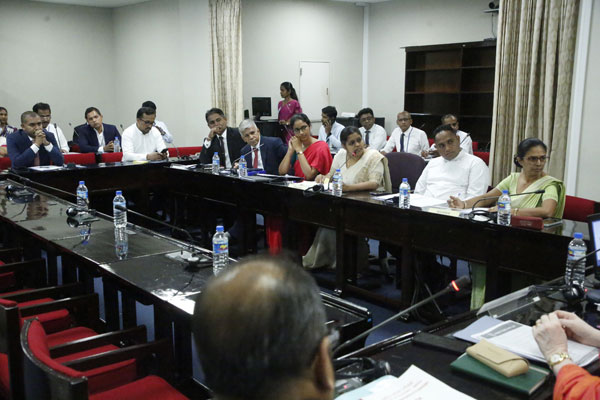
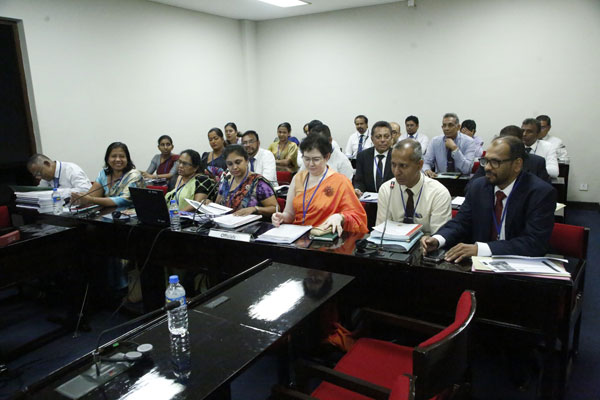
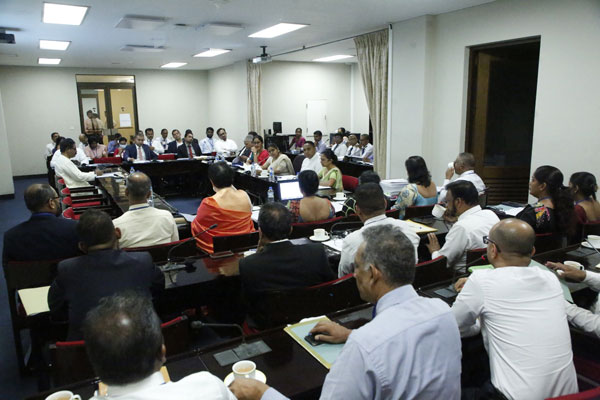
The Sectoral Oversight Committee on Economic Development and International Relations reviewed the performance of the Ministry of Industry and Entrepreneurship Development and the performance of the five institutions under it.
This took place recently in Parliament under the Chairmanship of Hon. Member of Parliament Ms. Lakmali Hemachandra, Attorney at Law. Hon. Minister of Industry and Entrepreneurship Development Sunil Handunnetti and Hon. Deputy Minister of Industry and Entrepreneurship Development Chathuranga Abeysinghe also participated in the Committee meeting held.
Accordingly, the performance reports of the Ministry of Industry and Entrepreneurship Development for the years 2023 and 2024, the annual reports of the National Gem and Jewellery Authority for the years 2022 and 2023, the annual report of the Gem and Jewellery Research and Training Institute for the year 2023, the annual reports of the Sri Lanka Export Development Board for the years 2021, 2022, and 2023, the annual reports of B.C.C. Lanka Limited for the financial years 2021/2022 and 2022/2023, and the annual reports and accounts of the National Salt Company for the financial years 2021/2022 and 2022/2023 were reviewed and subsequently approved.
Attention was drawn to the issues prevailing in the country’s industrial sector. The Secretary to the Ministry of Industry and Entrepreneurship Development pointed out that several issues, including the allocation of land to investors according to existing procedures, have persisted for a long time. Accordingly, it was revealed that the process of allocating land for a new industry could take more than 4 years. The Secretary also stated that, according to international concepts, generally 3% of a country’s land area should be allocated for industries, whereas in Sri Lanka this figure stands at only 0.01%.
It was also discussed that in the past, land was not allocated for industries in accordance with a national plan, but rather due to political or other reasons, resulting in various problematic situations. Accordingly, officials revealed that plans are now in place to allocate 50,000 acres of suitable land for industries across the island. The Committee recommended that a report be submitted, in consultation with the Land Reforms Commission, the Urban Development Authority, and the Sri Lanka Export Development Board, on the steps that could be taken and the future plan in this regard.
Attention was also drawn towards the current performance and issues of the National Gem and Jewellery Authority. Officials stated that steps will be taken in the future to merge the National Gem and Jewellery Authority with the Gem and Jewellery Research and Training Institute.
The current performance of the Sri Lanka Export Development Board was also taken into consideration. Officials stated that this is the only institution in the country responsible for promoting and developing exports, and that 5-year plans have been prepared covering sectors including apparel, tea, rubber, spices, information technology, gems, and jewellery. They further revealed that successfully managing U.S. taxation policies, the country’s largest export market, has been a significant achievement, and that with an export income of around USD 15 billion in 2023, the target is to increase this to USD 28 billion by 2028.
Officials stated that the production activities of the National Salt Company are being carried out with high efficiency. They pointed out that due to changes in climatic conditions, natural salt production has decreased in recent times. Accordingly, it was revealed that plans are in place to establish a facility in the Elephant Pass area to artificially produce salt using modern technology instead of the natural process. Officials further stated that the revenue target of the National Salt Company for this year is Rs. 1 billion, which is a 50% increase compared to the previous year.
It was also revealed that although B.C.C. Lanka Limited, a 192-year-old institution, produces high-quality coconut oil, the company has not obtained quality certifications. The current Chairman of the company informed the Committee that many export opportunities have been lost due to this situation, and that immediate steps have now been taken to obtain SLS, ISO, and other quality certifications.
Members of Parliament Hon. Anuradha Jayaratne, Attorney at Law, Hon. Sivagnanam Shritharan, Hon. Nilanthi Kottahachchi, Attorney at Law, Hon. Kanthasamy Prabu, Hon. Wijesiri Basnayake, Hon. Suranga Rathnayaka, and Hon. Thilina Samarakoon participated in this Committee meeting.

2026-10-08
The Committee on Public Finance recently summoned officials of the Central Bank of Sri Lanka to Parliament to inquire into the financial irregularities identified at NDB Bank and the final audit report relating to the matter.The Committee meeting, chaired by Hon. Member of Parliament Dr. Harsha de Silva, discussed irregularities identified in NDB Bank’s financial statements, shortcomings in the audit process, and the relevant audit reports.The meeting was attended by Hon. Deputy Ministers Chathuranga Abeysinghe, Dr. Kaushalya Ariyaratne, and Nishantha Jayaweera, as well as Hon. Members of Parliament Attorney-at-Law Rauff Hakeem, Ravi Karunanayake, Ajith Agalakada, Nimal Palihena, Wijesiri Basnayake, M.K.M. Aslam, Champika Hettiarachchi, and Attorney-at-Law Lakmali Hemachandra.The Committee also focused on the findings of the investigation conducted by the Sri Lanka Accounting and Auditing Standards Monitoring Board (SLAAMB), as well as the findings revealed through the investigation conducted by Deloitte Touche Tohmatsu India LLP. In particular, the Committee inquired into the failure of the external auditors to identify irregularities in NDB Bank’s financial statements.The accountability of senior management with regard to corporate governance and risk management in relation to the financial irregularities was also discussed.Furthermore, as a significant proportion of NDB Bank’s shares are held by institutions representing public and state funds, the Committee also considered the potential impact of such financial irregularities on public funds and the general public.The Committee also discussed the progress made by LankaPay in establishing a centralized fraud monitoring system to prevent fraud within the financial system. The need to strengthen fraud monitoring systems at the individual bank level to monitor transactions carried out within each bank was also emphasized.Accordingly, the following observations are included in the final audit report concerning the financial irregularities at NDB Bank:1. The audit covers the period from 1 April 2016 to 31 March 2026. The audit report specifically identifies the financial impact arising from fraudulent transactions amounting to Rs. 13,639,664,684 (Rs. 13.6 billion).2. According to the disclosure made on 29 September 2026, the financial impact arising from the fraudulent transactions is as follows:• Rs. 1.5 billion for the period prior to 1 January 2025;• Rs. 9.6 billion during 2025; and• Rs. 2.5 billion for the quarter ended 31 March 2026.3. Compared with the initial disclosure made by NDB on 6 April 2026, the reported amount of the fraud has increased by Rs. 0.4 billion, from Rs. 13.2 billion to Rs. 13.6 billion. Compared with the amount disclosed by NDB on 26 June 2026, based on the interim report dated 22 June 2026, the additional amount of fraud is Rs. 60 million.4. The final audit report has also confirmed the previous disclosures that no customer accounts were affected as a result of the fraud incident.5. The report has identified several governance failures at NDB relating to the processing of CEFT transactions, user-level activities within the Core Banking System, and the management of user credentials and access information. In addition, shortcomings have been identified in several operational areas, including transaction monitoring, daily account reconciliation, financial compliance, internal audit, branch network management, and operational risk management.6. The audit report has made comprehensive recommendations to strengthen the control mechanisms, governance structures, and processes relating to the above-mentioned activities of the bank.
2026-10-02
Following discussions, the Sectoral Oversight Committee on Governance, Justice and Civil Protection approved the Anti-Corruption (Amendment) Bill.The decision was made when the Sectoral Oversight Committee met in Parliament recently (Sep. 30) under the chairmanship, Hon. Member of Parliament Dr. Najith Indika.During the meeting, the Committee discussed practical issues that have arisen in implementing the Anti-Corruption Act, No. 9 of 2003, discrepancies between the Sinhala and English versions of the Act, the electronic system for submitting declarations of assets and liabilities, and public access to such declarations.The Committee also discussed matters including resolving the technical and administrative issues affecting the effective implementation of the Act. Following these discussions, the Committee granted its approval to the Anti-Corruption (Amendment) Bill.
2026-09-30
It was revealed at the Ministerial Consultative Committee on Youth Affairs and Sports, which met recently in Parliament under the chairmanship of Hon. Minister of Youth Affairs and Sports Sunil Kumara Gamage, that arrangements are being made to gazette and present to Parliament a new Bill prepared to completely reform the governance structure of Sri Lanka Cricket.It was stated before the Committee that the proposed new cricket governance structure would include independent directors. Under the proposed new legislation, District Cricket Associations will no longer engage directly in decision-making with Sri Lanka Cricket, but will instead function through Provincial Cricket Associations.The Committee was also informed that Sri Lanka Cricket provides Rs. 900 million annually, together with equipment, for school cricket. It was further revealed that plans have been proposed in consultation with the Ministry of Education, Higher Education and Vocational Education to formalize the recruitment of coaches and the player selection process.Meanwhile, the Committee reviewed the progress in implementing the recommendations of the Auditor General relating to sports associations. It was stated that 33 sports associations have completed the relevant recommendations, while reports are due to be obtained in respect of a further 33 associations.The Ministry has instructed that the collection of fees for walking tracks and sports complexes used by the public for health and exercise activities be suspended immediately. The Ministry’s policy that sports facilities should be maintained not as profit-making ventures, but as a government responsibility for the promotion of national health and community welfare, was also emphasized.It was also stated that, under the plan to provide at least one synthetic running track in every province, the next synthetic track is scheduled to be constructed in Anuradhapura. The Committee was informed that there are currently only two synthetic tracks in the country.The Committee also discussed matters relating to the development of sports facilities in the Ampara District, the development of Weber Stadium in Batticaloa and the Hingurakgoda Sports Complex, improvements to sports facilities in the Hali-Ela area of Badulla, and resolving issues at the Bandaragama Public Grounds in Kalutara.Furthermore, the Committee was informed that when allocating government funds for international competitions, funding will be provided only for official national teams representing Sri Lanka and officially recognized international tournaments. It was also revealed that no discrimination based on race or region would be made when selecting national teams or sending teams to participate in overseas competitions.The meeting was attended by Hon. Deputy Minister of Youth Affairs Dinidu Saman Hennayake, other Deputy Ministers, Hon. Members of Parliament, officials of the Ministry of Youth Affairs and Sports, and members of the Transformation Committee of Sri Lanka Cricket, among others.
2026-09-30
The Subcommittee on Shortage of Physical Resources in Schools discussed the progress of the General Education Modernization Programme (GEM) implemented by the Ministry of Education.The Subcommittee, appointed by the Ministerial Consultative Committee on Education, Higher Education and Vocational Education to investigate the shortage of physical resources in schools, considered these matters at a meeting held recently in Parliament under the chairmanship of Hon. Member of Parliament Samanmali Gunasinghe.Officials of the Ministry of Education briefed the Subcommittee on the work carried out in schools under the programme, which is being implemented with the assistance of the World Bank. The Subcommittee emphasized the need to further expedite the activities being carried out under the programme and instructed officials to submit a detailed report on its progress.The Subcommittee further emphasized the need to take necessary measures to address the requirements relating to sanitary facilities and drinking water facilities in schools, particularly to ensure the quality and safety of drinking water.The Subcommittee also conducted an extensive review of the progress of the programme to provide telecommunication facilities to schools, as well as the progress of programmes to establish model primary schools.Hon. Members of Parliament R.M. Samantha Ranasinghe and Padmasiri Bandara, together with officials of the Ministry of Education, also participated in the meeting.
Handbook of Parliament
The System of Elections in Sri Lanka
How Parliament Works
Business of Parliament
Copyright © The Parliament of Sri Lanka.
All Rights Reserved.
Design & Developed by TekGeeks