Handbook of Parliament
The System of Elections in Sri Lanka
How Parliament Works
Business of Parliament
Engage with your Parliament by logging in
2023-12-19
News Categories : Committee News
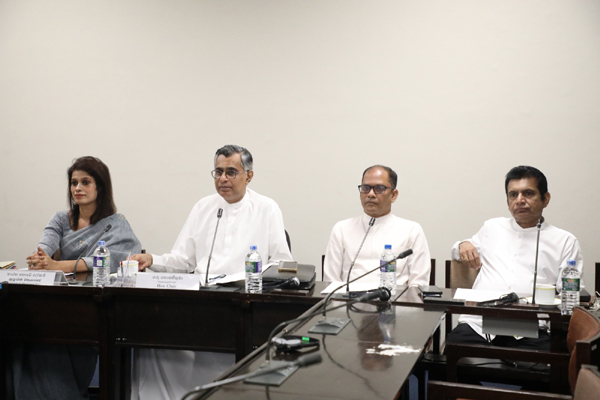
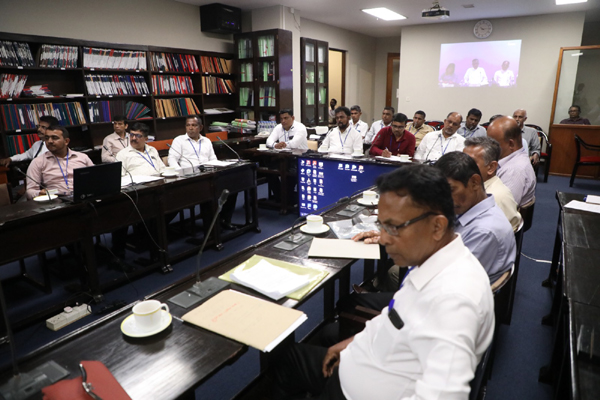
A discussion on obtaining the services of Samurdhi Development Officers for the implementation of the second phase of the Aswasuma Benefit Scheme was held in the Committee on Ways and Means of the Parliament. Officials from government institutes such as Department of Samurdhi Development, Welfare Benefits Board and representatives of professional associations of Samurdhi Development Officers were also called for that. The Committee on Ways and Means met on December 13th under the chairmanship of Member of Parliament Hon. Patali Champika Ranawaka.
Due to the refusal of the Samurdhi Development Officers to implement the first phase of the Aswasuma benefit scheme, the task was handed over to the Grama Niladhari officers. However, due to the issues related to their service constitution and allowance, it was not possible to get the contribution of the Grama Niladhari officers for that, so the process had to be brought in by apprentice officers, so many practical problems arose, the Chairman of the Committee said. He further emphasized the importance of utilizing Samurdhi Development Officers who have been appointed to carry out social welfare activities at the village level in the implementation of the second phase of Aswasuma.
Since it was revealed that there is no legal obstacle to that, the chairman advised starting the survey to find beneficiaries by giving less weight to the fields of education and health and more weight to the fact of poverty. He also pointed out that necessary steps should be taken to take into account the importance of measuring poverty based on the electricity bill so that the process can be completed according to a strong parameter that cannot be denied or challenged.
He asked the Samurdhi Development officials whether they were ready to join the national task of preparing an accurate list of the poor. Samurdhi officials pointed out that they are willing to involve in the implementation of the second phase of the Aswasuma, but in accordance with Sections 21 and 22 of the Welfare Benefits Act No. 24 of 2002, where they have been found guilty of acting on false information in the performance of their duties, subjected to punishment and recovered in wrong payments. Because of that, they requested to remove the legal difficulties caused to them due to the provision.
Chair of the Committee Patali Champika Ranawaka said that so far, the officers have not been inconvenienced by those clauses in the act.
The Chairman stated that one of the options should be chosen among the options of amending the relevant Act, reaching an agreement in writing between the parties, fulfilling the responsibility based on trust and amicable agreement based on the needs of the country. He also pointed out that the work that can be done the most and should be done with compassion and thinking about the surroundings of the poor is to approach duty based on trust.
However, Samurdhi officials emphasized the need of amending the Act on a legal basis rather than a verbal agreement. Accordingly, the Chai of the Committee stated that the Committee had previously made a recommendation to the Ministry of Finance to amend Sections 21 and 22 of the Welfare Benefits Act No. 24 of 2002, and that the recommendation would be forwarded to the Ministry of Finance again.
Members Committee on Ways and Means Hon. Ashok Abeysinghe, Hon. SMM Muszhaaraff, Hon. Nalaka Bandara Kottegoda, State Minister Hon. Anupa Pasqual and Member of Parliament Hon. Dayasiri Jayasekara were also present with the permission of the Committee Chair.

2026-03-24
The Select Committee of Parliament to conduct a comprehensive study on the lack of preparedness to face Cyclone Ditwah and report to Parliament and submit its proposals and recommendations in that regard, met for the first time on 19.03.2026 at Parliament under the chairmanship of Hon. Minister (Dr.) Nalinda Jayatissa.Addressing the meeting, the Chair emphasized the importance of gaining a clear understanding of how the relevant responsible institutions operate during natural disasters such as Cyclone Ditwah, in order to effectively carry forward the work of the Committee. Accordingly, it was decided to summon officials from the Disaster Management Centre, the Department of Meteorology, the Department of Irrigation, and the Mahaweli Authority of Sri Lanka to the next two committee meetings to obtain the necessary preliminary briefings.It was also proposed that, given the subject-specific scope of the Committee, officials possessing technical expertise and specialized knowledge in relevant fields should be called before the Committee from time to time to assist in understanding complex technical matters. The Chair noted that the Committee is required to submit its report to Parliament within three months from the date of its first meeting by 19.06.2026. Accordingly, efforts will be made to hold meetings promptly and prepare the report, including relevant recommendations, within this timeframe. He further stated that, in addition to proposals related to the Committee’s scope, the report is expected to include recommendations aimed at establishing a stronger mechanism to effectively respond to future events similar to Cyclone Ditwah.The meeting was attended by Hon. Members of Parliament Anuradha Jayaratne (Attorney-at-Law), Hector Appuhamy, Rohini Kumari Wijerathna, M.K.M. Aslam, Anushka Thilakaratne (Attorney-at-Law), Kanthasamy Prabhu, Ruwan Mapalagama, and (Dr.) Pathmanathan Sathiyalingam. Hon. Leader of the Opposition Sajith Premadasa also attended with the special permission of the Chair.
2026-03-24
Deputy Minister of Health, Hon. (Dr.) Hansaka Wijemuni, stated that disability should be viewed not only from a medical perspective but also from social and human rights perspectives. He made these remarks while participating in an awareness programme on service delivery for persons with disabilities, held on 20th March 2026, at the auditorium of the National Epilepsy Centre of the National Hospital of Sri Lanka (NHSL).Although Sri Lanka has made some progress in this area compared to other countries in the region, he noted that persons with disabilities still face numerous physical, communication, and attitudinal barriers when accessing healthcare services. He emphasized that the government is committed to implementing necessary policy changes to identify social barriers, enhance awareness, and bring about attitudinal change. He also highlighted the importance of providing health information in multiple accessible formats for persons with disabilities.The Deputy Minister further stressed the importance of systematically sensitizing healthcare staff to deliver services based on equality and dignity, going beyond the traditional medical model. He also appreciated the contribution made by the Parliamentary Caucus for Persons with Disabilities in this regard.This programme was the second in a series of awareness programmes conducted at the ministry level as part of the action plan of the Parliamentary Caucus for Persons with Disabilities. The workshop aimed to educate officials on inclusive service delivery within the health sector and was organized by the Caucus with the support of the Australian Government and the International Foundation for Electoral Systems (IFES).Chairman of the Parliamentary Caucus for Persons with Disabilities, Hon. Member of Parliament Sugath Wasantha de Silva, stated that this series of awareness programmes is a step towards ensuring an “unrestricted social life” for persons with disabilities. While appreciating the country’s free healthcare system, he pointed out that more than 1.6 million persons with disabilities in Sri Lanka still face physical and attitudinal barriers in accessing healthcare services. He emphasized that access to healthcare is a fundamental right linked to the right to life.He further proposed that a new perspective on disability, along with a specialized module, should be included in the curricula of medical and nursing colleges to ensure that future healthcare professionals are sensitized from the early stages of their training.Deputy Co-Chair of the Caucus, Hon. Member of Parliament (Dr.) Pathmanathan Sathiyalingam, President of the Disability Organizations Joint Front (DOJF), Ashoka Weerawardena, Professor Chamari Weeraratne of the Department of Pharmacology, University of Colombo, Deputy Director General of Health Services (Public Health), Dr. Vindya Kumarapeli, Director of the Youth, Elderly and Persons with Disabilities Unit of the Ministry of Health, Dr. Nishani Ubeysekara and representatives of the disabled community also shared their views.Several key issues were raised during the discussion, including the lack of sign language interpreters at hospital counters, difficulties faced due to high counters and surgical beds, the absence of toilets with commode facilities, and privacy concerns caused by “saloon-style doors” in accessible toilets. The need for priority identification cards for persons with intellectual disabilities who find it difficult to wait in queues was also highlighted.Officials noted that steps are being taken to develop infrastructure under World Bank and Asian Development Bank assistance, including accessibility features such as ramps, accessible toilets, and dedicated pharmacy counters. It was also revealed that pilot “Support Centers” staffed with personnel trained in basic sign language are being planned for primary hospitals.At the conclusion of the programme, it was proposed that persons with disabilities themselves should be employed at these Support Centers to ensure more effective, experience-based service delivery. Agreement was reached to take prompt follow-up action within the Ministry of Health on practical recommendations related to staff sensitization and the standardization of infrastructure.The programme was attended by officials of the Parliamentary Caucus for Persons with Disabilities, Programme Officer of IFES Ms. Anojitha Sivaskaran and other representatives of the organization, as well as representatives from institutions and organizations working with persons with disabilities.
2026-03-24
The Committee focused on obstacles, challenges, and issues related to the administration of national parks in Sri Lanka Attention was given to issues concerning the licensing of fishing nets and other equipment used by the fishing community The Committee also examined issues related to the government’s paddy purchasing process and price determination over the past few years The Sectoral Oversight Committee on Environment, Agriculture and Resource Sustainability met in Parliament on 04.03.2026 and 05.03.2026 under the chairmanship of Hon. Member of Parliament Hector Appuhamy. During these meetings, discussions were held with officials from relevant institutions on several sectors requiring timely attention.Accordingly, the Committee held extensive discussions on the challenges, obstacles, and issues related to the administration of national parks in Sri Lanka, issues concerning the licensing of fishing nets and other equipment used by the fishing community and matters relating to how successive governments have carried out the paddy purchasing process and determined prices in recent years.Following discussions on national parks in Sri Lanka, the Committee recommended that a comprehensive report containing all relevant information on these parks be submitted. The Committee also decided to conduct inspection visits to the relevant national parks in order to identify existing issues and propose solutions, along with engaging in discussions with the necessary officials.The Committee also paid extensive attention to fishing nets and other equipment used by the fishing community. The Chair recommended that a report be submitted regarding fish imported into the country as raw material for canned fish production in recent years.Furthermore, the Committee focused on issues related to the paddy purchasing process carried out by governments over the past few years and the determination of prices. In this regard, the Committee recommended that a report be submitted including data for 2023, 2024, and 2025 on the total extent of cultivated land in the country, the extent actually cultivated, and the reasons for lands not being cultivated.Members of the Committee were present at these meetings.
2026-03-24
The Select Committee of Parliament to look into and report to Parliament on the matter of selecting the Electoral System under which the Provincial Council Elections should be held and submit its proposals and recommendations in that regard, met for the first time on 17th March 2026 at Parliament, under the chairmanship of the Hon. Minister Vijitha Herath.Addressing the Committee, the Chairman pointed out that a legal impediment has arisen in conducting Provincial Council Elections due to the failure to complete the delimitation process required for the implementation of the Mixed Member Proportional Representation system introduced under the provisions of the Act No. 17 of 2017, which amended the Provincial Councils Elections Act.Members representing the Opposition, expressing their views, highlighted that a majority of key public institutions, including those in the education and health sectors, are administered through Provincial Councils. They pointed out that the absence of Provincial Councils for nearly nine years has led to numerous issues. Accordingly, the Opposition members proposed that the elections be held under the previous Proportional Representation system, and that necessary steps be taken thereafter to amend the electoral system.The Chairman emphasized the importance of fostering a broader and more in-depth dialogue in formulating an electoral system that ensures mandatory representation of women and provides opportunities for youth representation in Local Government Elections.Highlighting the importance of obtaining a preliminary understanding of the existing legal framework relating to the conduct of these elections, the Chairman proposed that officials from the Attorney General’s Department and the Election Commission be summoned to the next meeting to obtain their views.The Chairman also reminded that the Committee is required to submit its report within three months from the date of its inaugural meeting.The meeting was attended by Hon. Deputy Ministers Arun Hemachandra, Sunil Watagala, and Munir Mulaffer, as well as Members of Parliament R. M. Ranjith Madduma Bandara, Mano Ganesan, Shanakiyan Rajaputhiran Rasamanickam, Nizam Kariapper PC, Chandana Sooriyarachchi, Dharmapriya Wijesinghe, and Lakshman Nipuna Arachchi.
Handbook of Parliament
The System of Elections in Sri Lanka
How Parliament Works
Business of Parliament
Copyright © The Parliament of Sri Lanka.
All Rights Reserved.
Design & Developed by TekGeeks