Handbook of Parliament
The System of Elections in Sri Lanka
How Parliament Works
Business of Parliament
Engage with your Parliament by logging in
2022-06-25
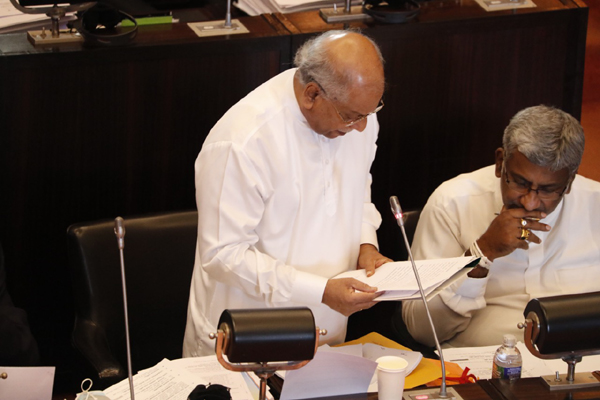
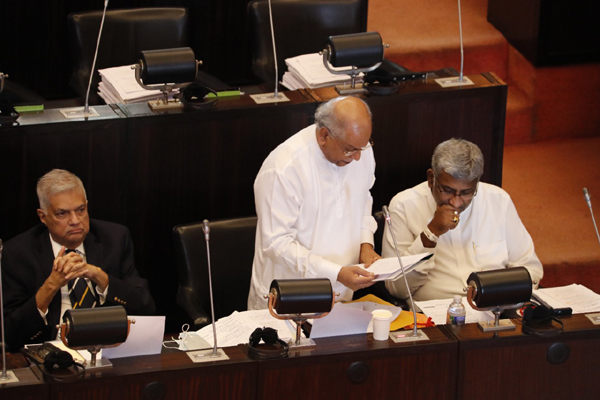
The Final Report of the Select Committee of Parliament to Identify Appropriate Reforms of the Election Laws and the Electoral System and to Recommend Necessary Amendments was tabled in Parliament on 22nd June by its Chairman, the Minister of Public Administration, Home Affairs, Provincial Councils and Local Government and Leader of the House of Parliament, Hon. Dinesh Gunawardena.
This Committee, which met for the first time on May 17th, 2021, received over 160 representations from non-governmental organizations, religious organizations, women's groups, representatives of various cultural and ethnic groups, and the general public in response to a press release issued to the public and representatives of interested organizations on electoral reform, requesting for their submission of representation respecting the right to freedom of expression.
Furthermore, 69 recognized political parties were requested for their representations and 36 recognized political parties had submitted their written and oral representations to the Committee. This included political parties represented in Parliament as well.
The Committee then tabled the final report of the Committee, considering all the oral and written representations made by recognized political parties, the general public and interested organizations, women's organizations and electronic media institutions during the 29 meetings of the Committee held.
While presenting the report, Chairman of the Committee Hon. Dinesh Gunawardena, explained the observations and recommendations contained therein.
Accordingly; he pointed out that the following recommendations are included in the report.
Accordingly, this final report contains 25 observations and 15 recommendations.
Recommendations on election systems have been made including local government, provincial council and parliamentary elections, as well as recommendations on increasing women's representation. Recommendations also have been made for the introduction of legal provisions to make it compulsory to allocate a 25% quota for youth representation in the nomination lists for local government elections and provincial council elections under youth representation.
The final report includes the recommendations regarding the recognition of political parties on the basis of voter recognition. The recommendations also have been made under the category ‘Media’ on media guidelines, conducting political propaganda activities through electronic media, violation of election laws on social media platforms, misinterpretation of information and dissemination of false information.
This report also includes recommendations on election campaigning, the right to vote, the nomination process, the electoral process, the Election Tribunal, delegation of powers of the Local Government Institutions and the Provincial Councils to the Commissioner / Secretary and the Provincial Secretary until the election is over, the failure to approve the annual budget by a local government Authority, restrictions on field officers to contest local government elections, national list and delimitation.
The final report of the Parliamentary Select Committee (PSC) of Parliament to Identify Appropriate Reforms of the Election Laws and the Electoral System and to Recommend Necessary Amendments is attached with this press release.

2026-10-09
The Prime Minister Dr. Harini Amarasuriya met with the delegation of the Asia Foundation on 07 October at Parliament.Welcoming the delegation from the Asia Foundation, the Prime Minister Dr. Harini Amarasuriya expressed appreciation for the Foundation’s longstanding partnership with Sri Lanka and its continued support for the country’s development efforts.The delegation congratulated the Government on its recent initiatives and commended Sri Lanka’s progress in navigating the economic crisis and strengthening the country’s recovery.During the meeting, The Asia Foundation outlined its key areas of engagement and interest in Sri Lanka, including digitalisation and digital transformation, women’s economic empowerment, the care economy, poverty alleviation and social protection, maritime security and social empowerment and inclusive development.Prime Minister Dr. Harini Amarasuriya briefed the delegation on the Government’s key priorities, including sustaining economic growth, attracting investment and promoting inclusive and equitable economic development, while remaining aligned with the programmes and commitments supported by the International Monetary Fund (IMF) and the World Bank.She further emphasised the importance of strengthening public institutions, enhancing institutional accountability and transparency, combating corruption and improving government revenue mobilisation as part of the Government’s efforts to strengthen governance.Prime Minister also highlighted education reform and the expansion of vocational and skills-based education as key priorities for developing a future-ready workforce and supporting the country’s economic transformation.The discussion also focused on advancing Sri Lanka’s digital economy and digital transformation, particularly through the use of technology to improve public service delivery and create new economic opportunities.The occasion was attended by the Chief Executive Officer of the Asia Foundation; Ambassador Kathleen Stephens, Chair of the Board; Ambassador Robert O. Blake, Jr. along with the representatives of The Asia Foundation and Mr. Pradeep Saputhanthri, Secretary to the Prime Minister; Ms. Sagarika Bogahawatta, Additional Secretary to the Prime Minister and the officials from the Ministry of Foreign Affairs, Foreign Employment and Tourism of Sri Lanka.
2026-10-08
A delegation from the Parliament of Sri Lanka recently participated in a tailor-made peer-to-peer training programme titled ‘Evidence, Innovation, and Foresight in Parliamentary Research’, held at the National Council of the Slovak Republic in Bratislava from 29 September to 2 October 2026. The initiative was conducted under the Inter Pares Partnership with the Parliament of Sri Lanka.Designed to support the ongoing development of the Parliamentary Research Division, the programme focused on comparative exchange with research services from prominent European parliaments. Key areas of study included research workflows, quality assurance, accessible product development, digital knowledge management, the responsible application of Artificial Intelligence (AI), and forward-looking research methodologies.The Sri Lankan delegation was led by Mrs. Kushani Rohanadeera, Secretary General of Parliament, and included, Mr. Siyath Ahemed, Librarian; Mr. Mohammed Ajiwadeen, Senior Research Officer; Ms. Tekshila Erandathi Lokuge, Senior Research Officer; Mr. Nishan Wickramasingha Mohottige, Systems Analyst; and Ms. Sachinie Gunasekara, Deputy Principal Officer. A major focus of the training was the secure and responsible adoption of AI tools in legislative research. Participants examined institutional frameworks covering AI governance, data protection, confidentiality, accuracy, political neutrality, and rigorous human oversight. Practical sessions demonstrated how AI can enhance evidence gathering, document comparison, summarization, and knowledge management.Additionally, the programme underscored the strategic value of legislative foresight. By utilizing horizon scanning, trend identification, and scenario development, parliamentary researchers can better equip lawmakers to anticipate future challenges and analyze the long-term implications of public policy beyond immediate political cycles.During the visit, the delegation met with the Secretary General and senior officials of the National Council of the Slovak Republic, alongside cultural visits to the Speaker’s Gallery and the National Museum.The Parliament of Sri Lanka extends its sincere appreciation to the National Council of the Slovak Republic, International IDEA, and the Inter Pares Partnership. Gratitude is also extended to the expert contributors and partner parliaments from Czechia, Hungary, Austria, Italy, Lithuania, and the United States Congressional Research Service for facilitating this valuable capacity-building initiative.
2026-10-08
The Anti-Corruption (Amendment) Bill was passed in Parliament today (Oct. 08) with amendments and without a vote. Accordingly the amendments seek to address legal, interpretational, administrative and technical issues identified in the implementation of the Anti-Corruption Act, No. 9 of 2023, discrepancies between the Sinhala and English texts of the Act, issues relating to the investigation and prosecution of corruption offences, administrative matters of the Commission to Investigate Allegations of Bribery or Corruption (CIABOC), and the process of submitting declarations of assets and liabilities through a centralized electronic system.These amendments are expected to further strengthen Sri Lanka’s existing legal and institutional framework for combating corruption and ensure that the Anti-Corruption Act is implemented effectively, transparently and with accountability.
2026-10-07
The Appropriation Bill for the year 2027 was presented to Parliament today (Oct. 07) for its First Reading by Hon. Dr. Anil Jayantha, Minister of Labour and Deputy Minister of Finance and Planning.The Appropriation Bill for the 2027 financial year provides for the allocation of financial resources required to meet government expenditure amounting to rupees four thousand nine hundred ninety two billion seven hundred seventy-three million three hundred eighty-eight thousand, as well as provisions authorizing the Government to obtain loans, among other matters.Accordingly, the 2027 Budget Second Reading, which includes the presentation of the Budget Speech and Budget Proposals, is scheduled to take place on 12 November 2026.Thereafter, the Second Reading Debate is scheduled to be held over seven days, from 13 November to 20 November, with the vote on the Second Reading scheduled for 6.00 p.m. on 20 November.Subsequently, the Committee Stage Debate on the Appropriation Bill is scheduled to be held over 19 days, from 21 November to 14 December. The vote on the Third Reading of the Budget is scheduled to take place at 6.00 p.m. on 14 December.During the period of the Budget Debate, Parliament is scheduled to meet at 9.30 a.m. every day, including Saturdays, except on public holidays and Sundays.The 2027 Appropriation Bill provides the necessary legal framework for government expenditure during the financial year from 1 January to 31 December 2027, including the provision of financial resources for such expenditure and the authorization required for obtaining the relevant loans.
Handbook of Parliament
The System of Elections in Sri Lanka
How Parliament Works
Business of Parliament
Copyright © The Parliament of Sri Lanka.
All Rights Reserved.
Design & Developed by TekGeeks