සි   |   த   |  

2021-10-08

News Categories : Committee News 

The Draft Report on Community based Correction System in Sri Lanka to be made open for public suggestions - Hon. Minister of Justice Mohamed Ali Sabry, PC

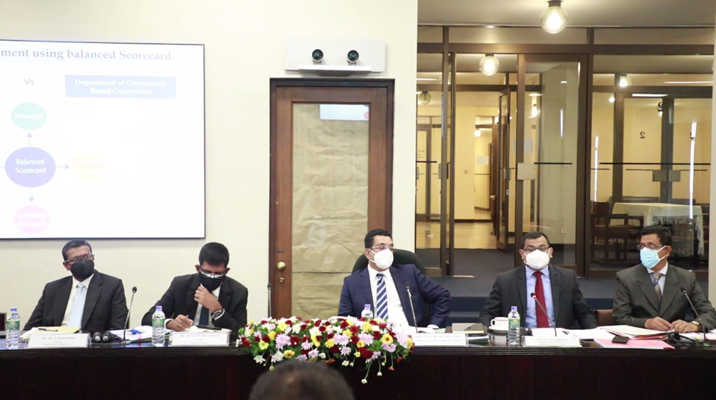
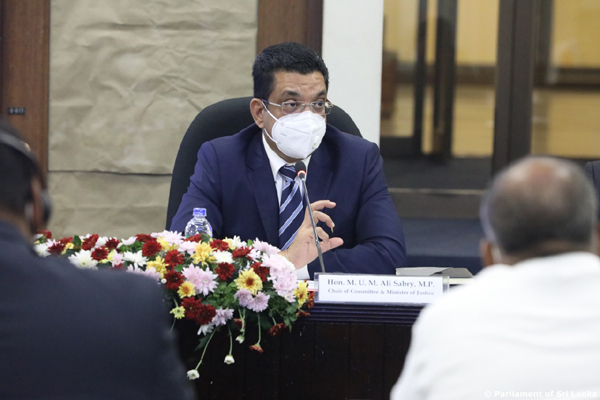
Addressing the 8th meeting of the Ministerial Consultative Committee on Justice, Hon. Minister of Justice M.U.M. Ali Sabry, PC directed the “Draft - Report on Community based Correction System in Sri Lanka” to be circulated among all Parliamentarians, for their suggestions and observations for the purpose of being further developed. He further instructed to obtain public views regarding the report.

Hon. Minister of Justice M.U.M. Ali Sabry made the aforesaid directive at the Ministerial Consultative Committee on Justice held yesterday (07) as the initial step towards the transformation of the Criminal Justice System in Sri Lanka.
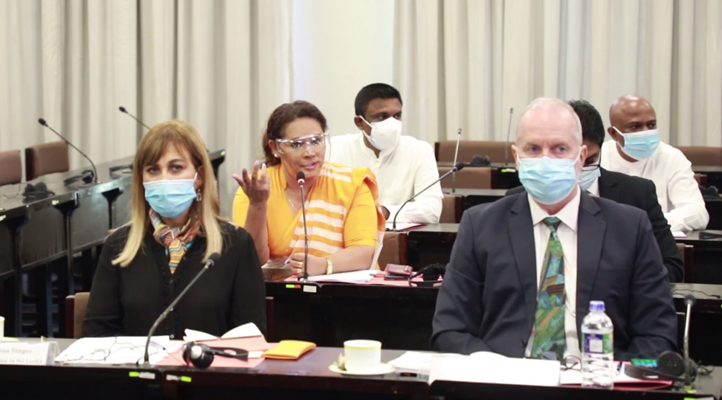
H.E. Ms. Hanaa Singer-Hamdy, UN Resident Coordinator to Sri Lanka and Mr. Robert Juhkam, Resident Representative of UNDP were also in attendance at the Ministerial Consultative Committee on Justice chaired by Hon. M.U.M. Ali Sabry.

The Hon. Justice Minister was of the view that there is no point of sending people behind bars without reforming them and therefore, community-based correction system would be a more effective method. Accordingly, possibilities of correcting those who are sentenced for less than two years within the community without imprisoning them was taken into consideration.

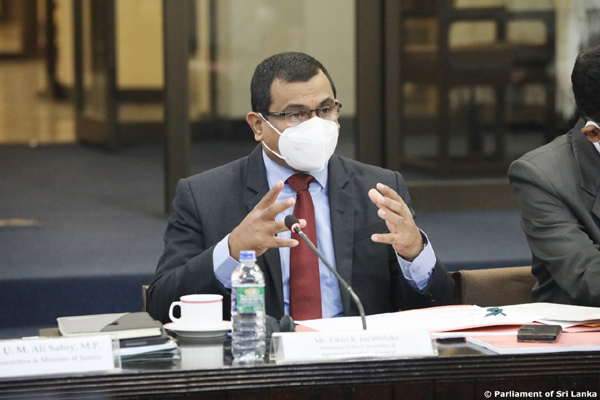
The discussion on Community based correction was set in motion following the presentation by the Assistant Secretary General of Parliament and former Justice Official Mr. Tikiri K. Jayathilake. The Assistant Secretary General addressing the committee, stated that Criminal Law and the notion of justice are entwined and it is important to extricate an individual into society as a responsible citizen rather than labeling them as criminals.

Furthermore, he stated that the said objective could be done by the Ministerial Consultative Committee via two tiers. One being the political tier inclusive of the political leadership in stirring towards the requisite reforms. The second tier includes officials and professionals representing various fields contributing their expertise towards the creation and development of relevant reforms.

The Assistant Secretary General of Parliament also emphasized that suggestions of Hon. Members of Parliament and various stakeholder are imperative in order to develop this system.

Addressing the Committee, H.E. Ms. Hanaa Singer-Hamdy, UN Resident Coordinator to Sri Lanka commended the Ministry of Justice for its efforts in the transformation of the Criminal Justice System. Adding to it, she further stated that Community based correction could avoid exposing offenders to the conditions of the prison which could sometimes be violent and unsafe creating a cycle of coming in and going out of prison.

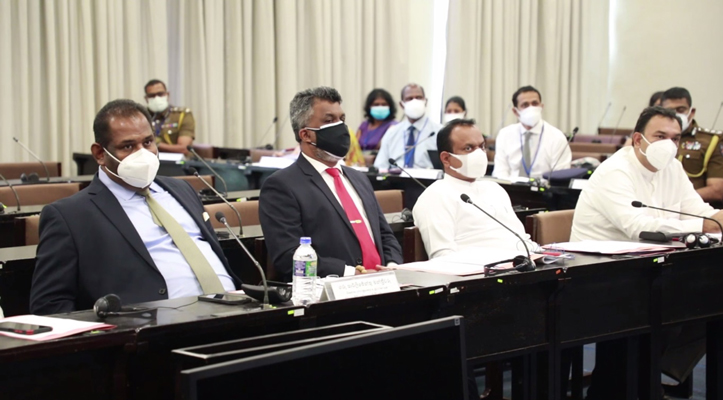
Hon. Members of Parliament Weerasumana Weerasinghe, G. G. Ponnambalam, Sagara Kariyawasam, Madhura Withanage, Diana Gamage, Gamini Waleboda, S. Kajendran, Ajith Rajapakse, Akila Ellawala marked their presence at the Ministerial Consultative Committee on Justice chaired by the Hon. Minister of Justice Ali Sabry.

 

1

2 3

5

6


Related News

2026-09-25

Committee on High Posts Approves Three Appointments

The Committee on High Posts of Parliament recently granted approval for the appointment of a new Ambassador, a High Commissioner, and a chairperson of a state institution.The approvals were granted when the Committee on High Posts met under the chairmanship of Prime Minister Dr. Harini Amarasuriya.Accordingly, the Committee approved the appointment of Mrs. Anzul Banu Jhan as the new Ambassador of Sri Lanka to the Republic of the Philippines and Mr. Chandana Rohana Kumara Ambagolla as the new High Commissioner of Sri Lanka to Canada.The Committee also approved the appointment of Mr. Nusith Kumarathunga as the new Chairman of Sri Lanka Insurance Corporation Limited.


2026-09-23

Special Committee Focuses on Measures to Facilitate Obtaining Driving Licences for Persons with Disabilities

A special committee appointed by the Ministerial Consultative Committee on Transport, Highways and Urban Development, to address the difficulties faced by persons with disabilities in obtaining driving licences, held its first meeting in Parliament recently, with particular attention focused on the steps that should be taken to make the process of obtaining driving licences more accessible and streamlined for persons with disabilities.At the meeting, attended by Hon. Members of Parliament Sugath Wasantha de Silva, Dinesh Hemantha and M.A.C.S. Chathuri Gangani, extensive discussions were held on the practical and legal challenges faced by persons with disabilities both in obtaining driving licences and in modifying and using vehicles to suit their respective disabilities.Attention was drawn to the medical examinations conducted by the National Transport Medical Institute (NTMI), the medical recommendations issued based on the nature of a person’s disability, and the procedure for issuing driving licences accordingly. Discussions also focused on conducting medical examinations at district level, expanding the range of vehicle types for which driving licences may be issued to persons with visual impairments, taking into consideration medical criteria including the field of vision, installing appropriate safety equipment in vehicles, and proposed amendments to the relevant Gazette notifications.The legal framework governing the issuance of driving licences to persons with hearing impairments, the use of special identification signs, and the assistance of sign-language interpreters were also discussed. Attention was also given to procedures for modifying vehicles to suit the individual needs arising from a person’s disability.Proposals were also put forward regarding issuing licences to one individual for multiple vehicles, simplifying the medical examination process, and improving the online system between the National Transport Medical Institute and the Department of Motor Traffic.The need for the necessary amendments to the relevant Gazette notifications, expanding services at the regional level, and creating awareness among relevant institutions to make the process of obtaining driving licences more accessible and streamlined for persons with disabilities was also emphasised. The importance of taking further steps to ensure the transportation rights of persons with disabilities while ensuring road safety was also stressed.Officials of the Ministry of Transport, Highways and Urban Development and other relevant representatives attended the meeting.


2026-09-23

Promotion of Export Agriculture (Amendment) Bill Receives Approval of Sectoral Oversight Committee

The Promotion of Export Agriculture (Amendment) Bill was considered and approved at a recent meeting of the Sectoral Oversight Committee on Environment, Agriculture and Resource Sustainability.The matter was discussed when the Committee, chaired by Hon. Member of Parliament Hector Appuhamy, met on the occasion under the chairmanship of Hon. Member of Parliament, Attorney-at-Law Bhagya Sri Herath.As part of the restructuring of the institutional structure of the Department of Export Agriculture, new positions were created and existing positions were upgraded, including changing the designation of “Director” to “Director General.” However, the relevant provisions of the Export Agriculture Promotion Act, No. 46 of 1992, had not been amended accordingly. Furthermore, other related designations that required amendment had also not been revised. The necessary amendments have therefore been introduced through this Bill.It was also noted that the definitions of export agricultural crops referred to in the Act as “notified agricultural crops” have become practically incompatible with current production and market conditions. Accordingly, the need has arisen to revise and update the relevant definition so that it is appropriate for the present and future export agriculture sector.Accordingly, the Bill provides that, in place of the definition of the term “Export Agricultural Crop” in Section 19 of the Act, the term shall mean means any crop identified as a crop that have an export potential in addition to the local consumption other than paddy, vegetables, fruits, root crops and additional food crops belonging to the category of food crops and declared by the Minister in charge of the subject as “a notified agricultural crop” under section 2 of this Act. It further provides that any crop identified as a plantation crop shall not be included in this definition.The Committee also inquired into matters relating to the export of crops from Sri Lanka, including pepper. It was revealed that Sri Lanka exported 12,910 metric tonnes of pepper in 2025, with India being the country's largest buyer.Several members of the Committee, along with officials from the Ministry of Agriculture, Livestock, Land and Irrigation, participated in the Committee meeting.


2026-09-23

Subcommittee to Address Salary Disparities in the Principals’ Service

The Sectoral Oversight Committee on Education, Manpower and Human Capital has decided to appoint a Parliamentary subcommittee to study the salary disparities arising when teachers are appointed to the Principals’ Service, as well as the resulting reluctance among senior teachers to enter the Principals’ Service, and to make recommendations in this regard.These matters were discussed when the Sectoral Oversight Committee on Education, Manpower and Human Capital met in Parliament recently, under the chairmanship of Hon. Member of Parliament, Attorney-at-Law Hesha Withanage.Particular attention was drawn to the salary disparity arising from the fact that, under the Sri Lanka Principals’ Service Minute issued on 22 October 2014, entry into the Principals’ Service from the Teachers’ Service is considered a “new appointment” rather than a “promotion.”Officials pointed out that this situation is further aggravated by the significant difference in salary increments when a teacher is appointed from Grade 1 of the Teachers’ Service to Grade III of the Principals’ Service. They also noted that, although an adjustment allowance was introduced under Circular No. 03/2014 to address the salary difference arising at the time of appointment to the Principals’ Service, a salary gap emerges again as the teacher’s service progresses because they do not receive the higher salary increments that they would have received had they remained in the Teachers’ Service.It was also discussed that, as a result, senior and experienced teachers in Grades 1 and 2-I of the Teachers’ Service are being discouraged from sitting for the Principals’ Service examination and entering the Principals’ Service. Accordingly, attention was drawn to amending the Service Minute so that entry into the Principals’ Service from the Teachers’ Service would be treated as a “promotion” rather than a “new appointment.”The procedure for granting promotions within the Teachers’ Service was also discussed. The Committee pointed out that a newly appointed teacher entering the service with a university qualification takes approximately 19 years of service to reach Grade 1 of the Teachers’ Service.Attention was also drawn to the direct recruitment of Bachelor of Education (B.Ed.) graduates to Grade 2 of the Teachers’ Service in accordance with the Teachers’ Service Minute.Meanwhile, it was revealed that a verbal agreement had been reached with the Public Service Commission to recruit B.Ed. graduates as teachers under the previous system until 2030. Accordingly, it was stated that a Cabinet Memorandum has been submitted to recruit B.Ed. graduates to Grade 2 of the Teachers’ Service during this year.It was also discussed that these recruitments are planned to be carried out separately from the ongoing recruitment process for 23,000 teachers, based on subject-specific vacancies existing at provincial level.The Committee also considered the need to give universities until 2030 to update B.Ed. degree programmes so that they correspond with the actual subject requirements of the school system. In particular, the Committee highlighted the need to introduce specialised B.Ed. programmes in fields such as Science, Mathematics and Primary Education.Meanwhile, the Committee also considered the issue of recovering excess salary payments made to 261 laboratory attendants and security guards in the Southern Province. It was revealed that approximately Rs. 50.8 million had been overpaid as a result of the employees being placed on the 12th salary step instead of the initial salary step of the relevant salary scale in 2008 and 2009.It was stated that the matter was identified in 2016 and was subsequently examined through an audit query in 2022. To date, Rs. 15.1 million has been recovered through the suspension of salary increments and deductions from salaries.The representatives who appeared before the Committee pointed out that the employees were not directly responsible for this administrative error and that their letters of appointment had specified a particular salary scale. Accordingly, the Committee decided to bring the matter to the attention of the Governor of the Southern Province by way of a letter, with a view to obtaining his positive intervention regarding the difficulties faced by the employees.


Copyright © The Parliament of Sri Lanka.

All Rights Reserved.

Design & Developed by  TekGeeks