Handbook of Parliament
The System of Elections in Sri Lanka
How Parliament Works
Business of Parliament
Engage with your Parliament by logging in
2021-02-10
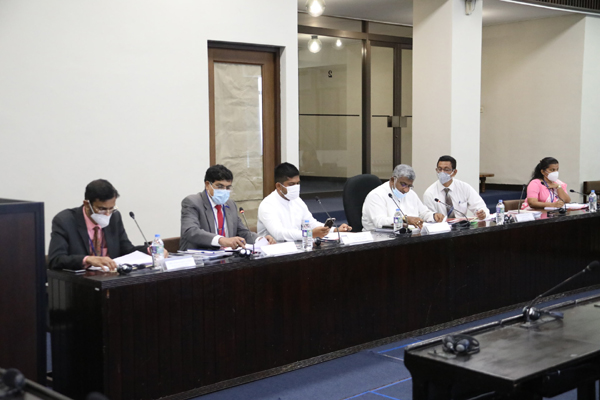
Strategic planning should be carried out in order to prevent the COVID19 virus from entering the society through tourists who visit the country whilst ensuring the prevention of the Virus from transmitting to the tourists from the community, said the Hon. Minister of Tourism Prasanna Ranatunga.
Accordingly, the Minister stated that health regulations should always be followed and steps should be taken to vaccinate the people of this country as a practical measure against the aforesaid concern.
The Minister emphasized on the above taking into consideration the time-consuming factor faced by tourists having to undergo PCR tests and a long quarantine period upon arrival.
Thus, measures have been put into effect in order to vaccinate 57% of the total population by March, said the Minister at the Consultative Committee on Tourism which met yesterday (09).
Hon. Member of Parliament Waruna Liyanage brought to light the issue related to the Dahaiyagala Elephant Pass in Udawalawe located between the Udawalawe National Park and the Bogahapitiya proposed Forest Reserve, identified as a place of importance as it is a decisive route for elephants. The MP pointed out that as a result, elephants in the said forest reserve are under threat due to the illicit clearing of these areas.
In consideration of the above, Minister Prasanna Ranatunga emphasized that elephants are a resource for the country's tourism industry and that the forests and the wildlife should be protected which are major tourist attractions.
Hon. Member of Parliament Udayana Kirindigoda, commenting at the committee stated that tourists often obtain information about the country through various websites regarding hotels and lodging in particular, associated with various tourist destinations. However, the MP stated that information provided on these sites are not updated and below the level of satisfaction. The MP was of the view that although quality information and photographs of hotels and lodges have been published on websites, in practice this is not the case and as a result the reputation of the country is being tarnished.
Agreeing with the aforesaid, Hon. Members of Parliament Geetha Kumarasinghe and Diana Gamage stated that the tourism sector can be developed further by issuing a license or certificate after reviewing the publications on the sites regarding hotels and lodges with its practical status.
Hon. Members of Parliament such as Chandima Weerakkody, Geetha Kumarasinghe and Manusha Nanayakkara expressed their views on tourism development in the Galle District. Minister Prasanna Ranatunga instructed the officials of the Tourism Development Authority to call upon a separate meeting to discuss the development of tourism in the Southern Province including Galle for the purpose of the above.
When inquired by the Minister of Tourism regarding the progress related to the development of tourism in the Batticaloa District, the State Secretary Mr. Madhava Devasurendra said that the development process has already been implemented in consultation with the relevant parties.
The Annual Report of the Tourism Development Authority for the year 2018, the Annual Report of the Tourism Development Fund for the year 2018 and the Annual Report of the Sri Lanka Convention Bureau for the year 2018 were presented at the meeting. The Minister of Tourism Prasanna Ranatunga stated that the needful to obtain approval will be carried out on this regard.
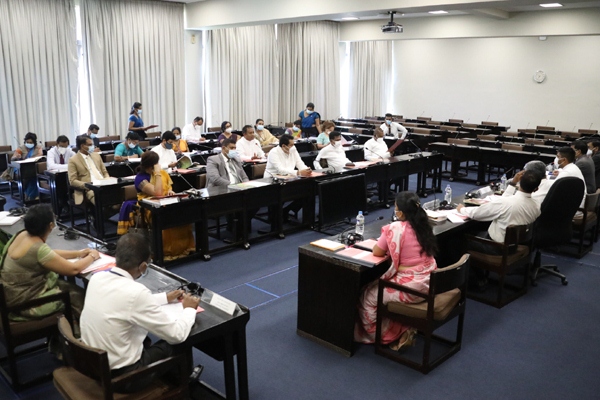
The Consultative Committee of Tourism was chaired by Hon. Minister of Tourism Prasanna Ranatunga. Hon. State Minister D. V. Chanaka, Hon. Members of Parliament Geetha Kumarasinghe, Manusha Nanayakkara, Udayana Kirindigoda, Jayantha Ketagoda, Dr. Upul Galappaththi, M. Udayakumar, Diana Gamage, Gunathilake Rajapaksa, Weerasumana Weerasinghe, Sampath Athukorala, Sivagnanam Sritharan and government officials also marked their presence.

2026-11-06
The Parliamentary Caucus for Youth discussed how to strengthen engagement between young people and Parliament and advance future initiatives aimed at increasing youth participation.The Caucus met recently at Parliament under the chairmanship of, Hon. Deputy Minister Eranga Gunasekara, where members exchanged views on the matter.Discussions also focused on several proposals, including a proposal on youth entrepreneurship and industrial development prepared by Hon. Member of Parliament Oshani Umanga; a proposal on empowering youth within local government authorities, prepared by Hon. Member of Parliament, Attorney-at-Law Hiruni Wijesinghe; and a proposal on a policy framework for youth in the plantation and cultivation sectors, prepared by Hon. Member of Parliament Ambika Samivel.Furthermore, extensive discussions were held on proposals prepared by the Caucus's Deputy Co-Chairs, Hon. Members of Parliament Lasith Bashana Gamage, Thanura Dissanayake and Attorney-at-Law Bhagya Sri Herath, concerning an external youth engagement programme and a series of pilot workshops.It was also decided to further study these proposals, which could be implemented for the benefit of young people, and finalize them following further consideration.Several members of the Caucus and other invitees were present at the meeting.
2026-11-05
The Trusts (Amendment) Bill, which is scheduled to be taken up for its Second Reading in Parliament today (Nov. 05), has received the approval of the Sectoral Oversight Committee on Governance, Justice and Civil Protection.The Bill was discussed and approved when the Sectoral Oversight Committee on Governance, Justice and Civil Protection met yesterday (04) under the chairmanship of its Chair, Hon. Member of Parliament Dr. Najith Indika.The Bill, which seeks to amend the Trusts Ordinance (Chapter 87), was presented to Parliament for its First Reading on 21 October 2026 by the Hon. Minister of Justice and National Integration, Attorney-at-Law Harshana Nanayakkara.Officials from the Legal Draftsman’s Department and the Ministry of Justice briefed the Committee on the amendments proposed under the Bill.Hon. Members of Parliament Ajith P. Perera, President’s Counsel Faizer Mustapha, Major General (Retired) G. D. Sooriyabandara and Dharmapriya Wijesinghe, among others, attended the Committee meeting.
2026-11-04
A special national programme was successfully conducted islandwide on the 2nd of November, under the leadership of the Women Parliamentarians’ Caucus and the Ministry of Health, with the aim of promoting early detection of breast cancer, one of the most commonly reported cancers among women in Sri Lanka, and raising public awareness about the disease. Awareness and screening programmes were organized at several Medical Officer of Health (MOH) offices across the districts represented by women Members of Parliament. The programmes were attended by women Members of Parliament, including Hon. Minister Saroja Savithri Paulraj, Chairperson of the Women Parliamentarians’ Caucus.In Sri Lanka, approximately 17 women are diagnosed with breast cancer every day, with around 6,000 new cases reported annually. Furthermore, more than 1,000 deaths occur each year due to the disease, equivalent to approximately three lives lost every day.Breast cancer can be completely cured if detected at an early stage. However, delays in seeking medical treatment due to fear, embarrassment or a lack of awareness have been identified as major challenges.All women should become familiar with the normal appearance and feel of their breasts and carry out regular breast self-examinations. If any unusual changes are detected, it is important to seek medical advice without delay.Early detection increases the chances of successful treatment. The government healthcare system provides free screening and other essential healthcare services.In addition, all women are encouraged to attend the Well Woman Clinic and undergo the recommended Pap test at the ages of 35 and 45. This screening helps detect precancerous changes at an early stage, thereby supporting the prevention of cervical cancer.
2026-11-03
A special meeting of the Ministerial Consultative Committee on Education, Higher Education and Vocational Education was held recently at the Parliament Complex, chaired by the Hon. Prime Minister and Minister of Education, Higher Education and Vocational Education, Dr. Harini Amarasuriya, to brief Members of Parliament on the revised National Curriculum Framework and the new education reform process.The meeting was attended by Ministers, Deputy Ministers, Members of Parliament, officials including the Secretary to the Ministry of Education, as well as a number of experts in the education sector, including representatives of the National Institute of Education (NIE).Secretary to the Ministry of Education, Higher Education and Vocational Education, Mr. Nalaka Kaluwewa, stated that, in accordance with a Cabinet decision, a National Committee comprising subject experts had been appointed by April 2026 to oversee the education reforms. He further explained that five main subcommittees established under this committee would provide the necessary guidance and direction for the process.He also stated that, in accordance with the Cabinet decision, the new reforms are scheduled to be introduced for Grade 1 in 2026, and for Grades 6 and 2 in 2027. Preparations are currently underway, including teacher training programmes, the development of modules and printing of teacher guides, as well as plans to upgrade digital infrastructure in schools.During the meeting, Director General of the National Institute of Education, Professor O.G. Dayaratne, together with officials from the education sector, delivered a comprehensive presentation on the foundation of the new education reforms, the National Curriculum Framework, assessment methodologies and the proposed implementation plan.He explained that the process had commenced in 2019 and that the National Institute of Education had prepared the National Curriculum Framework in accordance with the new policy approved by the National Education Commission in 2023. He emphasized that the framework was the result of a collective effort involving several institutions. The Director General further stated that the country was introducing education reforms modelled on systems implemented in some of the world's most advanced countries.The Director General of the National Institute of Education emphasized that the fundamental objective of general education should not be limited to producing future workers to meet the demands of the labour market. Rather, it should focus on nurturing holistic and well-rounded citizens enriched with ethics, virtues and values, while developing a future generation capable of building the nation.A shift from the existing content-based education system to an outcome-based and student-centred approach is proposed under the reforms. He further explained that a new assessment framework had been developed to reduce the pressure of rote learning and examination-oriented education. Under this framework, students' progress will be evaluated through a credit-based modular system and continuous assessments conducted throughout the year.Flexible vocational pathways have also been developed to provide students with an understanding of different vocational fields from Grade 6 onwards. These pathways will enable students in Grades 12 and 13 to obtain vocational qualifications up to NVQ Level 4 or pursue higher education.A website named "RIES" has been launched to raise public awareness of the education reforms among the general public, teachers and parents. In addition, an island-wide awareness programme is being implemented in several phases.Addressing the meeting, the Hon. Prime Minister emphasized that the fundamental objective of education should not merely be to prepare children to become future members of the workforce, but also to nurture them into well-rounded individuals and responsible citizens who will contribute to nation-building.She also pointed out that decisions regarding challenges arising during the implementation of the reforms should not be based solely on personal perceptions or opinions. Instead, such decisions should be guided by scientific research and evidence.Members of Parliament who participated in the discussion raised questions and shared their views and proposals regarding the education reforms.It was further emphasized that the support and cooperation of all stakeholders, without any divisions or differences, were essential to the successful implementation of this important national undertaking.The meeting was also attended by Hon. Deputy Minister of Education and Higher Education Dr. Madhura Senevirathna, Hon. Deputy Minister of Vocational Education Nalin Hewage, Secretary General of Parliament Mrs. Kushani Rohanadeera, Director of Legislative Services Mr. Jayalath Perera, and several other officials.
Handbook of Parliament
The System of Elections in Sri Lanka
How Parliament Works
Business of Parliament
Copyright © The Parliament of Sri Lanka.
All Rights Reserved.
Design & Developed by TekGeeks