Handbook of Parliament
The System of Elections in Sri Lanka
How Parliament Works
Business of Parliament
Engage with your Parliament by logging in
2023-05-23
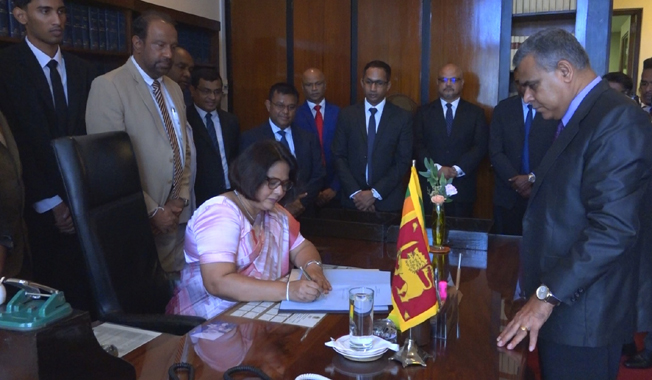
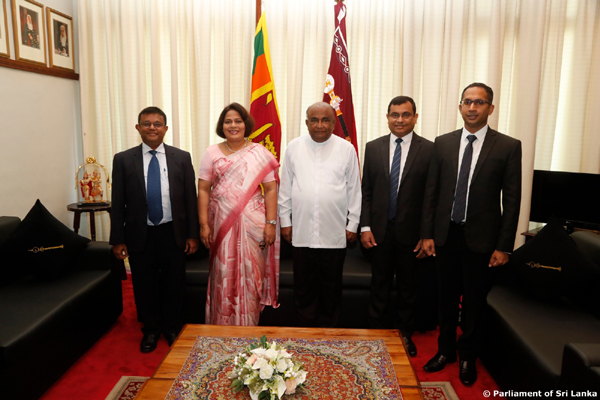
Mrs. Kushani Rohanadeera, who was newly appointed as the Secretary General of the Parliament, assumed her duties today (May 23) in the morning.
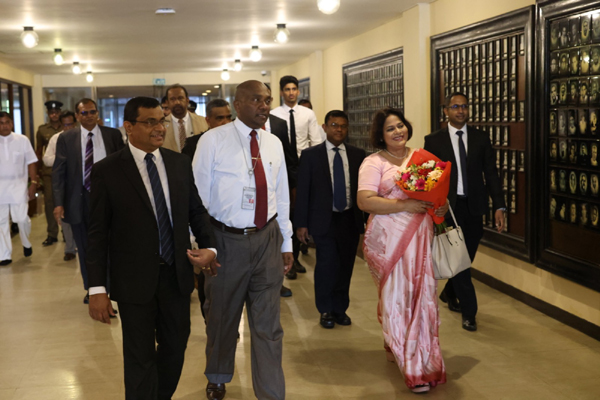
Mrs. Rohanadeera, who arrived in Parliament this morning to begin her new duties, was received by Assistant Secretaries-General Mr. Tikiri K. Jayathilake and Mr. Hansa Abeyratne.
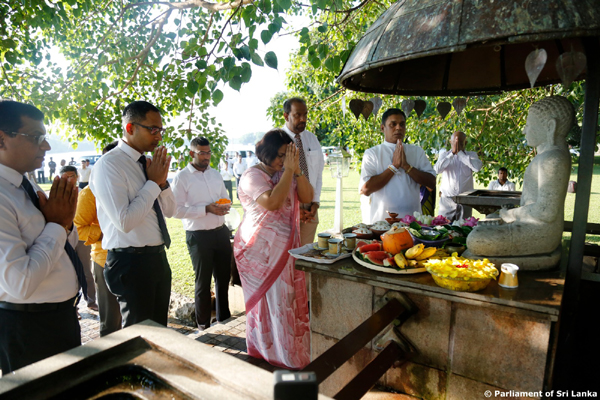
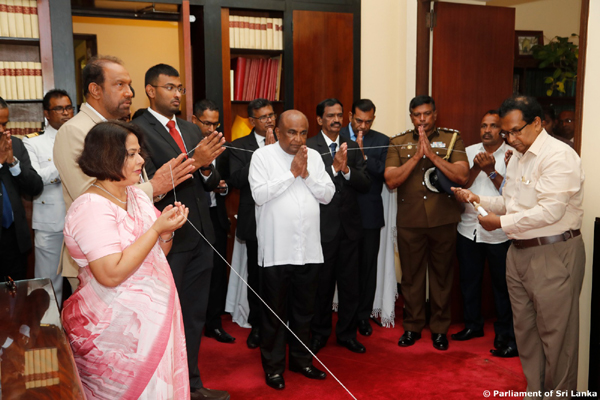
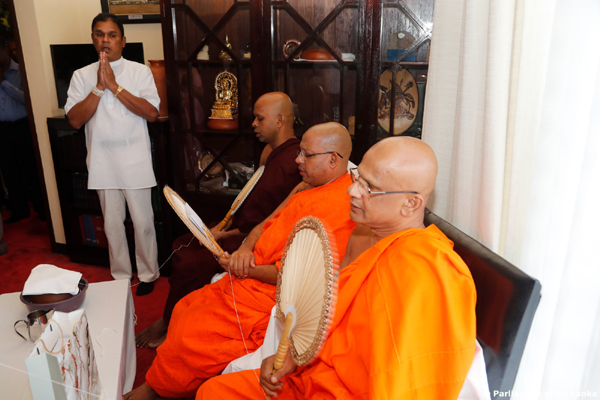
Post giving the official oaths/affirmation before the Hon. Mahinda Yapa Abeywardana, Speaker, blessings were added by the recital of Pirith by the Maha Sangha.
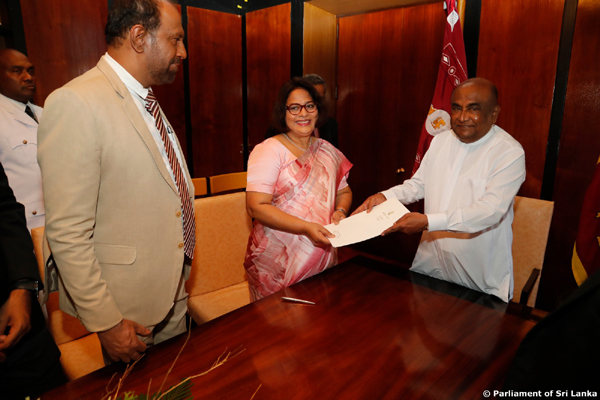
She then began her duties as the Secretary General of Parliament by certifying that the Ratanathissa Peace Foundation (Incorporation) Bill, which was passed by Parliament, as a true copy, which is to be certified by the Speaker.
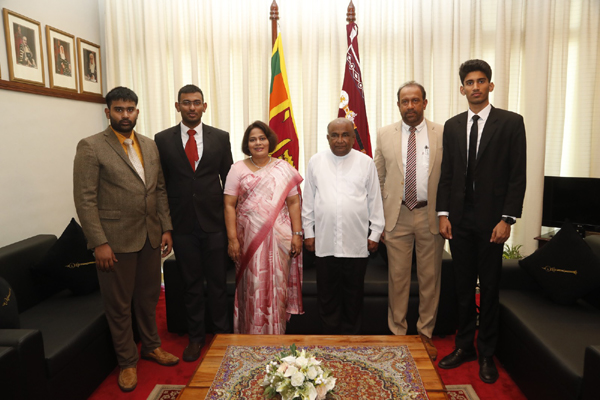
Former Secretary General of the Parliament Mr. Dhammika Dasanayake, Mrs. Rohanadeera's family members, heads of the departments of Parliament and others were present at this occasion.
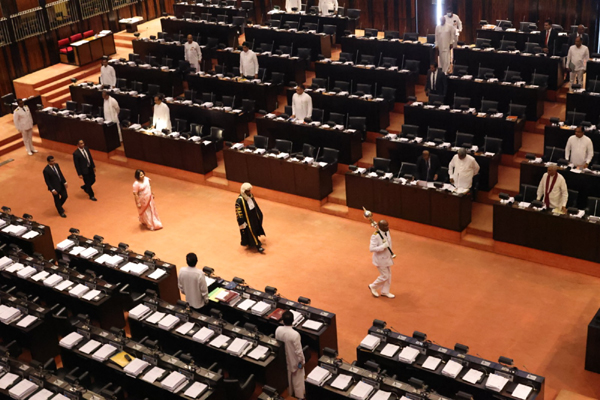
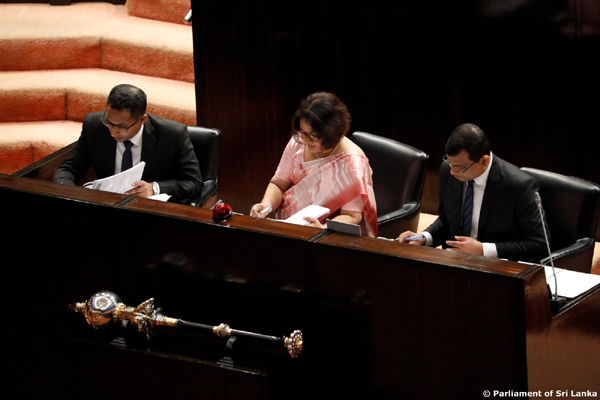
Today at 9.30 a.m. the Hon. Speaker, the new Secretary General and the Assistant Secretaries-General entered the chamber, led by the Serjeant-at-arms.
In accordance with the provisions of Article 65(1) of the Constitution, Hon. Mahinda Yapa Abeywardana, Speaker, announced that the Chief of Staff and Deputy Secretary General of the Parliament, Mrs. Kushani Anusha Rohanadeera, has been appointed as the Secretary General of the Parliament with effect from May 23rd, 2023.
Furthermore, according to the provisions of the Constitution, the Speaker officially informed that Mr. Dhammika Dasanayake, who held the position of Secretary General of the Parliament, retired from the said position on May 23rd, 2023.
Mrs. Rohanadeera, who completed her primary and secondary education at Ambalangoda Dharmashoka College, is a graduate of the University of Colombo in Biology. She also holds a Bachelor of Laws (LL.B.) degree from the Open University of Sri Lanka and is an Attorney-at-Law in profession.
In 1999, she joined the staff of the Secretary General of Parliament as a parliamentary officer. There on, she was promoted to the positions of Assistant Principal Officer, Deputy Principal Officer, Assistant Secretary General, Chief of Staff and Deputy Secretary General of Parliament.
Before joining the Parliamentary service, she has worked as a junior executive officer at Sampath Bank, a junior scientist at Environment Foundation, secretary to the director of the National Institute of Education (Distance Education), and a center coordinator at Informatics Private Institute.
Moreover, she has received training on parliamentary process and legislative process in many countries including India and Canada.
Married to Mr. Harigupta Rohanadeera, an Attorney-at-Law, she is a mother of three children and loves cooking and singing.

2026-11-23
The Budget head of the Ministry of Foreign Affairs, Foreign Employment and Tourism, taken up for debate today (Nov. 23), the second day of the Committee Stage Debate on the Appropriation Bill for 2027, was passed in Parliament without amendments and without a vote.In addition, the Second Reading debate on the Prevention of Foreign Terrorist Fighters Bill was held today from 6.00 p.m. to 6.30 p.m. The Bill was also passed in Parliament without amendments and without a vote.
2026-11-23
Special Attention to Establish a Parliamentary Forum for Children - SpeakerThe ideas put forward by children are well aligned with the Government's policy statement and that turning these ideas into reality is a collective responsibility of the entire society, Prime Minister and Minister of Education, Higher Education and Vocational Education Dr. Harini Amarasuriya stated. Listening to children's voices should not be limited to a single occasion and that adults and public representatives have a responsibility to create the necessary space for children to express their views, she emphasized.The Prime Minister made these remarks while participating in the “Little Amaya & Friends; A Wish for Sri Lanka” programme held at Parliament recently (Nov. 20), to mark World Children's Day and the 80th anniversary of the United Nations Children's Fund (UNICEF).The programme was organised with the aim of incorporating children's views and aspirations into the policy-making process of Parliament through its legislative, oversight, representation and budgetary functions.Speaker of Parliament, Dr. Jagath Wickramaratne, stressed the need to establish a Parliamentary Caucus for Children to protect children's rights and provide them with an opportunity to make their voices heard in Parliament. He emphasized the importance of establishing the Caucus promptly during the Tenth Parliament, with the support of all political parties, irrespective of party affiliations. The Speaker also commended UNICEF for its contribution over the past eight decades towards improving the health, nutrition, education and protection of children in Sri Lanka. Minister of Women and Child Affairs and Chairperson of the Women's Parliamentary Caucus, Saroja Savithri Paulraj, stated that children's views and needs should also be taken into consideration when formulating national policies, enacting legislation and making budgetary decisions.Leader of the Opposition, Hon. Sajith Premadasa, highlighted the importance of reaching a consensus, irrespective of political differences, on incorporating the rights of children, women and youth into the Fundamental Rights Chapter of the Constitution. He also pointed out the need for a comprehensive government policy to address malnutrition among children and mothers.Secretary-General of Parliament and Secretary of the Women's Parliamentary Caucus, Kushani Rohanadeera, stated that presenting the views and proposals of 55 child representatives from different parts of the country to Parliament had reaffirmed the importance of incorporating children's voices into the policy-making process. She also pointed out the need to activate the Parliamentary Forum for Children.Acting Representative of UNICEF Sri Lanka, Begona Arellano stated that although children do not have the right to vote, parliamentary laws and budgetary decisions directly affect their lives. Therefore, every Member of Parliament has a responsibility to represent all children in their respective areas. She further stated that UNICEF looks forward to strengthening its longstanding 80-year partnership with Sri Lanka through continued collaboration with Parliament.At the event, seven children presented their aspirations and proposals under the “A Wish for Sri Lanka” initiative, addressing two key questions: what kind of country should Sri Lanka be by 2036, and what matters most to children.In addition, UNICEF officials conducted a special session for members of the Women's Parliamentary Caucus on the theme, “The Role of Parliament in Strengthening Children's Rights through Legislation, Oversight, Representation and Budgetary Functions”.The Hon. Deputy Chairperson of Committees, Hemali Weerasekara, Hon. Chief Opposition Whip, Gayantha Karunathilaka, members of the Women Parliamentarians' Caucus, UNICEF officials and school children were among those who attended the event.
2026-11-23
The project to upgrade nine plantation schools with financial assistance of Rs. 600 million from the Government of India is currently underway, with contracts having been awarded to selected contractors on June 23, 2026, according to a report tabled in Parliament. The report further states that the Engineering Division has prepared the necessary documents to facilitate the payment of an advance amounting to 10% of the contract value and submitted them to the Indian High Commission for approval.These details were revealed in a written response of Prime Minister and Minister of Education, Higher Education and Vocational Education, Dr. Harini Amarasuriya tabled in Parliament, in response to questions raised by Attorney-at-Law and Member of Parliament Ms. Chamindrani Kiriella, seeking oral answers.The report states that, due to the economic crisis and the resulting increase in construction costs, the Engineering Division had informed the relevant authorities that the identified project activities could not be carried out within the initially allocated grant of Rs. 300 million. Accordingly, based on the revised cost estimate of Rs. 600 million prepared by the Engineering Division, the Government of India increased its grant from Rs. 300 million to Rs. 600 million in 2024.The response further notes that the COVID-19 pandemic during 2020–2021 and the economic crisis experienced by Sri Lanka in 2022 had a significant impact on the implementation of the project.It also identifies several other factors that contributed to delays, including the considerable time taken to coordinate with Provincial Engineering Departments to obtain estimates and other relevant technical documents, the need to secure the Indian High Commission's concurrence for each set of tender documents, and the additional time required to incorporate the amendments and observations made by the High Commission before proceeding with the procurement process.
2026-11-23
A decline in the number of Sri Lankan fishermen and fishing boats arrested by foreign countries has been observed during the period from 2020 to 2026, according to a report tabled in Parliament. Accordingly, 22 fishing boats and 126 fishermen were arrested by foreign countries in 2020, while the figures increased to 24 boats and 134 fishermen in 2021. In 2022, 20 boats and 103 fishermen were arrested, while the corresponding figures for 2023 were 23 boats and 116 fishermen. The number of arrests peaked in 2024, with 30 fishing boats and 165 fishermen taken into custody. However, the number of fishing boats arrested declined to 19, while the number of fishermen arrested dropped to 111 in 2025. In 2026, to date, 07 fishing boats and 40 fishermen have been arrested.These details were revealed in a written response of Minister of Fisheries, Aquatic and Ocean Resources Ramalingam Chandrasekar tabled in Parliament, in response to Questions for Oral Answers raised by Member of Parliament Ravi Karunanayake.The response also outlined several diplomatic measures that could be taken to prevent an increase in incidents involving the arrest of Sri Lankan fishermen in India and the Maldives. These include strengthening bilateral discussions, raising awareness among fishermen, and reaching a special agreement between Sri Lanka and the Maldives.Failure to obtain the relevant permissions and comply with established procedures when entering the maritime areas of the Maldives has been identified as a specific reason for the arrest of Sri Lankan multi-day fishing boats in Maldivian waters. Meanwhile, engaging in fishing activities within India's Exclusive Economic Zone (EEZ) and the transportation of illegal goods using fishing boats have been identified as key reasons for the arrest of Sri Lankan fishing boats in Indian waters.The response further noted that the use of Global Positioning System (GPS) and Vessel Monitoring System (VMS) equipment on fishing boats could help minimize arrests involving Sri Lankan fishermen and fishing boats. It also highlighted the lengthy legal procedures and high costs associated with cases involving fishermen arrested in Sri Lanka, India and the Maldives, and outlined measures that could be taken to expedite such legal proceedings.
Handbook of Parliament
The System of Elections in Sri Lanka
How Parliament Works
Business of Parliament
Copyright © The Parliament of Sri Lanka.
All Rights Reserved.
Design & Developed by TekGeeks