Handbook of Parliament
The System of Elections in Sri Lanka
How Parliament Works
Business of Parliament
Engage with your Parliament by logging in
2017-10-03
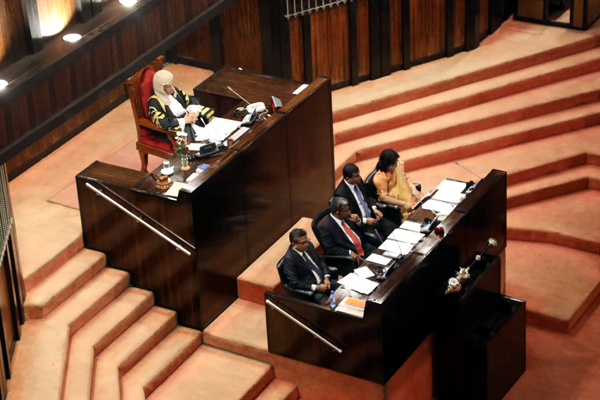
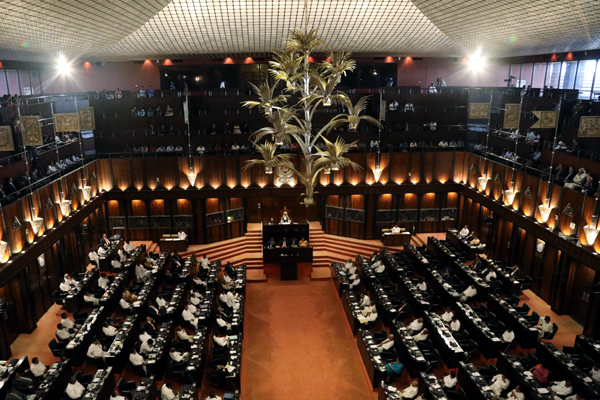
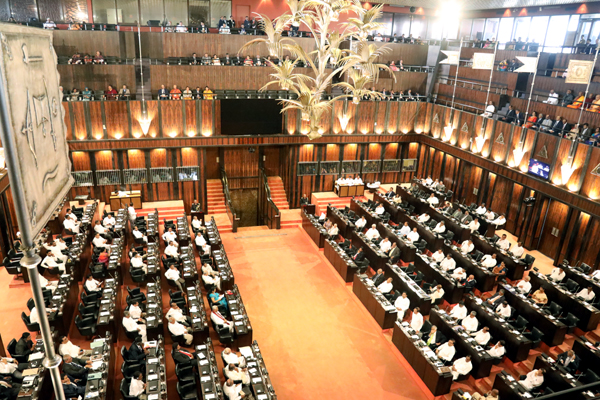
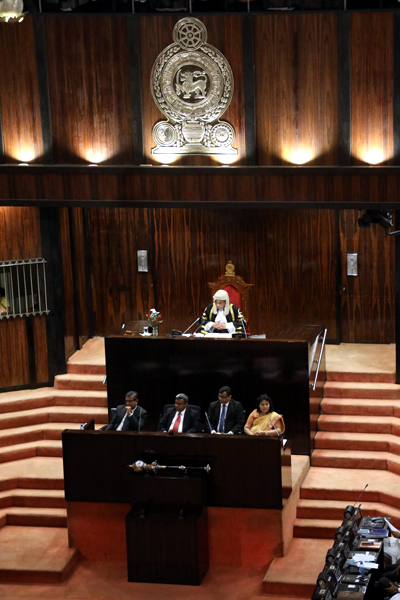
A special Sitting of Parliament was held today (Oct 03rd) at 2.30 p.m. to commemorate the 70th Anniversary of Parliamentary Democracy in Sri Lanka. At the commencement of Public Business, the Hon. Prime Minister and the Hon. Leader of the opposition in Parliament moved a Vote as follows;
“That this Parliament at its meeting today commemorates with pride the 70th anniversary of its first meeting as an independent Parliament and notes that Parliament of Sri Lanka is the oldest Parliament elected by universal adult franchise in the Asia region with an unbroken record of democratic governance and wishes for itself and the people of Sri Lanka a prosperity, development and further strengthening of democratic traditions, principles and rule of law.”
The speeches began with His Excellency the President and was followed with speeches by the Hon. Prime Minister, Hon. Leader of the Opposition, Hon. Leader of the House, Hon. Chief Government Whip, Hon. Chief Opposition Whip, and the Hon. Leaders of the recognized political parties in Parliament. The Hon. Speaker delivered the Vote of Thanks.
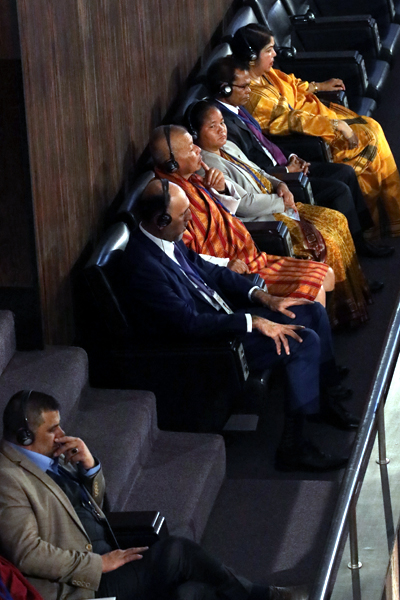
Hon. Speakers of the Parliaments of the SAARC countries who are in Sri Lanka to participate in the 8th conference of the Association of SAARC Speakers and Parliamentarians were present at the Speaker’s Gallery to witness the occasion.
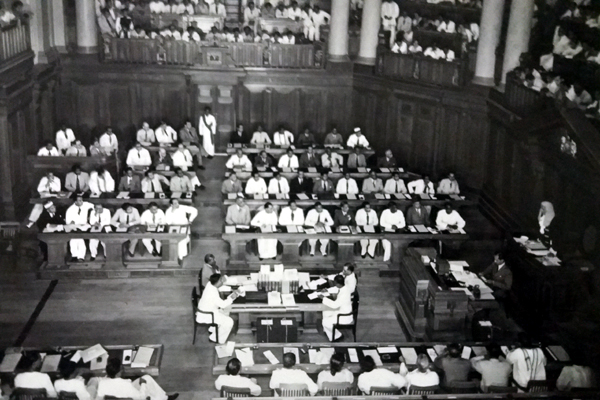
The first Parliament in Sri Lanka, known as “House of Representatives”, met for the first time on the 14th of October 1947 at the State Council building (Old Parliament Building) in Colombo. It consisted of 101 Members, of which 95 were elected by universal suffrage and 6 were nominated by the Governor-General.
The general election was held for a period of 19 days from 23rd of August to the 20th of September 1947. The United National Party won 42 seats, thereby obtaining a majority and selecting Rt. Hon. D. S. Senanayake as the country’s first ever Prime Minister. The other political parties that won seats at the general election were, Lanka Sama Samaja Party, Bolshevik Leninist Party, Communist Party, Labour Party, All Ceylon Tamil Congress and the Ceylon Indian Congress. Twenty Independent candidates were elected as well. The Hon. Sir Francis Molamure, first Member for Balangoda, was elected as Speaker. Mr R. St. L. P. Deraniyagala, C.B.E was the Clerk to the House of Representatives.
The First Parliament of Sri Lanka (then Ceylon) was bicameral consisting of two chambers known as the Senate and the House of Representatives. It was established as per the proposals put forward by the Soulbury Commission and by way of a Ceylon (Constitution) Order in Council. This replaced the State Council of Ceylon which was established in 1931. The Senate was abolished in 1971 and the House of Representatives was replaced with the unicameral National State Assembly in 1972 when the first republican constitution was enacted. With the promulgation of the second republican constitution on 7th of September 1978, the First Parliament of the Democratic Socialist Republic of Sri Lanka superseded the Second National State Assembly.
The current Parliament is the 8th Parliament of the Democratic Socialist Republic of Sri Lanka, and the 17th overall. Since 1947, 14 MPs have held the office of Prime Minister, while 18 have been elected as Speaker of Parliament. There have been seven Secretaries-General of Parliament (previously known as Clerk to the House) to date.
First Sitting on October 14th 1947
2026-11-16
A parliamentary delegation from the National Assembly of the Republic of Korea, representing the Korean Parliamentary League on Children, Population and Environment (CPE), met with the Hon. Deputy Speaker of Parliament, Dr. Rizvie Salih recently to discuss avenues for strengthening bilateral cooperation in environmental resilience, demographic policies, education and economic exchange. The Secretary General of Parliament, Ms. Kushani Rohanadeera, was also present at the meeting.The Korean delegation was led by Hon. Lee Yang-soo, Chairperson of the National Assembly Intelligence Committee and Vice President of the Korean Parliamentary League on CPE. It also comprised Hon. Kwak Sang-eon, Member of the Korean Parliamentary League on CPE; Hon. Kim So-hee, Vice President of the Korea-Sri Lanka Parliamentary Friendship Association; and H.E. Youn-Jung Kim, Ambassador of the Republic of Korea to Sri Lanka.Established in 1989, the CPE seeks to promote international Parliamentary cooperation in addressing global challenges relating to climate change, population and child welfare. In view of the 50th anniversary of diplomatic relations between Sri Lanka and the Republic of Korea in 2027, both sides expressed their commitment to further strengthening the longstanding friendship and cooperation between the two countries.During the discussions, the Deputy Speaker highlighted the impact of recent extreme weather conditions in Sri Lanka, particularly severe floods and landslides that have caused considerable damage to infrastructure and agricultural lands. He also drew attention to the country's demographic challenges, including declining fertility rates and a rapidly ageing population, which could have significant implications for future dependency ratios and workforce availability. The discussions also covered Sri Lanka's free education system and the challenges associated with maintaining and strengthening it.Sharing South Korea's experiences in addressing declining birth rates, the Korean delegates outlined several policy interventions, including affordable rental housing schemes for newly married couples, low-interest loans and housing incentives. The delegation also discussed proposals to extend the retirement age from 60 to 65 to address gaps in pension coverage, while emphasizing the importance of ensuring adequate employment opportunities for younger generations alongside such policy measures.Both delegations underscored the importance of prioritizing environmental protection alongside economic development, noting that natural disasters can undermine years of economic progress. The discussions also touched upon the growing popularity of Korean culture, particularly K-pop, in Sri Lanka, as well as the potential to further expand bilateral tourism.Furthermore, both sides highlighted the benefits of technical and vocational training opportunities available to Sri Lankan youth employed in South Korea, noting that such opportunities contribute to enhancing professional skills while generating economic benefits for Sri Lanka.The Korean delegation extended an invitation to the Parliament of Sri Lanka to participate in the Asia-Pacific Parliamentarians' Conference on Environment and Development (APPCED), scheduled to be held in South Korea next year, where Korea will act as the chair nation for several countries.The delegation also expressed its commitment to encouraging greater participation by Korean enterprises in Sri Lanka's forthcoming international Expo, scheduled for January next year.
2026-11-16
A total of 12,196 persons who were arrested or surrendered during and after the conflict in the Northern and Eastern Provinces have been rehabilitated and reintegrated into society, Minister of Public Security and Parliamentary Affairs Ananda Wijepala said.This was revealed in the Minister’s response to questions raised by Hon. (Dr.) Pathmanathan Sathiyalingam, Member of Parliament, seeking oral answers in Parliament.The Minister stated that several programmes had been implemented for those who underwent rehabilitation. These included counselling, yoga, spiritual and educational programmes, including basic education and language training. They were also encouraged to sit for the General Certificate of Education (G.C.E.) Ordinary Level and Advanced Level examinations. In addition, aesthetic programmes covering art, music, drama and performing arts, as well as driving training and sports activities, had been conducted for their benefit, the Minister added.He further stated that vocational training had been provided to rehabilitated individuals to improve their livelihoods, together with the necessary equipment and other forms of assistance relevant to their respective training programmes.According to a report tabled by the Minister in Parliament, government institutions and non-governmental organisations had also provided various forms of assistance to strengthen their livelihoods. These included financial loans, houses, sewing machines, fishing nets, bicycles, water pumps, carpentry tools, processing equipment, agricultural equipment, livestock and three-wheelers.
2026-11-16
The Hon. Deputy Minister of Education and Higher Education, Dr. Madhura Senevirathna, stated that no further volunteer teachers could be recruited into the Teaching Service following the recruitment of 4,700 volunteer teachers as Teacher Assistants.Deputy Minister further stated that Cabinet approval had been granted to recruit 4,700 teachers currently serving as volunteer teachers in schools across various provinces of the island and appoint them as Teacher Assistants. This recruitment was approved in accordance with Cabinet Memorandum No. 06/2282/229/085-II dated 04 January 2007.The Deputy Minister made these remarks while responding to questions raised by Hon. Member of Parliament M.S. Uthumalebbe, who sought oral answers in Parliament.He further stated that, of the 4,700 volunteer teachers approved for appointment as Teacher Assistants in the Western, Central, Southern, Northern and Eastern, North Western, North Central, Uva and Sabaragamuwa Provinces, 462 had been approved for appointment to the Northern and Eastern Provinces.
2026-11-14
A number of measures taken with the aim of providing sustainable solutions to prevent elephants from being killed in train collisions have been presented to Parliament. These initiatives aim to reduce elephant deaths caused by train collisions through improved railway infrastructure, staff awareness, habitat management and the introduction of modern surveillance and detection technologies.These details were revealed in the written response of the Hon. Minister of Environment, Dr. Dhammika Patabendi tabled, to questions raised by Hon. Member of Parliament Nalin Bandara Jayamaha, seeking oral answers.According to the response tabled in Parliament, the following measures have been implemented:Advanced train sets have been introduced on the Eastern Railway Line of the Sri Lanka Railways Department to improve visibility on both sides of the railway track and enable train drivers to control speed more effectively, and A 27-kilometre stretch of railway track, extending from Gal Oya Junction towards Hingurakgoda and from Gal Oya Junction towards Kantale, has been identified as an area frequently crossed by elephants. A total of 800 concrete blocks have been laid between the railway sleepers to fill the gaps and make it easier for wild elephants to cross the tracks.Since elephants roaming in certain areas, particularly around railway bends, are not easily visible to train drivers, undergrowth has been cleared within a distance of 10 to 20 metres from the railway tracks. Under this initiative, the Department of Forest Conservation has cleared vegetation along 20 Kilometres of railway track.Awareness programmes were conducted on 16 and 17 May 2025 for train drivers, station masters, railway engineers responsible for railway tracks, and assistant train drivers.An allocation of Rs. 25.4 million has been provided to the Department of Irrigation for the construction and improvement of two tanks within the Forest Conservation Reserve encountered when travelling towards Kantale beyond Habarana Railway Station. These tanks are located at a considerable distance from the railway line and will provide alternative water sources for elephants.CCTV cameras have been installed at location 141, Kasikote, between Gal Oya and Minneriya where elephants cross railway tracks. These cameras are monitored through the Anuradhapura Operations Control Centre to observe elephant movements and improve railway safety. Furthermore, a pilot project has been initiated to install thermal detector cameras on trains to identify wild elephants. Continuous testing and research are being carried out jointly by the Sri Lanka Railways Department and the Arthur C. Clarke Institute for Modern Technologies.According to the response tabled, a total of 81 elephants have died after being hit by trains between 2020 and October 12, 2026
Handbook of Parliament
The System of Elections in Sri Lanka
How Parliament Works
Business of Parliament
Copyright © The Parliament of Sri Lanka.
All Rights Reserved.
Design & Developed by TekGeeks
Watch the day’s proceedings