01

සි   |     |  

2025-11-03

News Categories : Committee News 

Committee on Ways and Means reviews Sri Lanka Customs’ revenue progress

  • Officials state that by September 30, 117% of the expected revenue target had been achieved
  • A new digital system to be introduced for the auctioning of confiscated goods


Officials of Sri Lanka Customs informed the Committee on Ways and Means that as of September 30, 2025, they had been able to achieve 117% of the expected revenue target. They stated that the expected customs revenue as of September 30, 2025, was Rs. 1,485 billion, while revenue amounting to Rs. 1,737 billion had been collected by that date.

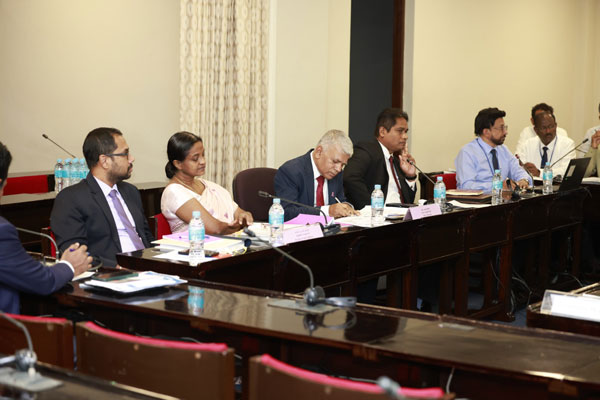
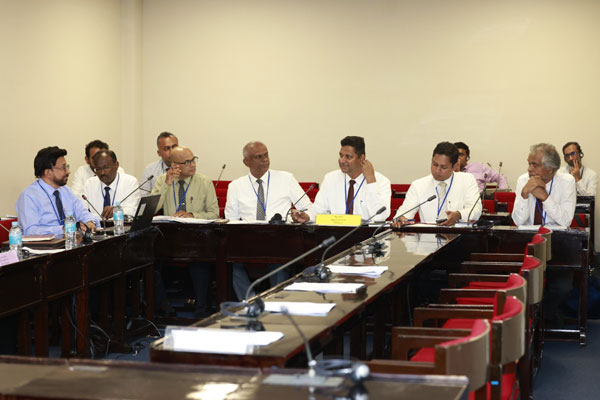
These facts were revealed at a recent meeting of the Committee on Ways and Means of Parliament, chaired by Hon. Member of Parliament Wijesiri Basnayake.

Officials further explained to the Committee that, compared to the previous year, customs revenue had recorded a significant increase every month this year. Accordingly, by October 14, 2025, the highest revenue had been generated through vehicle imports, which had earned Rs. 587.11 billion constituting 37% of the total revenue by that date.

By 14th October 55,447 motor cars had been imported, generating customs duties amounting to Rs. 474.26 billion. Additionally, 7,331 goods transport vehicles had been imported, generating Rs. 48.67 billion in revenue. Imports also included 142,524 motorcycles and 15,035 three-wheelers, earning Rs. 30.37 billion and Rs. 15.10 billion respectively. Furthermore, 1,679 passenger transport buses and vans had been imported, contributing Rs. 12.66 billion in revenue, according to officials.

Attention was also drawn to the future targets and technological advancements of Sri Lanka Customs. Officials informed the Committee that steps have been taken to introduce a new digital system (E-Tendering system) for the auctioning of confiscated goods and that it is scheduled to be launched in the near future. The Committee observed that this initiative would serve as a valuable precedent for other state institutions as well.

Members of the committee Hon. Deputy Minister (Prof.) Ruwan Ranasinghe, Hon. Deputy Minister Eranga Weeraratne, and Hon. Members of Parliament Ajith P. Perera Attorneys-at-Law, Sujeewa Senasinghe Attorneys-at-Law, Sujith Sanjaya Perera, Sunil Biyanwila, and Champika Hettiarachchi and Officials including Director General of Customs Mr. Seevali Arukgoda were present at this meeting.



Related News

2026-01-08

Ministerial Consultative Committee on Transport, Highways and Urban Development approves the Regulations under the Motor Traffic Act

The Ministerial Consultative Committee on Transport, Highways and Urban Development has approved the Regulations under the Motor Traffic Act (Chapter 203) scheduled to be presented to Parliament for approval on 08.01.2025.Accordingly, this approval was granted at the recent (Jan. 06) meeting of the Ministerial Consultative Committee on Transport, Highways and Urban Development held in Parliament under the chairmanship of Hon. Minister of Transport, Highways and Urban Development Bimal Rathnayake.As such, the Regulations published in the Extraordinary Gazette bearing No. 2452/40 under the Motor Traffic Act (Chapter 203) state that in an instance where a police officer has reasonable suspicion that a person driving, operating or physically controlling a motor vehicle on any road has used drugs, such police officer shall produce that person to a Government Medical Officer or an officer of a hospital who has been empowered for the purpose, for further examination.Furthermore, the Regulations published in the Extraordinary Gazette bearing No. 2455/29 under the Motor Traffic Act (Chapter 203) state that every person travelling on an expressway must wear a seat belt. Accordingly, the Committee granted approval for the said Regulations.In addition, officials of the Ministry of Transport, Highways and Urban Development briefed the Committee on the damage caused due to the sudden disaster situation that arose within the country and the progress of restoration efforts. Officials of the Road Development Authority stated that approximately 287 road sections belonging to the Authority, covering a distance of around 1481 kilometers, have been damaged. They further informed the Committee that the estimated cost for reconstruction would be around Rs. 86 billion.Officials of the Railway Department stated that the Department has incurred a loss of approximately Rs. 300 billion. Furthermore, officials stated that the Sri Lanka Transport Board has suffered a loss of around Rs. 63 million due to the emergency disaster situation.The Chair of the Committee also stated that a web page has been created to inform the public regarding the damage caused to the road system in various parts of the country. Accordingly, he pointed out that the public may access the page https://road-lk.org/ to obtain information on the relevant damage.Hon. Deputy Chairman of the Committees Hemali Weerasekara, Hon. Leader of the Opposition Sajith Premadasa, Hon. State Minister of Transport and Highways (Dr.) Prasanna Gunasekera, Hon. Deputy Minister of Urban Development Eranga Gunasekara, other Hon. Deputy Ministers, Hon. Members of Parliament and several government officials were present at this occasion.


2026-01-08

The Ministerial Consultative Committee on Defence meets under the chairmanship of Hon. President Anura Kumara Dissanayaka

A meeting of the Ministerial Consultative Committee on Defence was held yesterday (Jan. 07) evening in the Parliament premises under the chairmanship of Hon. President and Minister of Defence Anura Kumara Dissanayaka.At this meeting of the Ministerial Consultative Committee on Defence, Members of Parliament raised several issues such as reviewing the progress of the implementation of decisions reached at previous committee meetings, the release of lands in the Northern and Eastern Provinces, the opening of roads, and the functioning of schools.Accordingly, His Excellency the President issued the necessary instructions to officials to provide feasible solutions to those matters, and discussions were also held regarding existing obstacles and the steps to be taken in carrying out these activities.Matters such as the welfare of members of the defence forces and deploying more personnel for the United Nations peacekeeping forces were also discussed.Deputy Minister of Defence Major General (Rtd.) Aruna Jayasekera was also present at this meeting, along with several Ministers, Deputy Ministers, and Members of Parliament. Likewise, a group including the Secretary to the Ministry of Defence, Heads of the Tri-Forces, several senior officials of the defence sector, the Secretary General of Parliament Mrs. Kushani Rohanadeera, and officials of the Ministry were also present at this meeting.


2026-01-08

Ministerial Consultative Committee approves the Regulation under the Shop and Office Employees (Regulation of Employment and Remuneration) Act

Approval of the Ministerial Consultative Committee on Labour has been granted for the Regulation under Shop and Office Employees (Regulation of Employment and Remuneration) Act (Chapter 129), scheduled for debate in Parliament tomorrow (Jan. 9).This approval was granted at the meeting of the Committee held in Parliament on 2026.01.06, chaired by the Minister of Labour (Dr.) Anil Jayantha and with the participation of the Deputy Minister of Labour Mahinda Jayasinghe.This Regulation, made by the Minister of Labour on 2025.12.12, was presented to Parliament on 2025.12.18. The Regulation amends the current legal provision which states:“Any female employee who has attained the age of eighteen years may be employed in a residential hotel after 6.00 p.m and before 6.00 a.m, on the work of a female reception officer, ladies linen room attendant, ladies cloak room attendant or ladies lavatory attendant.”Accordingly, the Regulation introduces the required legal amendments to allow, in addition to the designated categories already permitted, female workers over the age of 18 employed in residential hotels as Food and Beverage Stewardess to be engaged in employment after 6.00 p.m. or before 6.00 a.m. on the following day.However, officials informed the Committee that under this Regulation, in any instance where the work shift of a female employer employed under this provision ends between 6.00 p.m. and 6.00 a.m., the employer shall be responsible for ensuring her health care, safety and welfare by providing suitable accommodation until 6.00 a.m. or providing transport facilities to her usual residence.Although the current female population in Sri Lanka is approximately 51%, female labour force participation is around 34%. It was discussed that easing existing legal restrictions is a timely need in order to create opportunities to increase female labour contributions, especially to support the rapidly developing tourism sector.A number of proposals on measures that can be taken to safeguard the rights of female workers and other employees, as well as matters relating to increasing the wages of plantation workers, were presented to the Committee by Hon. Members of Parliament. The Hon. Minister of Labour stated that discussions on these matters will be carried out in the future and necessary steps will be taken accordingly.A number of Members of Parliament, the Secretary to the Ministry of Labour, and officials representing the Ministry of Labour and institutions under it also participated in this Committee meeting.


2026-01-07

Income tax exemptions for employees of authorized persons limited, a 3-year transitional period for existing entities - Colombo Port City Economic Commission explains

CoPF approves the Colombo Port City Economic Commission (Amendment) Bill and Regulations Issued under the Imports and Exports (Control) Act, No. 1 of 1969 post considerationIn consideration of the Colombo Port City Economic Commission (Amendment) Bill, it was stated that the amendment thus limits income tax exemptions for employees of new entrant authorized persons. However, officials present stated that a 3-year transitional period for existing entities has been given.This was discussed at length at the Committee on Public Finance, chaired by Hon. Dr. Harsha de Silva, held in Parliament on 06.01.2026, when Members of the Committee sought clarity on the rationale for amending tax incentives, particularly the decision to limit income tax exemptions for employees of authorized persons to a transitional period for existing entities, while discontinuing such exemptions for new entrants.The Committee also examined proposed changes to application fees and charges, to reduce upfront costs on the part of investors by deferring certain payments until licensing, while seeking assurance that the revised structure would remain competitive and transparent.The Committee also queried the alignment of foreign exchange provisions with the Foreign Exchange Act No. 12 of 2017, seeking clarification on the treatment of rupee earnings, currency conversion, and safeguards to ensure consistency with national monetary and financial regulations.The offshore banking framework attracted significant attention, with the Committee Members requesting updates on the status of banking licence applications, differences between Port City offshore banking operations and domestic banking activities, and the adequacy of regulatory oversight. The Central Bank’s enhanced supervisory role, including capital, liquidity, governance, and compliance requirements, was discussed in the context of international best practices.Concerns were also raised regarding enforcement and penalties for non-compliance, with Members of Parliament emphasizing the need for deterrent-level sanctions, effective monitoring, and strong reputational safeguards to maintain the integrity of the Port City.Officials noted that the amendments are intended to operationalize the Port City framework, enable approvals of new business activities, and balance investor attractiveness with fiscal discipline, transparency, and international commitments.The Committee also took into consideration the Regulations issued under the Imports and Exports (Control) Act, No. 1 of 1969 (as amended). Accordingly, Regulations issued under the Imports and Exports (Control) Act, No. 1 of 1969(as amended), were presented to the Committee seeking approval to enable tax exemptions, streamlined procedures, and the swift clearance and distribution of relief goods donated by foreign donors to those affected by Cyclone Ditwah, received in the name of the Disaster Management Center or any government institution.The Committee questioned the Ministry of Finance on the non-establishment of the Disaster Management Fund, despite the existence of the necessary legal provisions and approvals. The Committee also raised concerns regarding the delay in establishing the “Rebuilding Sri Lanka Fund” as statutory fund, noting the potential issues that could arise if further delays persist. Accordingly, the Committee urged officials of the Ministry of Finance to take proactive measures in this regard.Following in-depth deliberations, the Committee approved the Colombo Port City Economic Commission (Amendment) Bill and the Regulations issued under the Imports and Exports (Control) Act, No. 1 of 1969. (as amended)The meeting was attended by Hon. Deputy Ministers Chathuranga Abeysinghe, Dr. Kaushalya Ariyaratne, Nishantha Jayaweera, Hon. Members of Parliament Ravi Karunanayake, Rauff Hakeem, Attorney-at-Law, Nimal Palihena, Wijesiri Basnayake, Thilina Samarakoon, Champika Hettiarachchi, Sunil Rajapaksha, Ajith Agalakada, and Lakmali Hemachandra, Attorney-at-Law.


Copyright © The Parliament of Sri Lanka.

All Rights Reserved.

Design & Developed by  TekGeeks