Related News
2026-11-12
Focus on Regulation of Electric Vehicle Technology, Restructuring of Research Institutions and Promotion of Innovation at Sectoral Oversight Committee
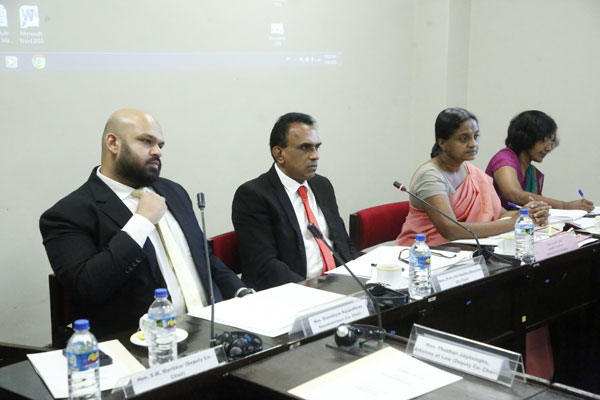
The Sectoral Oversight Committee on Science, Technology and Digital Transformation focused on several key issues, including the introduction of regulations and standards for electric vehicles and their battery technology, improving the performance of state research institutions, and commercializing innovations.At a recent meeting of the Committee, held in Parliament recently under the chairmanship of Hon. Member of Parliament Dr. Janaka Senarathna, the following reports were considered: the Annual Report of the Sri Lanka National Engineering Research and Development Centre (NERDC) for 2022; the Annual Report of the National Science and Technology Commission for 2023; the Annual Report of the Sri Lanka Inventors Commission for 2024; and the Annual Performance Report of the Ministry of Science and Technology for 2025.Discussions focused on the electric vehicle and battery testing facilities available at the Sri Lanka National Engineering Research and Development Centre (NERDC). It was revealed that the institution has the capacity to test a range of battery parameters, including capacity, durability and lifespan.However, attention was also drawn to issues arising from the absence of mandatory regulations and standards governing electric vehicles, batteries, controllers and charging stations imported into the country. Accordingly, officials stressed to the Committee the need to establish relevant standards and make testing and certification compulsory.The Committee also discussed the technology involved in converting fuel vehicles into electric vehicles, the need for training programmes, and the development of standards and regulatory mechanisms to ensure the safety of such vehicles.Attention was further drawn to the shortage of human resources in research and development institutions and the need for appropriate salary and allowance schemes to attract and retain qualified engineers and researchers. Officials also highlighted the importance of improving the performance of state research institutions, addressing existing shortcomings, effectively managing research outcomes, and consolidating institutions carrying out similar functions.The Committee also discussed the Sri Lanka Inventors Commission's electric fencing projects aimed at mitigating the threat posed by wild elephants, the establishment of incubation centres affiliated with universities, and plans to promote innovation through digital platforms. Officials informed the Committee that three of the four electric fencing projects implemented to date were operating successfully.Furthermore, discussions were held on a proposal to amend the Intellectual Property Act to introduce a ‘Petty Patent system’, with the aim of protecting the intellectual property rights of inventors and expediting the commercialization of inventions.Hon. Members of Parliament Lasith Bashana Gamage, Chathura Galappaththi, Thanura Dissanayake, Attorney-at-Law Hasara Liyanage and Chandima Hettiarachchi, along with a number of officials from the Ministry of Science and Technology, attended the meeting.
2026-11-11
Central Bank Officials Brief Committee on Public Finance on Private Sector Credit Growth, Inflation Target and Stability of the Banking System
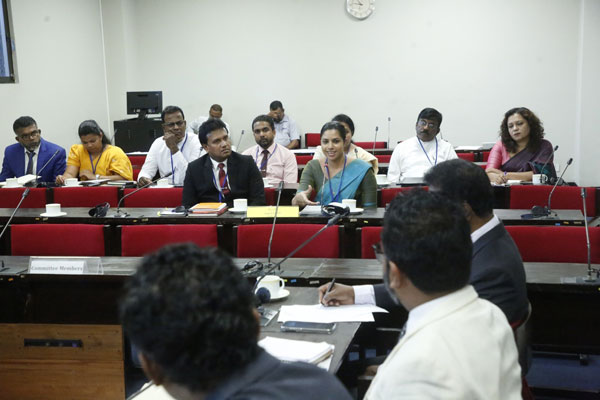
The role of the Central Bank of Sri Lanka, inflation targeting, private sector credit growth, economic growth potential and financial system stability were discussed extensively at a recent meeting of the Committee on Public Finance (COPF), held in Parliament recently under the chairmanship of Dr. Harsha de Silva, Member of Parliament.The meeting was attended by Hon. Deputy Minister Chathuranga Abeysinghe and Hon. Members of Parliament Ravi Karunanayake, Harshana Rajakaruna, Ajith Agalakada, Nimal Palihena, Wijesiri Basnayake, Sunil Rajapaksa and Thilina Samarakoon. A group of Central Bank officials, including the Governor of the Central Bank of Sri Lanka, Dr. P. Nandalal Weerasinghe, also participated in the meeting.In accordance with the provisions of Section 80(2)(a) of the Central Bank of Sri Lanka Act, the Governor of the Central Bank, members of the Governing Board and the Monetary Policy Board, as well as Deputy Governors, are required to appear before Parliament or one of its committees once every four months to brief them on the functions of the Central Bank. Furthermore, under Section 26(5), if the Central Bank fails to achieve its prescribed inflation targets for two consecutive quarters, it is required to submit a report to Parliament explaining the situation.During the meeting, Central Bank officials explained the decision to maintain the headline inflation target, based on the Colombo Consumer Price Index (CCPI), at 5%, and to continue maintaining this target over the next three years. It was also revealed that seven special reports had been submitted to Parliament on occasions when inflation remained below the lower limit of the target range of 3%.It was stated that the volume of credit extended to the private sector during the first nine months of 2026 amounted to Rs. 2.1 trillion, compared to Rs. 1.9 trillion during the corresponding period in 2025. Approximately 74% of this credit was provided by licensed commercial banks.However, the Committee drew attention to the increase in the share of short-term loans from 42% to 47%, while the share of long-term loans had declined from 35% to 29%. Discussions also focused on whether bank lending was being adequately channeled towards capital formation, new investments and expanding production capacity. In addition, the Committee sought clarification on the growth of different categories of loans, including mortgage loans and vehicle loans.The country's long-term economic growth potential was also discussed. The importance of implementing reforms in the trade, labour and land sectors, alongside monetary policy, was emphasized as essential for achieving sustainable economic growth. The development of human capital, improvements in productivity and attracting foreign direct investment were also highlighted as key priorities.Providing an update on financial system stability, Central Bank officials explained that the banking sector's Stage 3 non-performing loan ratio had declined from 9.7% to 8.8%. They also noted that capital and liquidity levels within the banking system remained above the regulatory requirements.Regarding NDB Bank, Central Bank officials stated that the forensic audit conducted in relation to the bank, together with the report of the Sri Lanka Accounting and Auditing Standards Monitoring Board, had been referred to the Attorney General on October 15, 2026. They further stated that regulatory measures had been imposed on the bank, including restrictions on dividend distributions, branch expansion and directors' remuneration.The Committee also focused on institutions illegally accepting public deposits and financial scams involving the fraudulent use of artificial intelligence to create fake images and voices of the Central Bank Governor, the Prime Minister and Members of Parliament.Central Bank officials pointed out that measures were being taken in coordination with the Telecommunications Regulatory Commission, the Sri Lanka Computer Emergency Readiness Team (CERT), the Police and Meta to prevent such scams.In addition, the Committee discussed regulatory matters relating to virtual assets and cryptocurrencies, the supervision of banking activities within the Colombo Port City, and the proposed consolidation of state-owned banks.
2026-11-10
Women Parliamentarians’ Caucus Focuses on Protecting Children’s Rights, Preventing Violence Against Women and Legal Reforms
The Women Parliamentarians’ Caucus met recently (Nov. 06) at Parliament under the chairpersonship of Hon. Minister Saroja Savithri Paulraj. Discussions focused on promoting children’s rights, taking action against gender-based violence, and strengthening the technical and research capacities of women parliamentarians.Accordingly, during a discussion with representatives of the United Nations Children’s Fund (UNICEF) in Sri Lanka, attention was drawn to the “Special Children’s Parliamentary Participation Programme”, scheduled to be held at Parliament on 20th November to mark World Children’s Day. It was noted that a Children’s Statement, prepared based on the views and opinions of more than 1,200 children from across the country, is to be presented to Members of Parliament with the participation of 50 children. The need to re-establish a Children’s Caucus within Parliament to promote children’s rights and welfare was also discussed.Furthermore, attention was drawn to expediting cases relating to child abuse, removing existing legal barriers to this process, and strengthening coordination among the relevant institutions.Subsequently, during a discussion with representatives of the United Nations Population Fund (UNFPA) in Sri Lanka, matters relating to the global 16 Days of Activism against Gender-Based Violence campaign were discussed. The discussion focused on plans to organize an awareness march under the theme “This is my right” and conduct public awareness programmes on preventing violence against women as part of the campaign, which is scheduled to run from November 25 to December 10.The visiting representatives stated that, in addition to women parliamentarians, Members of Parliament, Ministers, officials of government institutions, representatives of civil society organizations and university students are expected to participate in the march. Discussions were also held on introducing a digital directory of services, featuring a QR code, containing information on institutions and services available to women experiencing violence, as well as organizing a dialogue with the participation of relevant stakeholders.Meanwhile, during a follow-up discussion on technical cooperation with representatives of the Max Planck Foundation, attention was focused on parliamentary research support and knowledge sharing. The possibility of providing technical and research assistance to Members of Parliament in areas such as legislative drafting, comparative legal studies, and assessing the impact of proposed legislation on gender equality and human rights was also discussed.The importance of pursuing further initiatives in collaboration with international organizations to strengthen child protection, women's rights and gender-responsive policy measures was also emphasized during the discussions.The Hon.Deputy Chairperson of Committees of Parliament, Hemali Weerasekara; the Hon. Deputy Co-Chairpersons of the Women Parliamentarians’ Caucus, Attorney-at-Law Chamindrani Kiriella and Samanmali Gunasinghe; along with several women Members of Parliament serving on the Caucus, also participated in these discussions.
2026-11-10
COPE Chairman Emphasizes Importance of Developing Proper Corporate Plans and KPIs to Enhance the Performance of State-Owned Enterprises
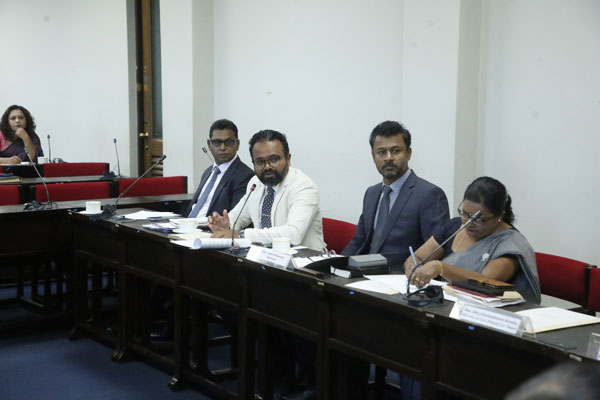
The Chairman of the Committee on Public Enterprises (COPE), Hon. Member of Parliament Dr Nishantha Samaraweera, has emphasized the importance of developing appropriate corporate and operational plans for State-Owned Enterprises (SOEs), identifying measurable Key Performance Indicators (KPIs) to assess their progress, and ensuring their effective implementation to enhance institutional performance.He made these remarks at a progress review workshop on the Key Performance Indicators outlined in the corporate and operational plans of 41 institutions, which had initially presented their corporate plans before the Third Sub-Committee of the Committee on Public Enterprises. The workshop was held recently at the Parliament.The Chairman also pointed out the need for public institutions to identify and act in accordance with their statutory powers and responsibilities to ensure the proper discharge of their functions, financial discipline and operational efficiency.He further stressed that, rather than focusing solely on past audit issues, it was important to assess the progress made in implementing corporate plans and evaluate whether the intended outcomes had been achieved through their implementation.The workshop was attended by Members of Parliament serving on the Committee on Public Enterprises; Auditor General Ms Samudika Jayaratne and audit officers of the National Audit Office; P. Ranasinghe and C. S. Mayadunne, Advisers to the Committee on Public Enterprises and the Committee on Public Accounts, respectively; officials from the Department of Management Audit, the Department of Public Enterprises and the Department of National Budget; as well as chief executive officers and chief financial officers of State-Owned Enterprises and other officials.