Handbook of Parliament
The System of Elections in Sri Lanka
How Parliament Works
Business of Parliament
Engage with your Parliament by logging in
2024-05-30
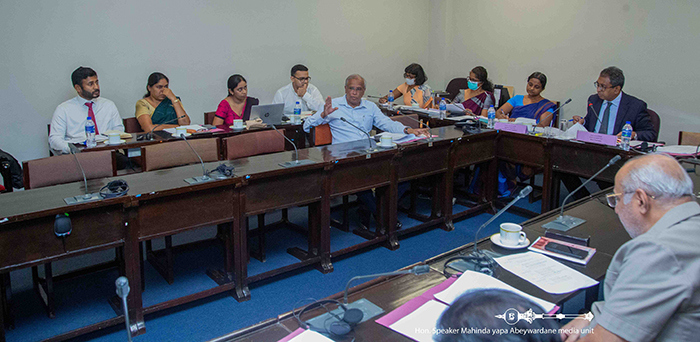
The Committee on Public Finance has directed the officials of the Welfare Benefits Board to give priority to the criteria that can be verified and determined in order to accurately identify poverty while selecting the beneficiaries. Drawing examples, the Committee pointed out that individual poverty can be identified better based on the electricity bill amount considering the electricity units consumed in each home.
The Committee pointed out that there are major problems and lack of formality in the criteria used in the selection of relief beneficiaries, and advised them to rectify it as soon as possible. The officials of the Ministry of Finance told the Committee that they will change the method of giving points that is currently used in the selection of relief beneficiaries.
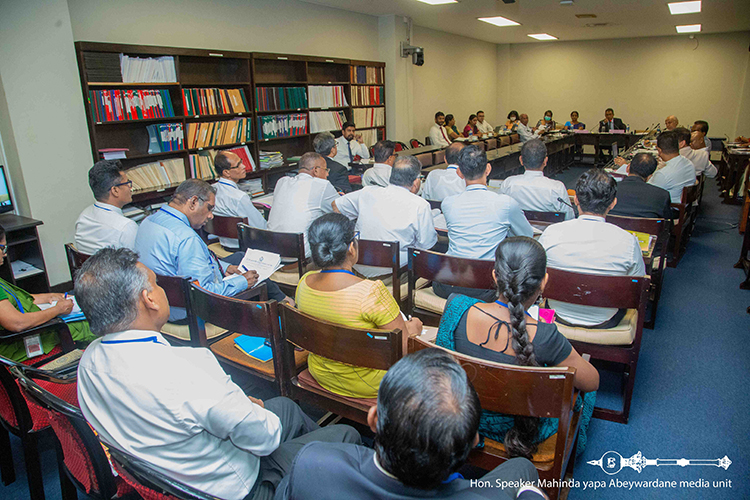
The matter was taken up for discussion when the Committee on Public Finance met in Parliament recently (May 28) under the chairmanship of Hon. (Dr.) Harsha de Silva.
Furthermore, the amendment to the regulations under section 27 of the Welfare Benefits Act No. 24 of 2002 published in the Extraordinary Gazette No. 2382/02 dated 29.04.2024 was considered before the Committee.
The members of the Committee pointed out the way in which huge corruption and irregularities take place through the manual recording of data by those people while selecting the beneficiaries. Accordingly, the Committee on Public Finance gave a recommendation to the Ministry of Finance officials to conduct the entire process from collecting necessary data to the selection of relief beneficiaries only via electronic means.
Furthermore, the displeasure of the Committee was expressed for not taking formal legal action for the irregularities that have arisen in relation to the selection of beneficiaries. The Committee pointed out that by not taking legal action, more and more corruption and irregularities will occur and it will create a serious obstacle for the right people to get the benefits. Accordingly, the Committee Chair instructed the officials to investigate the complaints received and take necessary legal measures for the same.
Furthermore, the order was reconsidered under Section 3 of the Port and Airport Development Tax Act No. 18 of 2011 published in the Extraordinary Gazette No. 2350-45 dated 21.9.2023. Milk powder prices and local milk powder market were discussed under this. The Chair emphasized the importance of introducing a price formula for milk powder based on a scientific method. Accordingly, the Chair also instructed the officials to introduce the HHI (Herfindahl-Hirschman index) index.
Members of Parliament Hon. Rauff Hakeem, Hon. Johnston Fernando, Hon. M. A. Sumanthiran, Hon. Mahindananda Aluthgamage, Hon. Nimal Lanza, Hon. Madhura Withanage, Hon. Mayantha Dissanayake, and other government officials were present at this Committee meeting held.

2026-11-06
The Parliamentary Caucus for Youth discussed how to strengthen engagement between young people and Parliament and advance future initiatives aimed at increasing youth participation.The Caucus met recently at Parliament under the chairmanship of, Hon. Deputy Minister Eranga Gunasekara, where members exchanged views on the matter.Discussions also focused on several proposals, including a proposal on youth entrepreneurship and industrial development prepared by Hon. Member of Parliament Oshani Umanga; a proposal on empowering youth within local government authorities, prepared by Hon. Member of Parliament, Attorney-at-Law Hiruni Wijesinghe; and a proposal on a policy framework for youth in the plantation and cultivation sectors, prepared by Hon. Member of Parliament Ambika Samivel.Furthermore, extensive discussions were held on proposals prepared by the Caucus's Deputy Co-Chairs, Hon. Members of Parliament Lasith Bashana Gamage, Thanura Dissanayake and Attorney-at-Law Bhagya Sri Herath, concerning an external youth engagement programme and a series of pilot workshops.It was also decided to further study these proposals, which could be implemented for the benefit of young people, and finalize them following further consideration.Several members of the Caucus and other invitees were present at the meeting.
2026-11-05
The Trusts (Amendment) Bill, which is scheduled to be taken up for its Second Reading in Parliament today (Nov. 05), has received the approval of the Sectoral Oversight Committee on Governance, Justice and Civil Protection.The Bill was discussed and approved when the Sectoral Oversight Committee on Governance, Justice and Civil Protection met yesterday (04) under the chairmanship of its Chair, Hon. Member of Parliament Dr. Najith Indika.The Bill, which seeks to amend the Trusts Ordinance (Chapter 87), was presented to Parliament for its First Reading on 21 October 2026 by the Hon. Minister of Justice and National Integration, Attorney-at-Law Harshana Nanayakkara.Officials from the Legal Draftsman’s Department and the Ministry of Justice briefed the Committee on the amendments proposed under the Bill.Hon. Members of Parliament Ajith P. Perera, President’s Counsel Faizer Mustapha, Major General (Retired) G. D. Sooriyabandara and Dharmapriya Wijesinghe, among others, attended the Committee meeting.
2026-11-04
A special national programme was successfully conducted islandwide on the 2nd of November, under the leadership of the Women Parliamentarians’ Caucus and the Ministry of Health, with the aim of promoting early detection of breast cancer, one of the most commonly reported cancers among women in Sri Lanka, and raising public awareness about the disease. Awareness and screening programmes were organized at several Medical Officer of Health (MOH) offices across the districts represented by women Members of Parliament. The programmes were attended by women Members of Parliament, including Hon. Minister Saroja Savithri Paulraj, Chairperson of the Women Parliamentarians’ Caucus.In Sri Lanka, approximately 17 women are diagnosed with breast cancer every day, with around 6,000 new cases reported annually. Furthermore, more than 1,000 deaths occur each year due to the disease, equivalent to approximately three lives lost every day.Breast cancer can be completely cured if detected at an early stage. However, delays in seeking medical treatment due to fear, embarrassment or a lack of awareness have been identified as major challenges.All women should become familiar with the normal appearance and feel of their breasts and carry out regular breast self-examinations. If any unusual changes are detected, it is important to seek medical advice without delay.Early detection increases the chances of successful treatment. The government healthcare system provides free screening and other essential healthcare services.In addition, all women are encouraged to attend the Well Woman Clinic and undergo the recommended Pap test at the ages of 35 and 45. This screening helps detect precancerous changes at an early stage, thereby supporting the prevention of cervical cancer.
2026-11-03
A special meeting of the Ministerial Consultative Committee on Education, Higher Education and Vocational Education was held recently at the Parliament Complex, chaired by the Hon. Prime Minister and Minister of Education, Higher Education and Vocational Education, Dr. Harini Amarasuriya, to brief Members of Parliament on the revised National Curriculum Framework and the new education reform process.The meeting was attended by Ministers, Deputy Ministers, Members of Parliament, officials including the Secretary to the Ministry of Education, as well as a number of experts in the education sector, including representatives of the National Institute of Education (NIE).Secretary to the Ministry of Education, Higher Education and Vocational Education, Mr. Nalaka Kaluwewa, stated that, in accordance with a Cabinet decision, a National Committee comprising subject experts had been appointed by April 2026 to oversee the education reforms. He further explained that five main subcommittees established under this committee would provide the necessary guidance and direction for the process.He also stated that, in accordance with the Cabinet decision, the new reforms are scheduled to be introduced for Grade 1 in 2026, and for Grades 6 and 2 in 2027. Preparations are currently underway, including teacher training programmes, the development of modules and printing of teacher guides, as well as plans to upgrade digital infrastructure in schools.During the meeting, Director General of the National Institute of Education, Professor O.G. Dayaratne, together with officials from the education sector, delivered a comprehensive presentation on the foundation of the new education reforms, the National Curriculum Framework, assessment methodologies and the proposed implementation plan.He explained that the process had commenced in 2019 and that the National Institute of Education had prepared the National Curriculum Framework in accordance with the new policy approved by the National Education Commission in 2023. He emphasized that the framework was the result of a collective effort involving several institutions. The Director General further stated that the country was introducing education reforms modelled on systems implemented in some of the world's most advanced countries.The Director General of the National Institute of Education emphasized that the fundamental objective of general education should not be limited to producing future workers to meet the demands of the labour market. Rather, it should focus on nurturing holistic and well-rounded citizens enriched with ethics, virtues and values, while developing a future generation capable of building the nation.A shift from the existing content-based education system to an outcome-based and student-centred approach is proposed under the reforms. He further explained that a new assessment framework had been developed to reduce the pressure of rote learning and examination-oriented education. Under this framework, students' progress will be evaluated through a credit-based modular system and continuous assessments conducted throughout the year.Flexible vocational pathways have also been developed to provide students with an understanding of different vocational fields from Grade 6 onwards. These pathways will enable students in Grades 12 and 13 to obtain vocational qualifications up to NVQ Level 4 or pursue higher education.A website named "RIES" has been launched to raise public awareness of the education reforms among the general public, teachers and parents. In addition, an island-wide awareness programme is being implemented in several phases.Addressing the meeting, the Hon. Prime Minister emphasized that the fundamental objective of education should not merely be to prepare children to become future members of the workforce, but also to nurture them into well-rounded individuals and responsible citizens who will contribute to nation-building.She also pointed out that decisions regarding challenges arising during the implementation of the reforms should not be based solely on personal perceptions or opinions. Instead, such decisions should be guided by scientific research and evidence.Members of Parliament who participated in the discussion raised questions and shared their views and proposals regarding the education reforms.It was further emphasized that the support and cooperation of all stakeholders, without any divisions or differences, were essential to the successful implementation of this important national undertaking.The meeting was also attended by Hon. Deputy Minister of Education and Higher Education Dr. Madhura Senevirathna, Hon. Deputy Minister of Vocational Education Nalin Hewage, Secretary General of Parliament Mrs. Kushani Rohanadeera, Director of Legislative Services Mr. Jayalath Perera, and several other officials.
Handbook of Parliament
The System of Elections in Sri Lanka
How Parliament Works
Business of Parliament
Copyright © The Parliament of Sri Lanka.
All Rights Reserved.
Design & Developed by TekGeeks