Watch

03

සි   |   த   |  

2022-12-09

News Categories : Committee News 

The regret of the National Council sub-committee regarding foreign funds not being used properly for the purchase of medicines

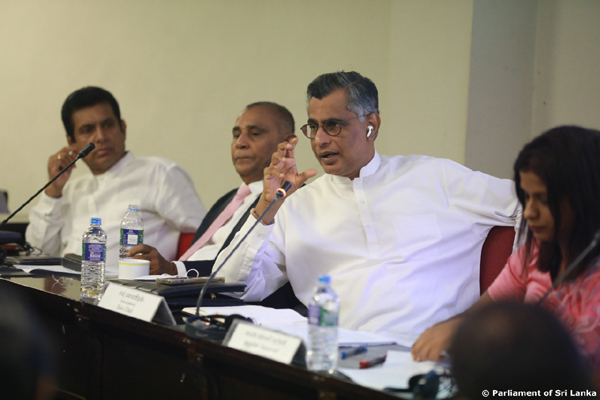
The chairman of National Council sub-committee on identifying short- and medium-term programs related to economic stabilization Hon. Patali Champika Ranawaka recently expressed his regret regarding the fact that the Government of India, the World Bank, the Asian Development Bank, and the Asian Infrastructure Development Bank had given funds to the Ministry of Health, but the government departments have not used it properly to purchase medicines.

However, he also mentioned that the quota given to the private sector under the credit facility has been properly utilized.   

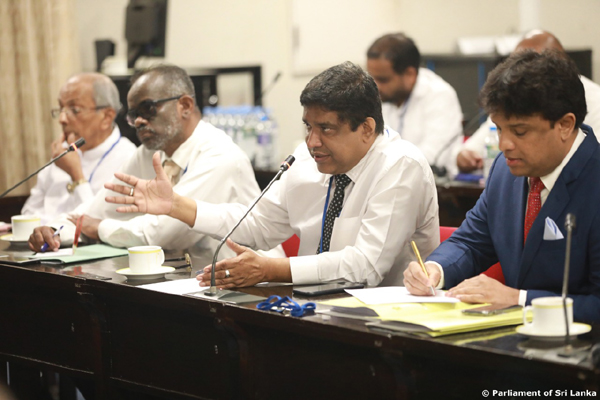
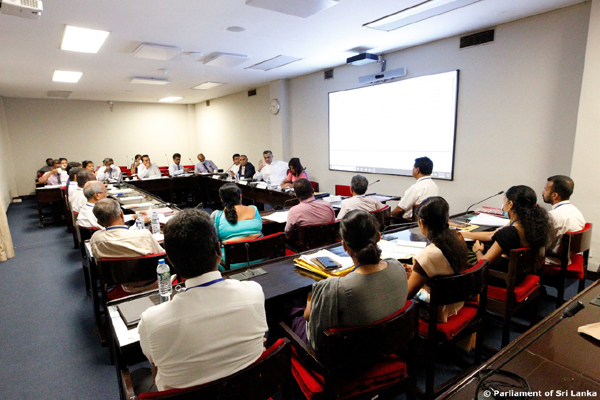
He said so when the National Council sub-committee on identifying short- and medium-term programs related to economic stabilization met recently with the aim of discussing the production of Western medicines and Ayurvedic medicines.

The officials of the health sector said that only 50 percent of essential medicines are currently available in this country. They also stated that 6 million dollars are spent annually to import the raw materials required for the production of local medicines. The committee pointed out that this import should be restricted and the efforts to produce the necessary raw materials locally should be encouraged.

Commenting on this, officials of the Medical Supplies Division stated that the amount of essential drugs to be ordered annually under the Indian Credit Line project has been ordered by April this year, and due to the nature of the project, there is some delay in receiving the drugs. In addition to international aid, treasury officials also said that rupees and dollar financial allocations will be provided from the treasury for the purchase of medicines.

A proposal was also presented here that if the State Pharmaceutical Manufacturing Corporation is able to supply the medicines required by the private sector, the country will be able to save some dollars.
Ayurveda department officials said that 130 herbal ingredients required for the production of local and Ayurvedic medicines are currently imported from countries like India and China and about 50 of them are not cultivated in Sri Lanka. They also stated that cultivation of the remaining 80 medicinal plants has been hindered due to land issues and other reasons. But the chairman of the committee pointed out that it is possible to believe that most of those 130 plants can be grown in Sri Lanka.

Also, there is a problem of collection of herbal medicines available in Sri Lanka, and as the reason, representatives of the Department of Ayurveda pointed out that there are obstacles in terms of growing and collecting plants due to forest conservation laws etc. Here, the committee chairman Hon. Patali Champika Ranawaka pointed out that there is a possibility of cultivating medicinal plants through a license system following discussions between the Department of Forest Conservation and the Department of Ayurveda. He also instructed the Department of Ayurveda officials to focus on preparing a drug collection program under the supervision of Forest Conservation Department officials.

Chairman of the Economic Stabilization Committee, emphasized that since the price of medicine has increased three times, great concern should be given to pensioners and the other senior citizens. If not, he pointed out that more damage than Covid pandemic could happen in the future.

Members of Parliament Hon. Ashok Abeysinghe, Hon. A. L. M. Ataullah, Hon. M. Rameswaram, representatives of the State Pharmaceutical Manufacturing Corporation, representatives of the Ministry of Health's Medical Supplies Division, representatives of the Department of Ayurveda, representatives of pharmaceutical companies were present at the meeting held.


 

1 2

3


Related News

2026-11-18

COPA Subcommittee Focuses on Developing a Mechanism to Repay Depositors Affected by Financial Crisis at Gampaha District SANASA Society

The Subcommittee appointed by the Committee on Public Accounts (COPA) to examine the crises in the cooperative sector discussed the financial irregularities at the Gampaha District SANASA Society and the difficulties faced in repaying depositors. The meeting was held at Parliament recently (Nov. 16th) under the chairmanship of Hon. Member of Parliament Ruwanthilaka Jayakody.During the meeting, the findings of the Auditor General’s report concerning management weaknesses at the Gampaha District SANASA Society were examined. Extensive discussions were held on the financial crisis arising from the investment of the Society’s funds in private companies without obtaining the required approval. It was revealed that these investments had resulted in the Society being unable to repay deposits made by both its members and external depositors.The Subcommittee also discussed weaknesses in the supervision and regulatory processes of the Department of Cooperatives, issues relating to the settlement of the Society’s assets, court-imposed injunctions, and the need to initiate legal action against the parties responsible.Special attention was given to exploring the possibility of assessing and selling the Society’s assets to facilitate the repayment of depositors. Discussions also focused on taking necessary steps to obtain the lifting of court orders restricting the disposal of assets and distributing the funds currently available among depositors on a fair basis.Furthermore, discussions were held on recovering surcharges from former members of the Board of Directors responsible for making unauthorized investments, initiating legal proceedings against the relevant private company, and completing unfinished projects to explore opportunities for generating revenue.The need to formulate a clear and practical mechanism to ensure the full repayment of depositors’ savings was emphasized during the meeting. Discussions were also held with officials of the Western Province and Gampaha District offices of the Department of Cooperative Development regarding the future measures to be taken.The Hon. Members of the Subcommittee,Attorney-at-Law Thushari Jayasinghe, T. K. Jayasundara and Susantha Kumara Nawaratne also attended the meeting.


2026-11-17

Parliamentary Sectoral Oversight Committee on Science, Technology and Digital Transformation Conducts Inspection Visit to Key Institutions

The Sectoral Oversight Committee on Science, Technology and Digital Transformation conducted inspection visits to several institutions operating under the Ministry of Science and Technology.Accordingly, the Committee visited the Sri Lanka Institute of Nanotechnology (Pvt) Ltd (SLINTEC) and the Sri Lanka Institute of Biotechnology (Pvt) Ltd (SLIBTEC) today (Nov. 17). The visits aimed to review the progress achieved by the respective institutions during 2025 and 2026, examine their proposed action plans for 2027, and observe the ongoing activities at their premises.The visits were conducted under the leadership of the Committee Chairman, Hon. Member of Parliament Dr. Janaka Senaratne. Hon. Members of Parliament Thanura Dissanayake, Lasith Bashana Gamage and Chathura Galappaththi also participated in the visits.


2026-11-17

Parliamentary Subcommittee Holds Further Discussions on Salary Anomalies and Amendments to Service Minutes Relating to Promotion from Teacher Service to Principal Service

Further discussions were held by a subcommittee appointed by the Sectoral Oversight Committee on Education, Manpower and Human Capital regarding salary anomalies arising when officers in the Teacher Service are promoted to the Principal Service.These matters were discussed at a recent meeting of the subcommittee, chaired by Hon. Member of Parliament Sunil Rajapaksha.Senior officials representing the Ministry of Education, Higher Education and Vocational Education; the Ministry of Finance, Planning and Economic Development; the Ministry of Public Administration, Provincial Councils and Local Government; and the Public Service Commission participated in the discussion.Extensive discussions were held on salary increment disparities and anomalies affecting officers in the Teacher Service when they are promoted to the Principal Service. It was pointed out that implementing salary revisions separately for individual services could create comparative disparities and complications in relation to other services across the wider public service.The subcommittee also held detailed discussions with officials on several other matters, including:amendments to the relevant service minutes and recruitment age limits, special allowances and transport facilities for principals, school classification and the filling of vacancies, the introduction of a formal transfer policy and renovation and improvement of official residential facilities for teachers and principals.Following further discussions on these matters, a final report containing recommendations is expected to be submitted to the Sectoral Oversight Committee.Hon. Members of Parliament Aboobucker Athambawa, Sugath Wasantha de Silva, Sujeewa Dissanayake and Chanaka Madugoda also attended the meeting.


2026-11-16

Sectoral Oversight Committee Focuses on Exploring Innovative Technological and Practical Solutions to Mitigate Human-Elephant Conflict and Enhance Elephant Conservation

The Sectoral Oversight Committee on Environment, Agriculture and Resource Sustainability met recently (Nov. 13) at Parliament, under the chairmanship of Hon. Hector Appuhamy, Member of Parliament.During the meeting, extensive discussions were held on managing human-elephant conflict, identifying the migratory patterns of wild elephants, and utilizing new technologies for elephant conservation. The death of the elephant Kawanthissa was also discussed.The loss of elephant habitats, obstruction of traditional elephant corridors, and the movement of elephants into human settlements and agricultural lands in search of food were identified as some of the key factors contributing to the escalation of human-elephant conflict. The importance of using GPS and satellite collar technology to identify and monitor elephant migration patterns was also emphasized.Several proposals were discussed to mitigate human-elephant conflict, including establishing joint committees at the local level involving wildlife officers, Grama Niladharis and community members, strengthening community participation, and implementing early warning communication networks.The challenges faced by wildlife veterinary surgeons in treating sick and injured elephants were also discussed. Attention was drawn to the services provided by veterinary officers of the Department of Wildlife Conservation, the risks involved in anaesthetizing elephants, and the need for essential technical equipment and facilities, such as mobile veterinary units and portable X-ray machines, to provide treatment in the field.Hon. Members of Parliament Kings Nelson, Upul Kithsiri, Attorney-at-Law M. A. C. S. Chathuri Gangani, Sudath Balagalla, Kitnan Selvaraj and Attorney-at-Law Bhagya Sri Herath were also present at the meeting.


Copyright © The Parliament of Sri Lanka.

All Rights Reserved.

Design & Developed by  TekGeeks