Handbook of Parliament
The System of Elections in Sri Lanka
How Parliament Works
Business of Parliament
Engage with your Parliament by logging in
2021-12-02
News Categories : Committee News
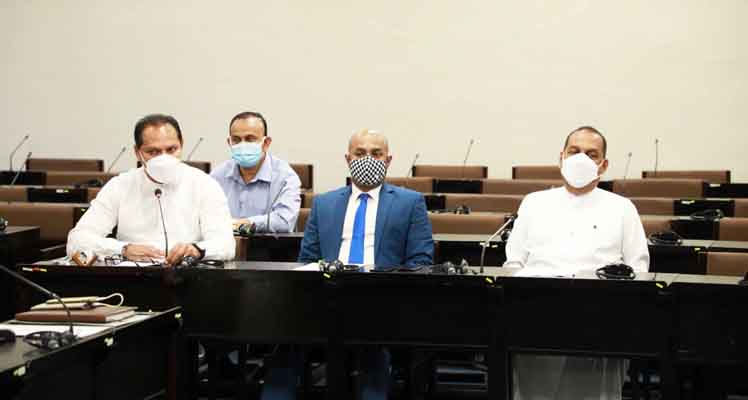
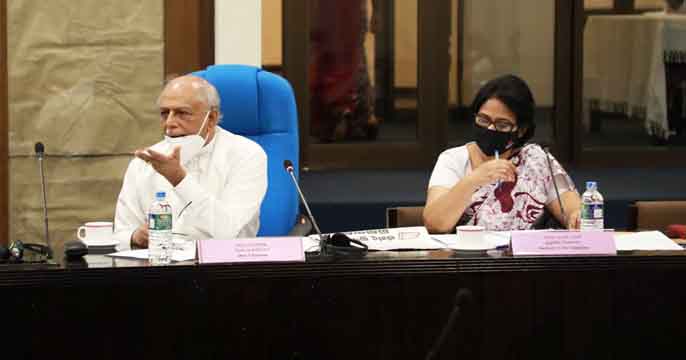
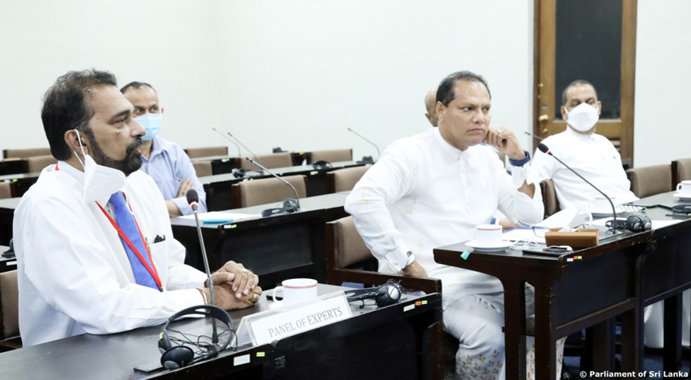
The Sri Lanka Freedom Party (SLFP) suggests that it would be appropriate to hold the Provincial Council elections expeditiously, under the former election system the least limited to this particular election alone. The suggestion was made at the Select Committee of Parliament to Identify Appropriate Reforms of the Election Laws and the Electoral System and to Recommend Necessary Amendments held today (02).
Hon. State Minister Dayasiri Jayasekara who testifying on behalf of the party at the committee stated that many problems have risen due to postponing of the provincial council elections for a long time. He stated that his party was of the view that the provincial council elections should be held immediately. Furthermore, local government elections should be held in the first quarter of next year. The number of local government representatives should be limited to a maximum of 5500, he said.
Hon. Minister Mahinda Amaraweera stated at the committee that it is not appropriate to extend the term of local government bodies. The Hon. Minister also pointed out that the public opinion is that the number of seats in local government bodies should be reduced.
Hon. Minister Nimal Siripala de Silva explained that after the announcement of the Local Government Elections, the powers of those institutions should be transferred to a commissioner until the election is held and the new members are sworn in.
The Leader of the House, Hon. Minister Dinesh Gunawardena stated that the Attorney General is of the view that the Provincial Council elections cannot be held under the existing law and that the necessary legal provisions should be brought for the purpose of the stated. He also stated that the general opinion of the Committee is that the Provincial Council elections should be held expeditiously.
The SLFP proposed to the committee that the number of members to be elected from the divisions should be 60 percent and the number of members to be elected proportionally should be 40 percent when the electoral system is amended.
Necessary legal provisions should be made to limit election expenses. H.E the President Gotabaya Rajapaksa’s presentation of a Cabinet Memorandum on Limiting Election Expenditure is commendable. The party also said that women's representation at all levels should be 25 percent of the total number of candidates.
Furthermore, the conduct of media during election period should be regulated. The SLFP also emphasized the importance of regulating social media behaviour.
Professor Sudantha Liyanage, Vice Chancellor of the University of Sri Jayewardenepura, Chairman of the Expert Committee on the analysis of appropriate reforms of the election laws and the electoral system and to recommend necessary amendments stated if the new electoral system is adjusted to the 70:30 ratio, the existing number of seats in local government bodies could be reduced by 1,500.
He also pointed out the need to revise the electoral system so that the winning political party in the local government area gets two bonus seats.
The Secretary to the Select Committee, Deputy Secretary General & Chief of Staff of Parliament Ms. Kushani Rohanadheera stated that the next meeting of the Parliamentary Select Committee will be held on the 07th.
Hon. State Ministers Lasantha Alagiyawanna and Duminda Dissanayake also represented the SLFP at the committee meeting. Hon. Members of Parliament M. A. Sumanthiran, Madhura Withanage and Sagara Kariyawasam were also present as members of the Committee.
Officials representing the Election Commission and the Attorney General's Department were also present.

2026-03-06
The Third District Consultation aimed at strengthening inclusive service delivery for persons with disabilities was recently (Feb. 27) held in Batticaloa District. The event was organized by the Parliamentary Caucus for Persons with Disabilities of the Tenth Parliament and convened at the Batticaloa Municipal Council Hall . The consultation was held under the patronage of the Chair of the Caucus, Hon. Member of Parliament Sugath Wasantha de Silva and Batticaloa District Secretary J.S. Arulraj. The event was attended by the Deputy Co-Chairman, Hon. Member of Parliament (Dr.) Pathmanathan Sathyalingam, as well as Members of Parliament representing the Batticaloa District Shanakyan Rajaputhiran Rajamanickam, (Dr.) Ilayathambi Sirinath, Gnanamuthu Srinesan, and Kanthasamy Prabu. Senior government officials including Assistant District Secretary G. Praveen, District Social Service Officer Chandrakala Gnaneswaran, police officers, sectoral experts, and social development officers participated in the discussions. The representatives of the organizations of person with disabilities of Batticaloa districts were also participated in this event. The urgency of the consultation was underscored by the statistics indicating that more than 9,000 persons with disabilities reside in Batticaloa District, supported by 14 active associations. District Secretary J. S. Arulraj highlighted critical service gaps, including the immediate need for 21 trained teachers across 23 special education units currently serving 183 students. He also raised concerns regarding the issuance of formal identification cards for persons with disabilities, difficulties in obtaining driving licences, and widespread accessibility barriers in public buildings.In his address, Hon. Sugath Wasantha de Silva emphasized that the consultation represented a unified, non-partisan effort to foster a compassionate and inclusive society. He stated that services for persons with disabilities must be delivered on the basis of humanity and equality. He further announced that the Caucus plans to engage with the Ministry of Education in March to address systemic barriers in qualifying examinations for government employment. He called upon government officials and political leaders to collaborate with dedication to resolve longstanding challenges faced by persons with disabilities.Deputy Co-Chairman (Dr.) Pathmanathan Sathyalingam stressed the importance of identifying and supporting persons with disabilities in Batticaloa who have not yet received assistance. He highlighted the need for coordinated action through relevant institutions to ensure adequate facilities and services, particularly for individuals affected by conflict and other causes of disability.Members of Parliament representing the district drew attention to persistent shortcomings in service delivery and the practical challenges faced by persons with disabilities in their daily lives. The participants from disability community raised several concerns, including extending deadlines for educational allowances; adapting competitive examinations for visually impaired candidates through Braille-based alternatives; providing priority access in hospitals to reduce waiting times; ensuring that reserved seating on public transportation is respected; and improving accessibility at local government offices, where meetings are often held on upper floors without ramps or elevators.While some matters were addressed immediately through directives issued to relevant officials, others were referred to district authorities and the Parliamentary Caucus for longer-term policy reform, reflecting a commitment to sustainable and systemic change.The Chair of the Caucus reaffirmed that the Union remains committed to conducting district-level visits nationwide to listen directly to the concerns of persons with disabilities and to proposing practical, policy-driven solutions to ensure inclusive governance across Sri Lanka.The event was organized collaboratively by the International Foundation for Electoral Systems (IFES), with funding support from the Government of Australia, in partnership with the Batticaloa District Secretariat.
2026-02-24
The Committee on High Posts of Parliament has approved the nominations of two Heads of Mission and a Ministry Secretary.The approvals were granted when the Committee met in Parliament recently (Feb. 20) under the chairmanship of Prime Minister Dr. Harini Amarasuriya.Accordingly, the Committee approved the nomination of Mrs. Nirmala Indumathie Dias Paranavitana as Ambassador of Sri Lanka to the Federal Democratic Republic of Ethiopia and Permanent Representative of Sri Lanka to the African Union.The Committee also approved the nomination of Professor Mohamed Ibrahim Fazeeha Azmi as the new Ambassador of Sri Lanka to the Islamic Republic of Iran.In addition, approval was granted for the appointment of Mr. K.A. Vimalenthirarajah as the Secretary to the Ministry of Trade, Commerce, Food Security and Cooperative Development.
2026-02-24
Committee reviews progress of disaster relief provided to the public affected by Cyclone DitwahAttention drawn to disaster management insuranceReview of the current progress of the Public Debt Management Office (PDMO) programmesThe Committee on Public Finance instructed officials to establish a legal framework for the Rs. 200 daily attendance allowance granted by the Government to estate workers.Clarifying matters at length, the Chairman of the Committee emphasized that the Committee has no objection to increasing the wages of estate workers. However, he stated that the legal basis of the mechanism used to make this payment must be discussed. It was pointed out that the payment is currently being made under a Memorandum of Understanding (MoU) entered into with private plantation companies, without being gazetted, and that such an arrangement could be terminated at any time. Officials further noted that the Rs. 200 allowance does not qualify for contributions to the Employees’ Provident Fund (EPF).Officials informed the Committee that the MoU has been entered into with private plantation companies for a period of three years, and that once this period ends, a policy decision would be required if the Government intends to continue the payments.The Committee Chair pointed out that it is inappropriate to utilize public funds to pay salaries in private institutions without proper financial discipline. Officials stated that the payment is being made as it has been approved by Parliament under the 2026 Budget.According to the approved budget estimates, the allocation for this payment is categorized as a “development subsidy.” As development subsidies are generally intended to support increased production, the Deputy Secretary to the Treasury (DST) suggested that the payment would be more appropriately termed a “production incentive.” However, it was observed that neither the payments already made for January nor the relevant MoUs specify such a requirement in practice. The Committee also questioned whether excluding the Rs. 200 daily allowance from Employees’ Provident Fund (EPF) and Employees’ Trust Fund (ETF) calculations is in compliance with the relevant laws. When asked whether the Attorney General’s advice had been sought regarding the MoUs and related matters, officials stated that such advice had not been obtained.Accordingly, the Committee emphasized that these problematic areas must be rectified and that a proper legal basis should be established for the payment.These matters were discussed when the Committee on Public Finance met in Parliament on 17.02.2026 under the chairmanship of Hon. Member of Parliament Dr. Harsha de Silva, with the participation of Hon. Deputy Ministers Chathuranga Abeysinghe and Nishantha Jayaweera and Hon. Members of Parliament Ravi Karunanayake, Ajith Alahakoon, M.K.M. Aslam, Attorney-at-Law Chitral Fernando, Wijesiri Basnayake, Sunil Rajapaksha, Nimal Palihena, Thilina Samarakoon and Champika Hettiarachchi.The Committee also discussed the progress of disaster relief provided to the public affected by Cyclone Ditwah. Officials stated that approximately Rs. 24.4 billion has so far been released under various relief measures announced for those affected. While the majority of allowances for house cleaning, purchase of household items, and assistance for schoolchildren have already been distributed, officials explained that delays in housing reconstruction and rental assistance payments have occurred due to processes such as damage assessments and land identification. Officials further clarified the verification procedures and accountability mechanisms in place. Committee members highlighted the difficulties faced by those expecting relief payments and stressed that housing assistance in particular should be expedited.Officials of the National Insurance Trust Fund (NITF) also explained their financial position and the reinsurance claims the Fund is required to settle following claims submitted by general insurance companies after Cyclone Ditwah. The estimated reinsurance claims payable by NITF currently amount to approximately Rs. 11 billion. Although NITF has not reinsured its risk exposure with an international reinsurer since 2023, officials stated that it has the capacity to settle the existing claims.It was revealed that the Treasury maintains a significant cash buffer to meet the Government’s daily expenditure requirements, with approximately Rs. 750 billion available by the end of 2025. Due to payments made in December, the cash buffer had declined to this level, leading to increased issuance of Treasury bills from late December to mid-January, which in turn raised interest costs during that period. However, the situation has now stabilized. It was also noted that as the return earned from investing the cash buffer is approximately 2–3 percent lower than the Government’s annual interest cost, maintaining such reserves entails an opportunity cost.Attention was also drawn to the progress of the Public Debt Management Office (PDMO), which has been in operation for 14 months. It was observed that 90 percent of total staff recruitment has been completed. Officials have been provided with specialized local and international training to enhance professional capacity.Although the Central Bank’s auction system is currently used for public debt management activities, steps are being taken to establish an independent system within the PDMO to enable full operational autonomy in the future.The Committee observed that Sri Lanka’s total domestic debt stock amounts to Rs. 31 trillion, comprising Rs. 15.6 trillion in Treasury bills and Rs. 15.4 trillion in Treasury bonds. The average cost of this total debt is reported at 8.73 percent.It was further noted that Sri Lanka’s total external debt servicing requirement for 2026 is projected at USD 2,504 million. Expected foreign inflows for that year amount to USD 2,100 million, including USD 858 million in project loans, USD 150 million in World Bank budget support, USD 380 million from the Asian Development Bank (ADB), and USD 800 million from the International Monetary Fund (IMF).Accordingly, a resource management gap exceeding USD 400 million remains to be addressed for debt servicing in 2026.
2026-02-24
The Parliamentary Sub-Committee on Energy met in Parliament on 18.02.2026 under the Chairmanship of Hon. Member of Parliament Ajith P. Perera. During the meeting, several matters relating to the energy sector were discussed.Accordingly, attention was drawn to Demand Side Management (DSM) of electricity, the current progress of the Kerawalapitiya Power Plant, future sustainability plans of LTL Holdings (Pvt) Ltd and Lanka Electricity Company (Pvt) Ltd, the “Soorya Bala Sangramaya” programme, and the promotion of hydrogen as an energy source.This Sub-Committee convenes as a body appointed by the Sectoral Oversight Committee on Infrastructure and Strategic Development, chaired by Hon. Member of Parliament S. M. Marikkar.
Handbook of Parliament
The System of Elections in Sri Lanka
How Parliament Works
Business of Parliament
Copyright © The Parliament of Sri Lanka.
All Rights Reserved.
Design & Developed by TekGeeks