
2020-01-06
News Categories : News
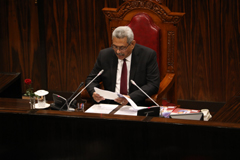 Placing National Security at the utmost high, H.E the President Gotabhaya Rajapaka stated that he has already taken necessary steps to strengthen the national security apparatus during his tenure.
Furthermore, H.E the President Gotabhaya Rajapaksa said that coordination between the Armed Forces and the Police, who are collectively responsible for maintaining national security and the network of national intelligence agencies has been recognized and strengthened to make our motherland a safe country free of terrorism, extremism, underworld activities, theft and robbery, extortionists, the drug menace, disruptors of public order and the abuse of women and children.
He stated the above while addressing the 4th session of the 8th Parliament today, 03rd of January 2020 at the Parliament Complex.
Full text of the speech:
I have this opportunity to address you as the Head of State of the Democratic Socialist Republic of Sri Lanka consequent to the historic victory granted to me by the people of this country on the 16th of November.
I express my gratitude to all citizens, institutions and all political parties who were committed to a peaceful, free and fair election.
Irrespective of the political party you, the Honourable members in this august Assembly belong to, together all of us have as our prime responsibility to work for the betterment of the people of this country.
I have served this nation as an Army Officer for twenty years, and as Secretary of Defence for nearly another ten years.
Even though I was not actively engaged in politics, I have experienced what service to the people is, from an early age.
My father’s elder brother, D. M. Rajapaksa, began his political journey in the State Council in 1936, representing the Hambantota electorate. After his demise in 1945, the people of Hambantota elected my father, D. A. Rajapaksa, to the State Council. Later, he was elected through the popular vote as a Member of the country’s first Parliament.
From that time until now, many members of the Rajapaksa family, hailing from the rural village of Medamulana in Giruvapaththuwa, Ruhuna, have served as elected public representatives. There have not only been Members of Parliament, Deputy Ministers, Cabinet Ministers, a Deputy Speaker of Parliament, a Speaker of Parliament, a Leader of the Opposition and a Prime Minister, but also two Presidents elected to office by the people, who reposed their trust in us.
From the first day the honourable D. M. Rajapaksa, known as the Lion of Ruhuna, appeared in the State Council, he wore a maroon coloured shawl.
What he symbolized through this maroon shawl were the millet farmers of Giruvapaththuwa.
Following D. M. Rajapaksa, my father D. A. Rajapaksa and each member of the Rajapaksa family who was elected to Parliament wore the maroon shawl.
Even though I do not wear this shawl, I stand for the same profound philosophy of constant dedication to the poor that is symbolized by the maroon shawl.
It is this same philosophy that is embodied in the Policy Statement I presented during my Presidential election campaign.
Honourable Speaker, I now take this opportunity to table the “Visions of Prosperity and Splendour” Policy Statement.
The people of this country gave me a clear mandate at the Presidential election held on 16th November 2019. That mandate was granted because of the trust the people had in me. I, together with my Government, stand committed to honour the trust of the people and implement the programme of developing a prosperous nation that we promised to them.
The people who elected me to office desired a profound change in the political culture of this country. They rejected political agendas founded on race. The majority of the people proved that it is no longer possible for anyone to manipulate and control the politics of this country by playing the role of king maker.
I invite the politicians concerned to understand this reality. I call upon all to join together in the national undertaking to develop this country, and to reject the politics based on petty agendas that have sown division in our society in the past.
We must always respect the aspirations of the majority of the people. It is only then that the sovereignty of the people will be safeguarded.
In accordance with our Constitution, I pledge that during my term of office, I will always defend the unitary status of our country, and protect and nurture the Buddha Sasana whilst safeguarding the right of all citizens to practice a religion of their choice.
I remember my father being at this Parliament, during my childhood. I often used to watch Parliamentary proceedings from the public gallery. The Parliament we had then was exemplary. The discourse that took place in it was of great importance. The debates were replete with logic and rich arguments. School children and adults were eager to come to Parliament to listen to those debates. Members of Parliament always behaved in a way that upheld the dignity of the Parliament and the office they held. The people then had great respect for the Parliament. They respected people’s representatives. Unfortunately, latterly, that respect gradually waned.
This Parliament should once again become an exemplary institution where the real issues of the people are discussed, where matters concerned with national policy are subjected to debate, and where the responsibilities of the legislature are duly fulfilled. The responsibility of ensuring that the Parliament once again becomes an institution winning the respect of the people lies with the Members who are in this House.
There is a social, economic and political crisis in the country today. Even after 70 years of Independence, we cannot be satisfied with the country’s development. We all have a responsibility to change this situation. We must be prepared to make the sacrifices required for this.
The primary responsibility of a people’s representative is service to the people. We should all remember that the offices we hold are not privileges, but responsibilities.
To develop the country, the right vision and plans are needed. The Policy statement, “Vistas of Prosperity and Splendour”, placed before the people at the Presidential Election by me contains a national programme that was crafted during a period of nearly four years by incorporating my vision with the ideas and recommendations of national organisations such as Viyathmaga, the findings of the “Conversation with the Village” programme conducted by the Sri Lanka Podujana Peramuna, the discussions held with other political parties, and the ideas contributed by the general public.
In accordance with that programme, we have already taken several steps including the easing of taxes that were unduly burdening the public, introducing a high degree of transparency and efficiency to the government administration, and curtailing unnecessary government expenditure.
In our policy, National Security occupies the foremost place.
We have already taken steps to strengthen the national security apparatus. Talented officers have been given appropriate responsibilities again. We have taken steps to ensure proper coordination between the Armed Forces and the Police, who are collectively responsible for maintaining national security. The network of national intelligence agencies has been reorganized and strengthened.
We will take all necessary steps to make our motherland a safe country free of terrorism, extremism, underworld activities, theft and robbery, extortionists, the drug menace, disruptions of public order, and the abuse of women and children.
Our primary purpose is to create a productive citizen, a happy family, a disciplined society and a prosperous nation.
The Government must take the initiative to make every healthy citizen of employable age a useful and productive citizen. What we need is for all of them to contribute to the nation’s economy.
We must ensure that the benefits of development reach every group of people. We must employ modern methodologies and indicators to gauge whether the needs of the people are truly being met, and whether they are happy. It is no longer necessary to wait for elections to find out how people feel about the work programme of the Government.
We need everyone’s support for our efforts to reduce the cost of living of the people. The corporate sector must ensure that some percentage of the benefits of the tax concessions recently provided to them are passed onto the public as well. Accordingly, we expect a reduction in the price of all goods and services on which taxes have been reduced.
Eliminating poverty is a priority of our Government. We must understand the causes of poverty and find solutions to eliminate such causes. We will be able to alleviate poverty by finding practical approaches to issues such as the lack of proper education or skills, the lack of land for cultivation, or the lack of capital for self-employment.
We have made plans to find employment opportunities for 100,000 young men and women from low income families within the next month. My government is prepared to present practical solutions to resolve unemployment, with the public sector and the private sector working together.
One of our main themes during the last election was the development of a virtuous, law abiding and disciplined society. The public has given us a mandate for this purpose.
Ours is a country with an ancient history, and a society nurtured by Buddhist teachings and the teachings of other world faiths. We must always safeguard our culture and our values.
Our target is to make Sri Lanka a developed country. It must be a sovereign, independent nation. Also, it must be a safe, and a peaceful country. Sri Lanka will be a prosperous nation only when all of these are achieved.
We have introduced a people-centric economic policy through the “Vistas of Prosperity and Splendour” manifesto.
Its main aims are to ensure economic stability for all citizens, provide equal opportunities to all who seek to improve themselves, to establish a clean and efficient state sector that is committed to public service, and to protect and empower local entrepreneurs.
In order to successfully establish a people-centric economy it is important that every official from the highest to the lowest level of government becomes aware of our vision and aims. That will enable them to perform their duties more productively.
We must also implement a special programme to combat corruption and fraud. Legal action must be taken promptly against all who engage in corrupt practices, irrespective of their status.
Today, most countries have employed technology as a means of enhancing the efficiency of the state sector. Through this, it will also be possible to provide equal opportunities for all. As such, we will pay special attention to increasing the use of technology in government institutions.
We must plan for the future, based on the geographic location, natural resources and human resources of our country.
Sri Lanka has been an international trading hub for merchants from Greece, Rome, Arabia, China and various other nations for thousands of years. One of the main reasons for Sri Lanka’s renowned standing was our country’s unique location in the ocean connecting the east and west. We can benefit from this advantage in the same way today.
During the period from 2005 to 2014, the government of President Mahinda Rajapaksa planned to develop Sri Lanka into the commercial hub of South Asia.
The Mattala Airport was built adjacent to the Hambantota Port with the aim of establishing an industrial city in the south.
The decision to develop the Colombo Port City was taken with the aim of making Sri Lanka a hub for finance and commerce in Asia. We must carry forward these projects that were designed according to achieve long term objectives.
If we work according to a proper plan, we will be able to encourage international businesses to locate themselves in Sri Lanka and supply goods and services to regional neigbouring countries. To encourage such investors, we must be prepared to swiftly provide all the facilities they require within Sri Lanka.
For economic development to occur, it is important that we accelerate improvements to the road network, including the expressways, so that travel from any one part of the country to another in a few hours becomes possible. The development of the train service is an integral part of this programme. We can also help alleviate the grave problem of heavy road congestion through an efficient and comfortable train service.
Urbanization brings both good and bad results to a country. We need a restructuring programme to ensure that the benefits of development reach every region of the country. This will help us reduce congestion, pollution and the cost of living. People dispersed throughout Sri Lanka should have access to facilities for education and healthcare, and opportunities for employment, within their own area. The development of the roads and rail network together with the provision of high-speed internet and telecommunication facilities throughout the country is essential for this.
The cost of electricity is an important factor in economic development. It particularly affects the attracting of investors to the industry sector. We need short-term and long-term solutions to generate power at a reasonable price. In looking at long term solutions, our principle is to pay special attention to the use of eco-friendly renewable energy sources such as solar, wind and hydro-power.
Although our country is rich in gem and mineral resources, relevant value-added industries have not yet developed to international standards. Each year, the country is deprived of significant foreign exchange earnings through the export of these natural resources without value addition. We should establish a world class marketplace in which gems from not only Sri Lanka but even from African nations can be sold after value addition.
While we should provide new technological facilities for conducting oceanic and geological surveys, we must provide special incentives to encourage investments in industries that will provide value addition to Sri Lanka’s mineral resources.
We will not allow various laws, permits and restrictions to impose unnecessary and unfair limitations on some of Sri Lanka’s traditional livelihoods, including the gem industry, tile industry, brick industry, carpentry and handicrafts.
When planning for the future, more attention than at present must be given to the agriculture, plantation and fisheries sectors. As a country that possesses a large oceanic economic zone in temperate waters, we can develop these industries much further.
We need to increase earnings from agricultural produce such as spices, fruits, vegetables, grains, meat and fish, for which there is export potential.
One third of the country’s population is engaged in agriculture, plantation industries and the fisheries sector. We must raise their standard of living.
There is a need for new technology-based approaches that can develop these industries beyond traditional farming methods.
Encouraging the production of food free of pesticides and chemicals, by increasing the use of organic fertilizer for agriculture is part of our policy. We must prepare plans to encourage Sri Lanka’s entire agriculture sector to shift to using only organic fertilizer within the next decade. Increasing domestic production of organic fertilizer should be included in these plans.
The problems that had been caused to growers of export-oriented crops through the allowing of unlimited re-exports were addressed by the new
2026-08-28
A 25-member delegation of parliamentary officials from Sri Lanka, representing all nine departments in the Parliament of Sri Lanka, is participating in Capacity Building Programme at the Lok Sabha Secretariat in New Delhi.This Capacity-Building Programme was initiated through the High Commission of India in Sri Lanka at the request of Ms. Kushani Anusha Rohanadeera, Secretary-General of the Parliament of Sri Lanka. Subsequently, under the direction of Shri Om Birla, Speaker of the Lok Sabha, Shri Utpal Kumar Singh, Secretary-General of the Lok Sabha Secretariat, arranged and facilitated the programme. As a result of this collaboration, 50 parliamentary officials from the Parliament of Sri Lanka were given the opportunity to participate in the programme.The first batch of 25 Sri Lankan parliamentary officials participated in the programme in India last month. The delegation was accompanied by Mr. Hansa Abeyrathne, Assistant Secretary-General of the Parliament of Sri Lanka. Following this, the second batch of 25 Sri Lankan parliamentary officials, led by Ms. Kushani Anusha Rohanadeera, Secretary-General of the Parliament of Sri Lanka, is currently in the programme in New Delhi.Both programmes were conducted by the Parliamentary Research and Training Institute for Democracies (PRIDE) of the Lok Sabha Secretariat, with the objective of strengthening the professional knowledge, skills and institutional capacities of parliamentary officials.The visiting officials were warmly received by senior officials of the Lok Sabha Secretariat upon their arrival at the VIP terminal of Indira Gandhi International Airport, New Delhi.As part of their visit, the Sri Lankan parliamentary officials paid floral tribute to Mahatma Gandhi at Prerna Sthal in the Parliament House Complex before the commencement of their programme.The capacity-building sessions cover a wide range of subjects related to parliamentary administration and functioning. These include international parliamentary relations and protocol, executive accountability to Parliament and the role and functions of parliamentary committees, the organisational structure of the Lok Sabha Secretariat, and the functioning of its Administration Branch.The programme also provides participants with an opportunity to learn about the functioning and management of committee secretariats and branches, parliamentary privileges and ethics, and services provided to Members of Parliament, including members’ services, allowances and welfare.Other key areas covered include preparation of the Secretariat’s budget, the functions of the Integrated Finance Unit (IFU) and Budget and Budgetary (B&B) branches, and the role and powers of presiding officers in legislatures.The delegation visited the Parliament House to observe the Lok Sabha and Rajya Sabha Chambers and the Central Hall of Samvidhan Sadan. Visit to the Parliament Library Building are also included in the programme, provided the officials with an opportunity to familiarise themselves with India’s parliamentary infrastructure and support services.In addition to the academic and institutional sessions, the programme also included a cultural visit to Agra. The programme forms part of ongoing parliamentary cooperation and capacity-building initiatives between India and Sri Lanka, providing officials from the two institutions with opportunities to exchange experiences and gain a deeper understanding of parliamentary procedures, administration and democratic institutions.Senior officials of the Parliament of Sri Lanka, led by Ms. Kushani Anusha Rohanadeera, Secretary-General of the Parliament of Sri Lanka, met with Shri Utpal Kumar Singh, Secretary-General of the Lok Sabha Secretariat, in New Delhi and engaged in a cordial and fruitful discussion. During the meeting, Ms. Rohanadeera expressed her sincere appreciation to Shri Utpal Kumar Singh for arranging and facilitating the Capacity-Building Programme for Sri Lankan parliamentary officials and for the support extended towards its successful implementation.In addition, the Secretary-General and a group of officials representing the Department of Communications of the Parliament of Sri Lanka also observed the operations of “Sansad TV,” the official television channel of the Indian legislature.The continuation of the programme through successive batches highlights the growing institutional engagement between the Parliament of Sri Lanka and the Lok Sabha Secretariat and contributes to the sharing of parliamentary expertise and best practices between the two countries.
2026-08-21
The Supplementary Estimate to provide Rs. 7500 million required by the Government to purchase paddy from the 2026 Yala season was approved by Parliament today (Aug. 21). The debate on the Supplementary Estimate was held from 11:30 a.m. to 12:30 p.m.The Supplementary Estimate was presented to allocate Rs. 7500 million from the funds allocated for projects/programmes of the Ministry of Agriculture, Livestock, Land and Irrigation for 2026, which are expected to remain unutilized during the year, for the purchase of paddy.
2026-08-21
A minute of silence observed in the Chamber to express condolencesParliament today (Aug. 21) expressed its condolences to the late veteran singer Dr. Nanda Malini, recalling her immense contribution to Sri Lankan music and society. Accordingly, a minute of silence was observed in the Chamber following a request by Hon. Prime Minister Harini Amarasuriya.Speaking thereafter, the Prime Minister said she was deeply saddened to hear of the passing of Dr. Nanda Malini, who was revered as the “golden voice” of Sri Lankan music and who, through her distinctive singing career spanning more than eight decades, enriched the country’s music and culture.The Prime Minister further stated that, as an admirer who had listened to Nanda Malini’s many songs and experienced different moments of life accompanied by those songs, her passing was not merely the loss of an unparalleled artistic personality in Sri Lankan music. It was also the departure of a familiar voice that had been closely connected to our lives and memories, and that had been with us through moments of both happiness and sorrow.She noted that Nanda Malini’s songs were deeply connected to the experiences of generations, and that the memories associated with her beautiful voice are felt even more strongly following her passing. The Prime Minister said that Nanda Malini’s singing career represented not only an era in Sri Lankan music, but also a living expression of the lives of the people, social movements and human emotions of the country.Going beyond singing about human emotions such as love and separation, Nanda Malini gave voice through her songs to the sorrow, fear, hopes and struggles of ordinary people, the Prime Minister recalled. That was why, when listening to her songs, people heard not merely the voice of a singer, but the voice of their own society.The Prime Minister said that, at this moment of mourning Nanda Malini’s passing, she was remembering not only an incomparable artist who had been lost to Sri Lankan music, but also a beloved voice that was connected to many memories in the lives of the people. She also noted that although the voice that had accompanied the people for decades has now fallen silent, the songs she sang would continue to live on in their memories and hearts. She expressed her deepest condolences to Nanda Malini’s two daughters and all members of her family, as well as to the people of Sri Lanka who loved her singing voice.Speaking on the occasion, Hon. Opposition Leader Sajith Premadasa stated that he personally knew Dr. Nanda Malini and described her as one of the greatest singers produced by Sri Lanka. He said she was an artist who never bowed to anyone and who always stood up for the people, possessing an exceptional sense of humanity, kindness and compassion.Hon. Speaker Dr. Jagath Wickramaratne, who also spoke on the occasion, said that he joined the sentiments expressed in the Chamber in memory of the late Dr. Nanda Malini. On behalf of the Parliament of Sri Lanka, he expressed the hope that she may attain Nibbana.
2026-08-20
The Committee on Parliamentary Business, which met today (Aug. 20) under the chairmanship of Hon. Speaker Dr. Jagath Wickramaratne, decided to take up for debate tomorrow, from 11:30 a.m. to 12:30 p.m., the Supplementary Estimate seeking approval for the allocation of Rs. 7500 million (7.5 billion) required by the Government to purchase paddy during the 2026 Yala season.The Supplementary Estimate has been presented to provide Rs. 7.5 billion from the funds allocated in 2026 for projects and programmes of the Ministry of Agriculture, Livestock, Lands and Irrigation, which are expected to remain unutilized during the current year, for the purpose of making the required payments.Thereafter, the Adjournment Motion to be presented by the Government is scheduled to be debated from 1:00 p.m. to 5:30 p.m.

Handbook of Parliament
The System of Elections in Sri Lanka
How Parliament Works
Business of Parliament
Copyright © The Parliament of Sri Lanka.
All Rights Reserved.
Design & Developed by TekGeeks


