Watch

04

සි   |   த   |  

2025-10-27

News Categories : Committee News 

World Bank representatives emphasize the need for an updated data system for selecting eligible beneficiaries under the Aswesuma Social Security Programme

World Bank representatives have emphasized the importance of maintaining an updated and accurate data system when selecting eligible beneficiaries for the Aswesuma Social Security Programme. They further stated their readiness to provide the necessary technical support and international expertise for this purpose.

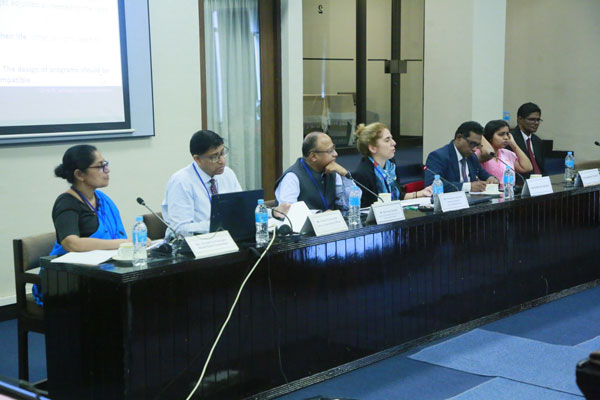
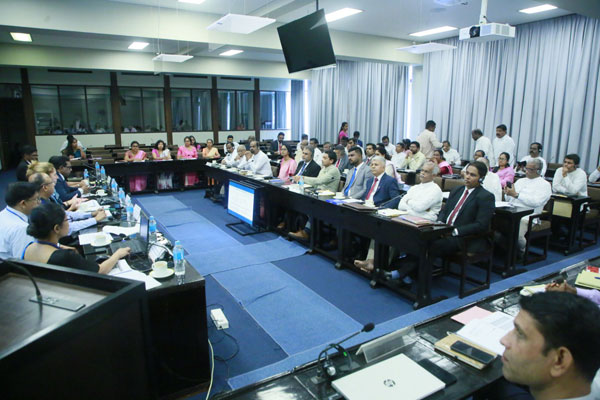
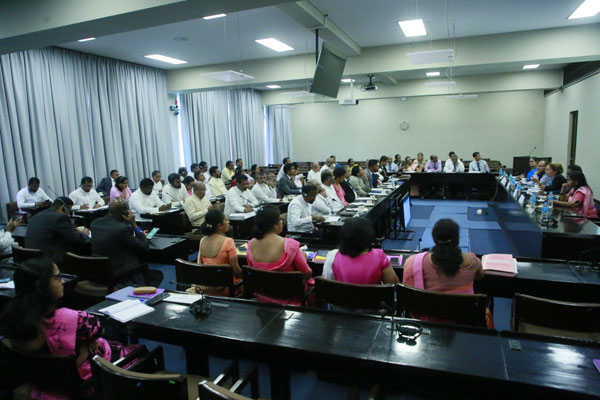
These observations were made during a joint meeting held recently (Oct. 22) at Parliament, attended by Members of the Ministerial Consultative Committee on Finance, Planning and Economic Development; Members of the Sectoral Oversight Committee on Economic Development and International Relations; other Honourable Members of Parliament; representatives of the World Bank; and officials of the Ministry of Finance, Economic Stabilization and National Policies.

The meeting was held with the participation of the Hon. (Dr.) Upali Pannilage, Minister of Rural Development, Social Empowerment and Welfare; and the Hon. (Ms.) Lakmali Hemachandra, Attorney-at-Law, Chairperson of the Sectoral Oversight Committee on Economic Development and International Relations. The World Bank delegation included Ms. Francesca Lamanna, Senior Economist for the Social Security Project, and Mr. Srinivas Varadan, Senior Social Security Specialist, along with several others.

During the discussions, the World Bank representatives stated that establishing a comprehensive data system for social Security would enable the accurate identification of genuinely poor and vulnerable individuals and families. They noted that the mere inclusion of citizens’ information in the database would not automatically qualify them as Aswesuma beneficiaries. Instead, the data must be verified and analyzed to correctly identify those eligible for relevant benefits.

They further emphasized that such a Social Security data system constitutes a productive investment for the country and, therefore, highlighted the need for continuous updating of the data system.

Members of Parliament who took part in the discussion also expressed their views regarding issues encountered in distributing Aswesuma benefits. They suggested that the beneficiaries of Aswesuma be selected through local committees and that the list of selected beneficiaries be publicly displayed within the respective village to ensure transparency in the process.

Officials involved in implementing the Aswesuma programme stated that certain challenges had arisen due to inadequate information provided to the implementing officers, Divisional Secretaries, and Grama Niladhari officers. However, they noted that measures are currently being taken to properly inform these officers of their respective roles and to obtain their cooperation in ensuring the successful implementation of the programme.

This occasion was also attended by the Hon. Leader of the Opposition, Sajith Premadasa, Hon. Ministers, Hon. Deputy Ministers, Hon. Members of Parliament, Ms. Shalika Subasinghe – Advisor to the World Bank, and officials of the Ministry of Finance, Economic Stabilization and National Policies.



Related News

2026-11-13

Sectoral Oversight Committee Approves Prevention of Foreign Terrorist Fighters Bill

The Prevention of Foreign Terrorist Fighters Bill received the approval of the Sectoral Oversight Committee on Economic Development and International Relations.The Bill was considered and approved when the Sectoral Oversight Committee met recently in Parliament under the chairmanship of Hon. Member of Parliament (Attorney-at-Law) Lakmali Hemachandra. The Bill has been presented to give effect to United Nations Security Council Resolution 2178, adopted on 24 September 2014, which addresses the prevention and suppression of the threat posed by foreign terrorist fighters, and to provide for matters connected therewith or incidental thereto.The Bill was presented to Parliament for its First Reading on 20 October by the Minister of Foreign Affairs, Foreign Employment and Tourism.Officials explained to the Committee that legal action could be instituted in Sri Lanka under this Act in cases where an offence has been committed within or outside Sri Lanka by a Sri Lankan citizen or a citizen of another country, provided that the act in question also constitutes an offence under the law of the relevant country.Officials further informed the Committee that engaging in terrorist activities, planning or preparing such activities, participating in them, as well as providing or receiving terrorist training, have been defined as offences under the proposed Act.The officials also emphasized that these legal provisions had not been introduced on an ethnic basis or with the intention of targeting Sri Lankans residing overseas.Following an extensive discussion, the Committee approved the Bill. However, Hon. Member of Parliament Sivagnanam Shritharan, a member of the Committee, expressed his opposition to the Bill.Hon. Members of Parliament Suranga Rathnayake, Thilina Samarakoon, Wijesiri Basnayake and Sivagnanam Shritharan, among others, attended the Committee meeting. Government officials representing the Ministry of Foreign Affairs, Foreign Employment and Tourism, the Ministry of Defence, the Attorney General’s Department and the Legal Draftsman’s Department were also present.


2026-11-13

Salary Anomalies in the Sri Lanka Principals’ Service Discussed at Subcommittee Meeting

Salary anomalies arising when teachers are appointed to the Sri Lanka Principals’ Service were discussed at length at a subcommittee appointed by the Sectoral Oversight Committee on Education, Manpower and Human Capital.These matters were discussed when the subcommittee met recently under the chairmanship of Hon. Member of Parliament Sunil Rajapaksa.Representatives of trade unions of the Sri Lanka Principals’ Service and officials representing the Ministry of Education, Higher Education and Vocational Education and the Ministry of Finance, Planning and Economic Development participated in the meeting.Trade union representatives pointed out that one of the main reasons for these salary anomalies was the fact that the transition from the Teachers’ Service to the Principals’ Service was treated as a “new appointment” rather than a promotion.They further noted that the situation was exacerbated by the significant difference in salary increments when teachers in Grade I of the Teachers’ Service are appointed to Grade III of the Principals’ Service.They also pointed out that although an adjustment allowance had been granted to compensate for the salary difference arising from the appointment to the Principals’ Service, a further salary disparity emerges over time. This is because officers do not receive the higher salary increments, they would have been entitled to had they remained in the Teachers’ Service.It was further emphasized that this situation has discouraged senior and experienced teachers serving in Grades I and II-I of the Teachers’ Service from sitting for the Principals’ Service examination and joining the Principals’ Service.The Chairman of the Subcommittee stated that, having considered the matters presented to the Committee, steps would be taken to submit the relevant recommendations to the Salaries and Pensions Commission for Public Officers.In addition, the Subcommittee decided to hold discussions with the Ministry of Education, Higher Education and Vocational Education, the Ministry of Finance, Planning and Economic Development, and the Director General of Establishments to address other issues faced by officers serving in the Principals’ Service.Hon. Members of Parliament Abubakar Athambawa, Sugath Wasantha de Silva and Chanaka Madugoda also attended the meeting.


2026-11-12

Progress in the Education, Higher Education and Vocational Education Sectors Discussed at Sectoral Oversight Committee

The Sectoral Oversight Committee on Education, Manpower and Human Capital discussed the operations of state institutions under the education, higher education and vocational education sectors, the progress of development projects, existing challenges and future plans. The Committee met recently (Nov. 06) at Parliament under the chairmanship of Hon. Member of Parliament, Attorney-at-Law Hesha Withanage Ankubura Arachchi. During the meeting, the financial and physical progress of the budgetary allocations made to the Ministry of Education, Higher Education and Vocational Education for 2026 was reviewed.Discussions focused on the development of school buildings and infrastructure, education reforms, the printing and distribution of textbooks, student welfare programmes and progress in teacher education. Delays in procurement and the shortage of technical officers encountered in implementing the relevant development projects were also discussed.Officials also briefed the Committee on the performance of the Department of Examinations of Sri Lanka and the Department of Educational Publications, including the conduct of examinations and plans for the production and distribution of textbooks. The importance of providing necessary educational facilities for children with special needs was also emphasized.Furthermore, discussions were held on the distribution of school uniforms and the payment of student allowances under school welfare programmes. Officials also informed the Committee about the introduction of a new computerized system to expedite the payment of student allowances and the arrangements being made to transfer the funds directly to students' bank accounts.The operations and development plans of institutions in the higher education and vocational training sectors were also reviewed. These included universities, the Tertiary and Vocational Education Commission of Sri Lanka, the National Apprentice and Industrial Training Authority (NAITA), and the Ceylon-German Technical Training Institute (CGTTI).During the meeting, the Committee Chairman instructed all relevant institutions to submit comprehensive reports on their financial and physical progress to the Committee. He also emphasized the importance of submitting these reports within the stipulated timeframes.The Committee further decided to summon the relevant institutions not only at the end of each year but also midway through the year to review the progress of development activities.In addition, the financial and physical progress of the budgetary allocations made to the Ministry of Youth Affairs and Sports and the institutions functioning under it for 2026 was also reviewed.Members of the Committee, Secretaries to the Ministries of Education, Higher Education and Vocational Education, and Youth Affairs and Sports, along with a number of other officials, attended the meeting.


2026-11-12

Focus on Regulation of Electric Vehicle Technology, Restructuring of Research Institutions and Promotion of Innovation at Sectoral Oversight Committee

The Sectoral Oversight Committee on Science, Technology and Digital Transformation focused on several key issues, including the introduction of regulations and standards for electric vehicles and their battery technology, improving the performance of state research institutions, and commercializing innovations.At a recent meeting of the Committee, held in Parliament recently under the chairmanship of Hon. Member of Parliament Dr. Janaka Senarathna, the following reports were considered: the Annual Report of the Sri Lanka National Engineering Research and Development Centre (NERDC) for 2022; the Annual Report of the National Science and Technology Commission for 2023; the Annual Report of the Sri Lanka Inventors Commission for 2024; and the Annual Performance Report of the Ministry of Science and Technology for 2025.Discussions focused on the electric vehicle and battery testing facilities available at the Sri Lanka National Engineering Research and Development Centre (NERDC). It was revealed that the institution has the capacity to test a range of battery parameters, including capacity, durability and lifespan.However, attention was also drawn to issues arising from the absence of mandatory regulations and standards governing electric vehicles, batteries, controllers and charging stations imported into the country. Accordingly, officials stressed to the Committee the need to establish relevant standards and make testing and certification compulsory.The Committee also discussed the technology involved in converting fuel vehicles into electric vehicles, the need for training programmes, and the development of standards and regulatory mechanisms to ensure the safety of such vehicles.Attention was further drawn to the shortage of human resources in research and development institutions and the need for appropriate salary and allowance schemes to attract and retain qualified engineers and researchers. Officials also highlighted the importance of improving the performance of state research institutions, addressing existing shortcomings, effectively managing research outcomes, and consolidating institutions carrying out similar functions.The Committee also discussed the Sri Lanka Inventors Commission's electric fencing projects aimed at mitigating the threat posed by wild elephants, the establishment of incubation centres affiliated with universities, and plans to promote innovation through digital platforms. Officials informed the Committee that three of the four electric fencing projects implemented to date were operating successfully.Furthermore, discussions were held on a proposal to amend the Intellectual Property Act to introduce a ‘Petty Patent system’, with the aim of protecting the intellectual property rights of inventors and expediting the commercialization of inventions.Hon. Members of Parliament Lasith Bashana Gamage, Chathura Galappaththi, Thanura Dissanayake, Attorney-at-Law Hasara Liyanage and Chandima Hettiarachchi, along with a number of officials from the Ministry of Science and Technology, attended the meeting.


Copyright © The Parliament of Sri Lanka.

All Rights Reserved.

Design & Developed by  TekGeeks