Handbook of Parliament
The System of Elections in Sri Lanka
How Parliament Works
Business of Parliament
Engage with your Parliament by logging in
2023-12-09
News Categories : Committee News
The Asia Internet Coalition (AIC), which represents key players in the internet industry and promotes the understanding and resolution of internet policy issues in the Asia-Pacific region, disclosed that the international standard for adopting VAT on software and digital service providers is based on the jurisdiction of the consumer, not the jurisdiction under which a particular business operates.
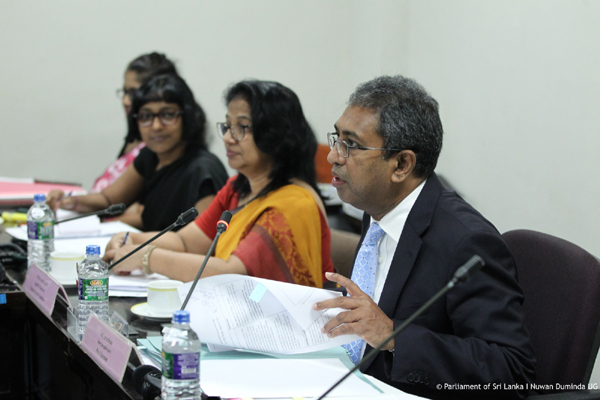
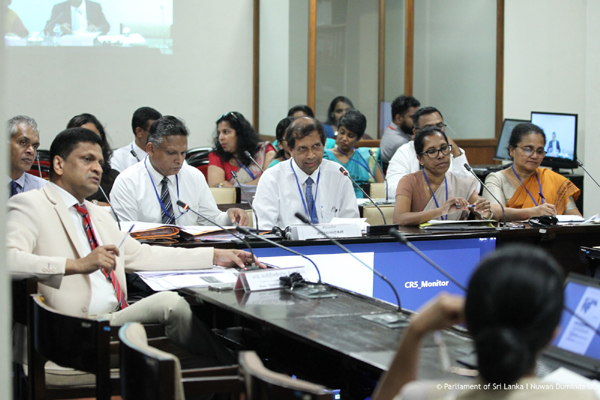
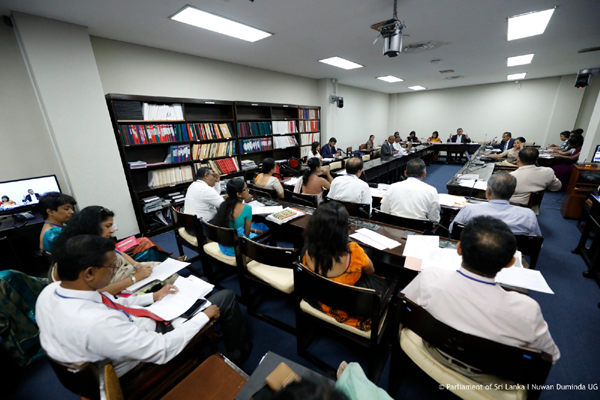
The afore stated matters were discussed when the Committee on Public Finance (COPF) took into consideration the impact of the implementation of provisions of the Value Added Tax (Amendment) Bill on domestic software and digital operators.
As an extension to a concern raised at the previous CoPF held, domestic and international software & digital service providers such as PickMe, Uber, AIC (representing Meta, Google, X, Booking.com, Amazon, etc) and Daraz were called before the Committee on Public Finance held recently (Dec. 07) Chaired by Member of Parliament Hon. (Dr.) Harsha de Silva.
It was disclosed that all such software and digital service providers are exempted from the application of VAT at present and with the Value Added Tax (Amendment) Bill coming into effect from the 1st of January 2024, all such exemptions will be removed and the applicability of such provisions will put on-shore service providers at a disadvantage as opposed to businesses that operate offshore.
The Committee was of the view that such a policy decision would discourage businesses from operating on-shore and thereby cause such businesses to move off-shore impacting government revenue and deterring new start-ups and digital service providers. Accordingly, the Committee directed the officials of the Ministry of Finance to look into the growing concern with the assistance of The Asia Internet Coalition (AIC) and to report to the Committee on a way forward on or before the 31st of December 2023.
Moreover, the Committee also took into consideration five Orders and a Resolution. Accordingly, the Resolution under Section 10 of the Customs Ordinance published in the Gazette Extra Ordinary No. 2347/06, and five Orders under the Special Commodity Levy Act, No. 48 of 2007 published under the Gazette Extra Ordinary Nos. 2345/64, 2346/16, 2348/44 and 2353/77 were taken up for discussion and approved by the Committee on Public Finance.
The Committee was of the view that the Ministry of Finance must have an in-depth analysis carried out with the assistance of all relevant institutions before making policy decisions related to the increase and decrease of taxes that impact vital essentials such as wheat and green gram.
Furthermore, the Committee also took into consideration the Regulations under the Colombo Port City Economic Commissions Act, No. 11 of 2021 pertaining to the Down – Town Duty Free intended to be established at the Port City Colombo.
Accordingly, the downtown duty-Free mall targets 70% of tourist consumers mainly from China and India, and will consist of premium luxury brands with 25 product categories including global brands.
Upon careful consideration by the Committee on Public Finance, it was observed that certain provisions stating which items can be imported under the Regulation are in the form of rules that are not legally binding. Therefore, the Committee believes that the Regulation needs to be revisited to avoid any gaps that may arise and prevent people from exploiting it. Accordingly, the members of the Colombo Port City Commission were instructed to rectify the discussed issues and present the revised version to the Committee.
State Minister Hon. (Dr.) (Mrs.) Seetha Arambepola and Members of Parliament Hon. Chandima Weerakkody, Hon. Mahindananda Aluthgamage, Hon. Wajira Abeywardana, Hon. Nimal Lanza, Hon. Premnath C. Dolawatte, Hon. Madhura Withanage were present at the Committee meeting held.

2026-07-08
The Committee on Public Finance (CoPF) has approved the submission to Parliament of a Resolution under the Customs Ordinance and two Orders under the Sri Lanka Export Development Act, following its consideration.The decision was taken at a meeting of the Committee held in Parliament on 6th July, chaired by Hon. Member of Parliament Dr. Harsha de Silva.Accordingly, the Committee considered the Resolution published in Extraordinary Gazette No. 2478/03 under the Customs Ordinance (Chapter 235), as well as the Orders published in Extraordinary Gazette Nos. 2478/04 and 2479/38 under the Sri Lanka Export Development Act. Officials representing the Ministry of Finance, Sri Lanka Customs, and the Sri Lanka Export Development Board (EDB) attended the meeting.In line with the 2026 Budget proposal to implement the National Tariff Policy, the existing customs import duty rates of 0%, 15% and 20% on imported goods have been restructured into a four-band system of 0%, 10%, 20% and 30%, effective 1 April 2026.Committee discussions emphasized that these amendments are not merely changes to tax rates, but mark the beginning of implementing a National Tariff Policy that will shape Sri Lanka's trade and investment environment over the coming decade. Officials explained that the principal objective of the policy is to establish a scientific and predictable tariff structure that will enable Sri Lanka to integrate more effectively into global supply chains.Under the policy, a new four-band tariff structure based on the United Nations Broad Economic Categories (BEC Revision 5) classification is proposed, requiring the reclassification of numerous HS tariff codes. The new tariff framework will classify imports under four principal categories—capital goods, intermediate goods, sensitive intermediate goods, and consumer goods—while also balancing the objectives of protecting domestic industries and maintaining stable government revenue.It was also revealed that, to provide relief to the construction sector, the current effective import tax rate on ceramic tiles, which stands at approximately 85–90%, will be reduced in stages to 20% by 2029. This is expected to lower construction costs and encourage investment in housing and infrastructure.The Government also proposes introducing new national tariff sub-categories for various sectors in response to requests from domestic industries.Officials further noted that the Government aims to gradually phase out para-tariffs such as the CESS and the Ports and Airports Levy (PAL) by 2029, moving towards a simpler tariff regime. The Committee also advised officials to consider measures to mitigate any adverse impacts that may arise from tariff liberalization.It was noted that these tax reforms are expected to support the Export Development Board's objective of doubling Sri Lanka's export earnings from US$18 billion to US$36 billion over the next five years. The policy is also expected to provide a strong foundation for integrating Sri Lanka into global supply chains, particularly in the electronics, rubber products, pharmaceuticals, and information technology sectors.The Committee also expressed serious concern over delays in updating trade data. The Chair observed that the Department of Trade and Investment Policy's trade database had not been updated since 2021, and instructed the relevant officials to update all trade data and related information required for evidence-based policymaking within one week.The Gazette notifications are scheduled to be debated in Parliament today (8 July), following which they are expected to be submitted for Parliamentary approval.The meeting was attended by Hon. Deputy Minister Chathuranga Abeysinghe, Hon. Deputy Minister Dr. Kaushalya Ariyarathna, and Hon. Members of Parliament Ravi Karunanayake, Harshana Rajakaruna, and Attorney-at-Law Lakmali Hemachandra.
2026-07-08
Hon. Minister of Transport, Highways and Urban Development Bimal Rathnayake stated that the Government will introduce a Cluster Bus Company System to improve public transportation, adding that Cabinet approval for the initiative was recently granted.The Minister made these remarks yesterday (7th July) while chairing the meeting of the Ministerial Consultative Committee on Transport, Highways and Urban Development in Parliament.He further stated that the scheme will initially be implemented as a pilot project on bus routes 177, 170 and 190.The Minister also said that the previous four categories of bus services; normal, semi-luxury, luxury and super-luxury have been streamlined by removing the semi-luxury and super-luxury categories. Referring to the Semi-Luxury category, the Minister stated that a related court case is currently pending and that the relevant facts will be presented before the court.Minister Rathnayake further pointed out that it is not equitable to apply a single fare formula to both long-distance and short-distance bus services. Given the higher operating costs associated with long-distance services, a separate methodology will be introduced to determine fares for long-distance buses. He emphasized that the Government is committed to safeguarding both the bus industry and passengers.The Chair of the Committee also sought clarification from officials on whether bus fares could be reduced following recent fuel price decreases. Officials explained that although fuel prices have declined, other operating costs remain high, limiting the scope for fare reductions.The Committee also discussed a range of issues including reducing road accidents, establishing dedicated lanes for bicycles and motorcycles, road development projects, and complaints from passengers regarding the failure to receive correct change from bus conductors. Officials were instructed to take the necessary action on these matters.The Chair further directed officials to intervene promptly to resolve issues raised by Members of Parliament relating to the transport and urban development sectors.The Committee also agreed that regulations made by the Minister of Transport, Highways and Urban Development under the Motor Traffic Act (No. 203), and published in Extraordinary Gazette No. 2480/22 dated 19 March 2026, should be submitted to Parliament for approval following the Committee's consideration.The regulations extend the concessionary period granted for fitting seat belts to seats in vehicles travelling on expressways where seat belts were not originally installed by the manufacturer. As the Committee observed that the previous grace period was insufficient, it has been extended from 20 March 2026 until 19 June 2026.The meeting was attended by Hon. Deputy Minister of Urban Development Eranga Gunasekara, several Members of Parliament, and officials representing the Ministry of Transport, Highways and Urban Development.
2026-07-07
The current progress of tourism promotion projects being implemented in various parts of the country, as well as the proposed budgetary allocations for next year aimed at further developing the tourism sector, were discussed at length during the meeting of the Ministerial Consultative Committee on Foreign Affairs, Foreign Employment and Tourism.The discussion took place when the Committee met recently at Parliament under the chairmanship of the Minister of Foreign Affairs, Foreign Employment and Tourism, Hon. Vijitha Herath.During the meeting, the Committee also reviewed the current status of Sri Lanka's trade agreements with foreign countries. The Chair informed members that a special committee has been appointed to review the country's foreign trade agreements, and that necessary policy decisions will be taken after its report is received.Members of Parliament also presented a number of proposals for new projects and programmes that could be implemented in different parts of the island to further promote the tourism industry.The meeting was attended by the Deputy Minister of Foreign Affairs and Foreign Employment, Hon. Arun Hemachandra, the Deputy Minister of Tourism, Prof. Ruwan Ranasinghe, and Members of Parliament serving on the Consultative Committee.
2026-06-25
The report submitted by the Central Bank of Sri Lanka to the Committee on Public Finance (COPF) regarding the disappearance of USD 2.5 million that had been held by the Treasury for the repayment of state debt was discussed at a recent meeting of the Committee.The meeting was held in Parliament on the 23rd June under the chairmanship of Hon. Member of Parliament Dr. Harsha de Silva, with the participation of Hon. Deputy Ministers Chathuranga Abeysinghe, Dr. Kaushalya Ariyarathne, and Nishantha Jayaweera, as well as Hon. Members of Parliament Attorney-at-Law Rauff Hakeem, Ravi Karunanayake, Harshana Rajakaruna, Ajith Alahakoon, Nimal Palihena, Attorney-at-Law Chithral Fernando, Wijesiri Basnayake, Champika Hettiarachchi, M.K.M. Aslam, and Attorney-at-Law Lakmali Hemachandra.The report submitted by the Ministry of Finance, Planning and Economic Development to the Committee on Public Finance on the 8th regarding the disappearance of USD 2.5 million was subsequently examined by officials of the Central Bank of Sri Lanka. Following this review, the Central Bank submitted a report containing its observations and views to the Committee.Extensive discussions were held on the report presented by the Central Bank. The Chairman of the Committee on Public Finance stated that, after considering both the report submitted by the Ministry of Finance, Planning and Economic Development and the report submitted by the Central Bank, a final report would be prepared and presented to Parliament in due course.Dr. Harshana Suriyapperuma, Secretary to the Ministry of Finance, Planning and Economic Development; Varuna Sri Dhanapala, Secretary to the Ministry of Digital Economy; Dr. Nandalal Weerasinghe, Governor of the Central Bank of Sri Lanka and officials of the Sri Lanka Computer Emergency Readiness Team (CERT) were also preset at the meeting.
Handbook of Parliament
The System of Elections in Sri Lanka
How Parliament Works
Business of Parliament
Copyright © The Parliament of Sri Lanka.
All Rights Reserved.
Design & Developed by TekGeeks