2023-06-21
Sectoral Oversight Committee on Environment, Natural Resources & Sustainable Development disclosed that 23 projects initiated by the Urban Development Authority by spending government funds are currently stopped and that amongst such projects, 11 have been stopped due to issues between the institutions.
The Committee emphasized that in addition to the projects that have stopped due to lack of funds, the main reason for these projects to stop is that there is no good cooperation or agreement between the relevant institutions.
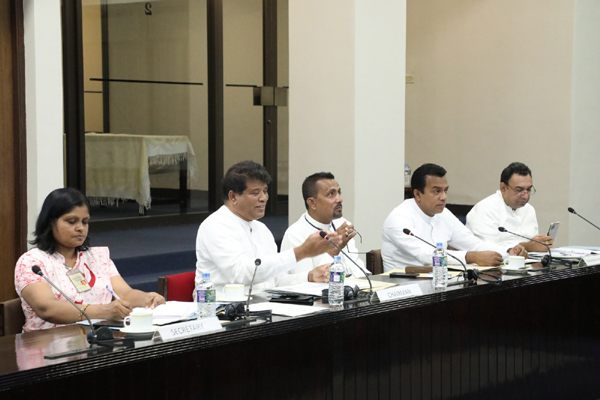
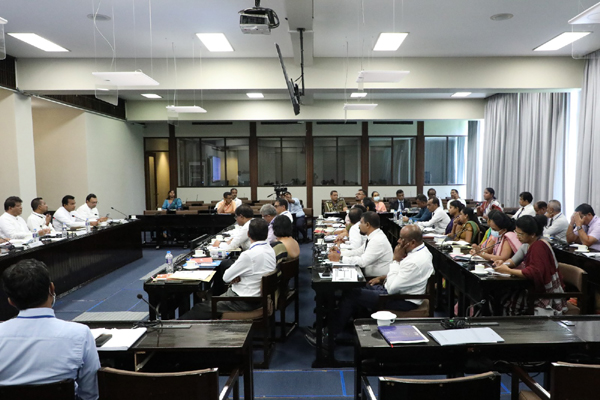
The Sectoral Oversight Committee on Environment, Natural Resources & Sustainable Development which met on the 20th of June 2023 under the Chairmanship of Hon. Ajith Mannapperuma, took into consideration the projects which have been initiated by the Urban Development Authority but have been abandoned due to various reasons thereby making a change in the strategies or existing rules followed in starting and maintaining the projects.
Thus, it was revealed that an amount of 56,388 million rupees has been estimated for 11 projects that have been stopped in the middle due to the problems between the institutions, and although the Urban Development Authority has spent 2,531 million rupees, there are outstanding bills of 14,23 million rupees for further payment. Also, it was revealed that an amount of 56,999 million rupees is required for the completion of the projects.
Since there are projects that have been stopped due to lack of funds as well as projects that have been stopped due to institutional issues that need to be resolved between various institutions, the committee focused its attention on projects that have been stopped in the middle due to problems between institutions at this Committee meeting held.
The Ceylon Electricity Board, Road Development Authority, National Water Supply and Drainage Board, Sri Lanka Railway Department and the Prisons Department were called before the Committee, including the Urban Development Authority.
Among the 11 projects that have been stopped due to inter-institutional issues, the construction of the new access road from Kottawa to Mahenawatta, the development of Alavwa town (road widening), the construction of the entrance to Yakkala from the Gampaha highway, the expansion of Imaduwa town, the construction of low-income houses in Beruwanawatta, Aheliyagoda, Hatton The committee considered the development of the railway station and the replacement of the Welikada prison were looked into during the Committee.
Work on the construction of the new access road from Kottawa to Mahenawatta is about 98% completed and that the problem of land acquisition has been largely resolved as another place has been proposed for the people who will lose their land and post resolving the remaining issues with the Homagama Divisional Secretary, the project can be given to the Road Development Authority for completion Officials of the Urban Development Authority said.
It was disclosed that the construction of 34 low-income houses in Beruwanavatta, Aheliyagoda, planned to resettle people who will lose their land during the construction of the proposed by-pass instead of the pass through the city, which is very important for the development of Aheliyagoda, has been stopped due to problems in obtaining electricity and water supply for those houses. The Committee instructed since the houses have been completed, to have the projects completed by resolving problems of providing facilities with the Electricity Board and the Ratnapura District Community Water Supply Department and to resolve ownership issues of the land existing between the Railway Department and the Road Development Authority through cooperation between the institutions.
Furthermore, it was revealed before the Committee that although the land acquisition work of the proposed Gampaha Makavita Nelumwila Health Lane Project has been completed, the project has stopped midway. As 13 million has been spent for this purpose, the Committee instructed to carry out urban forestry on this piece of land and use it in the process of increasing forestry in Sri Lanka.
Under the replacement of Welikada prison, the Prisons Department and the Urban Development Authority were instructed that the value of the land where Welikada is currently located should be accurately assessed by the Government Valuation Department, and the money obtained by leasing the existing land or calling for tenders and selling the land should be used to locate the prison on the proposed land in Horana with more space and facilities under approved measurements.
The Committee emphasized that the cost can be covered through the investment received without spending government funds for the relevant project. The Committee also emphasized that by replacing the Welikada prison, the government hopes to use the more valuable Welikada land for other productive investment purposes and to re-establish the prison with more spacious facilities with the large amount of funds received.
According to the facts considered, the Committee emphasized that the main reason for the cease of the projects is the lack of good cooperation or agreement between the institutions involved. The recommendation of the Committee was that when starting projects under the limited resources available, a preliminary analysis should be done regarding the social, economic and environmental impacts and the most beneficial and most important method should be followed. The participating officials were also instructed to follow the instructions and guidance given by the Committee and inform the Committee within 3 weeks of the progress regarding the work of the considered projects.
Committee Members Hon. Thushara Indunil Amarasena, Hon. Akila Ellawala, Hon. Waruna Liyanage, Hon. (Dr.) Thilak Rajapakshe, Hon. Upul Mahendra Rajapaksha were present at the Committee meeting held.

2026-09-08
The Co-Chairs of the Parliamentary Caucus for Open Parliament Initiative stated that steps will be taken to present to Parliament the views and proposals put forward during the “Voice to Policy” dialogue series organized for youth, with the aim of promoting the concept of an Open Parliament.They made these remarks while participating in the “Voice to Policy” programme held last Saturday (Sep. 05) at the Golden Crown Hotel in Kandy for youth in the Kandy District. The Co-Chairs of the Parliamentary Caucus for Open Parliament Initiative, Hon. Minister Prof. Krishantha Abeyasena and Hon. Member of Parliament Shanakiyan Rajaputhiran Rasamanickam, participated in the programme.The first programme of the “Voice to Policy” dialogue series was held in the Gampaha District, the second in the Batticaloa District, and the third in the Kandy District. Members of the Caucus, Hon. Members of Parliament S.M. Marikkar, Attorney-at-Law Susanta Dodawatte, Attorney-at-Law Chamindrani Kiriella, Attorney-at-Law Thushari Jayasinghe, Lal Premanath, Major General (Retired) G.D. Sooriyabandara and M.K.M. Aslam, as well as Assistant Secretary-General of Parliament Mr. Hansa Abeyratne and others, participated in the programme held in Kandy.The young people who participated in the programme representing the Kandy District identified the challenges they face under five key themes: economic opportunities and employment; public administration and accountability; social inclusion and justice; political participation and representation; and other matters.They also proposed solutions to the identified issues and identified the relevant government institutions that could be held responsible for addressing them. The young participants subsequently presented the issues and proposals to members of the Caucus. Based on these proposals, an extensive dialogue was held between representatives of the Parliamentary Caucus for Open Parliament Initiative and the youth of the Kandy District.Members of the Caucus stated that their objective is to bring the views and proposals of youth to Parliament. They further assured that steps would be taken to submit to Parliament a report containing the views and proposals presented during the “Voice to Policy” programmes conducted to date, and to take the necessary measures to further engage young people with parliamentary processes and activities.The programme was sponsored by CII (Coalition for Inclusive Impact).
2026-09-07
The Select Committee of Parliament to conduct a comprehensive study on the lack of preparedness to face Cyclone Ditwah and report to Parliament and submit its proposals and recommendations in that regard recently questioned senior officials of the Sri Lanka Police who were involved in responding to the disaster at the time.The questioning took place when the Committee met recently at Parliament under the chairmanship of Hon. Minister (Dr.) Nalinda Jayatissa.Accordingly, a group of Senior Superintendents of Police and Superintendents of Police from the districts affected by Cyclone Ditwah were summoned before the Committee.Former Member of Parliament Nimal Piyatissa was also summoned before the Committee. He was called to provide detailed information regarding comments he made to the media concerning the measures taken in response to the cyclone at the time it occurred.Members of Parliament serving on the Committee also participated in the meeting.
2026-09-07
The 13th meeting of the Parliamentary Caucus for Persons with Disabilities was held recently at Parliament under the chairmanship of Hon. Sugath Wasantha de Silva, Chair of the Caucus.The meeting focused on the draft action plan of the Caucus prepared for the period from July 2026 to June 2027, and discussions were held on its implementation going forward.Prepared with the technical assistance of the International Foundation for Electoral Systems (IFES), the action plan has been developed under four key areas: parliamentary coordination and oversight; budget advocacy and accountability; legal and policy reforms; and accessible and inclusive public services. The meeting discussed future actions relating to each of these areas.IFES Sri Lanka Deputy Director Mr. Indraka Ubesekara, Senior Programme Officer Ms. Anojitha Sivaskaran, and National Council for Persons with Disabilities member Mr. Tikiri Kumara Jayawardena briefed the Caucus on the work carried out to date and the plans for the future.The importance of incorporating the views and needs of persons with disabilities into planning at the local level was also highlighted. Based on the experiences of district-level consultation programmes conducted in Kilinochchi, Mullaitivu, Kalutara and Polonnaruwa, it was noted that a similar programme is scheduled to be held in the Hambantota District in the future.Discussions were also held on establishing an appropriate mechanism to ensure the active participation of the disability community in the preparation of local development plans through district-level accessibility audit committees and district coordinating committees. It was further pointed out that incorporating accessibility features from the initial stages of building and urban planning can help minimize the costly modifications that may otherwise be required at a later stage.The meeting was also informed that a report comprising 234 policy and practical proposals, prepared with the participation of nearly 60 organizations representing the disability community for the 2027 National Budget, has already been submitted to the Presidential Secretariat, the Ministry of Finance and relevant government institutions. The Caucus decided to closely monitor how these proposals are implemented and whether they result in tangible benefits for persons with disabilities.Attention was also drawn to further strengthening the existing legal and policy framework to safeguard the rights of persons with disabilities and ensure accessibility. It was decided to hold a special discussion with officials of the relevant ministries and the Legal Draftsman’s Department to inquire into the progress of the proposed “New Bill on the Rights of Persons with Disabilities” and the “Sign Language Bill”, which are currently being drafted.The meeting also discussed the need to update existing legal provisions and standards relating to accessibility for persons with disabilities in line with international best practices. Proposals were put forward to introduce accessibility guidelines for private-sector institutions and gradually incorporate them into the legal framework, as well as to implement a pilot project with several selected private institutions.Special attention was also given to making public services more accessible and inclusive. The meeting discussed the findings of accessibility audits conducted at the Ministry of Labour’s “Mehewara Piyasa” building and Sethsiripaya Buildings Phases I and II. It was also noted that steps have been taken to ensure that the construction of Sethsiripaya Phase III is designed to be accessible to persons with disabilities from the outset.In addition, programmes such as low-floor bus services, accessible tourism for persons with disabilities, and the “Friendly Cities” programme were identified as models for improving accessibility within public services. Attention was also drawn to removing accessibility barriers faced by persons with disabilities when accessing healthcare services.Addressing the meeting at its conclusion, the Chair of the Caucus, Hon. Sugath Wasantha de Silva, stated that one of the Caucus’s primary objectives is to create an environment in which the disability community can lead free, independent and dignified lives without fear or uncertainty.The Chair further stated that Parliament would continue to fulfil its role in giving priority to the voices of persons with disabilities when making decisions concerning them, and in ensuring their participation in every sector of society. He also expressed his appreciation to all Members of Parliament, IFES and other stakeholders who have contributed to this work.The meeting was attended by Hon. Members of Parliament, including (Dr.) Nihal Abeysinghe, Attorney-at-Law Susantha Dodawatte, Padmasiri Bandara, (Dr.) Elayathamby Srinath, Attorney-at-Law Bhagya Sri Herath and Chandima Hettiarachchi, among others.
2026-09-03
The Committee on Ways and Means of Parliament recently reviewed the operations of Sri Lanka Customs, including its revenue performance. The matter was considered when the Committee met recently under the chairmanship of Hon. Member of Parliament Wijesiri Basnayake.Officials, including the Director General of Customs, informed the Committee that the expected Customs revenue as of June 30, 2026, was Rs. 1,060,559 million, while actual revenue collected by that date amounted to Rs. 1,379,084 million. This represented 130% achievement against the expected revenue target. Officials further informed the Committee that Customs had generated revenue exceeding the monthly targets in every month of the year to date, and that, compared with 2025, higher revenue performance had been recorded in each month.Providing information on vehicle imports in 2026, officials stated that 316,000 vehicles had been imported as of June 30, 2026, generating Rs. 512,547 million in tax revenue. According to the information presented to the Committee, the highest amount of tax revenue, Rs. 386,726 million, had been generated through the importation of motor vehicles.Furthermore, among the categories of commodities generating the highest Customs revenue, petrol motor cars less than 1,000cc ranked first, generating Rs. 137.4 billion. This represented 9.96% of total revenue.The Committee also focused on matters including the volume of imported containers and the procedures followed for their inspection, the introduction of modern technology to improve the efficiency of Sri Lanka Customs operations, challenges in revenue administration, and future plans.Several Members of the Committee on Ways and Means, together with officials representing the Ministry of Finance, Planning and Economic Development and Sri Lanka Customs, participated in the Committee meeting.