Handbook of Parliament
The System of Elections in Sri Lanka
How Parliament Works
Business of Parliament
Engage with your Parliament by logging in
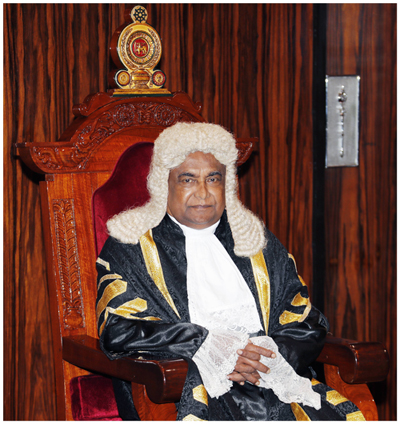
The coming New Year will be a challenging one for all of us amid the economic storms and social and political upheavals in the world. In the midst of all this, we, the citizens of a small island, have the least ability to stand firm and independent. But it is not impossible.
In my opinion, we should all think about the year 2023, when we celebrate the Diamond jubilee of our country's independence, from such a careful, responsible and respectful point of view. Looking forward to 2023, there is no mistake in calling the past year 2022 as a year of changes in the history of Sri Lanka more than any other. Also, the lessons learned from those experiences cannot be called a disadvantage but a great heritage for a long future to come.
Until now, we have to rise united again from the social, political, economic and extremist storm that destroyed the respectable unity that had been built up as a Sri Lankan nation. It is a serious responsibility placed on the shoulders of all Sri Lankans by the present and the future, not just politicians.
Regardless of what happened in the past, we must definitely treat each other with respect in the future. No matter which party we represent, there is no need to see the other party as our enemies. Respect is an essential factor for both parties to reach a common, mediated agreement.
Also, as adults, we should be more careful about our future generations in the coming New Year than last year. In the face of a competitive world, we should look at our children with a cautious eye. Not only the family, the school, but also the temple, the church and the neighbors have a selfless responsibility for the children who will be the future leaders of our country.
To celebrate a freedom that is supreme to us, we must step into the 'Heavenly Kingdom' of national freedom, as poet Rabindranath Tagore says in the thirty-fifth verse of his famous book ‘Gitanjali’. In that heavenly kingdom, our minds will be free from fear; Must be able to hold head straight; Knowledge must be free; Our words must flow from the bottom of truth. Must have logical thinking. There must be unrelenting vigor. A country should move towards such a state of freedom.
May 2023 be a new year filled with freedom, joy, wisdom and innovative thinking for all of you!
Mahinda Yapa Abeywardena,
Speaker,
Parliament of Sri Lanka
2026-09-09
The Chief of Defence Staff (Repeal) Bill was passed in Parliament today (Sep. 09).The debate on the second reading of the Bill was held in Parliament from 11.00 a.m. to 5.00 p.m. today, following which the Bill was passed without a division.The Bill was presented to Parliament for its first reading on 4th August 2026.The Bill has been introduced to repeal the Chief of Defence Staff Act, No. 35 of 2009. The Act was enacted in 2009 to carry out functions including the coordination of activities between the Armed Forces and the Ministry of Defence, in accordance with the requirements of the time.Accordingly, with the repeal of the Chief of Defence Staff Act, No. 35 of 2009, the position of Chief of Defence Staff is also set to be repealed under this Bill.Furthermore, upon the commencement of this Act, all movable and immovable property belonging to the Office of the Chief of Defence Staff will be transferred to the Ministry of Defence.
2026-09-09
The Hon. Prime Minister and Minister of Education, Higher Education and Vocational Education, Dr. Harini Amarasuriya, stated in Parliament that plans have been prepared to modernize the Government Printing Corporation by gradually phasing out old and outdated machinery that has been in use for more than 50 years and procuring efficient equipment equipped with modern technology.She further stated that the modernization programme aims to establish a modern printing unit equipped with advanced technology, capable of targeting international markets and providing Smart Security Printing capabilities.The Prime Minister made these remarks in response to Questions for Oral Answers raised by Hon. Member of Parliament Major General (Retired) G.D. Sooriyabandara.The Prime Minister stated that the Government Printing Corporation currently employs 445 permanent employees, along with a further 21 employees on a contractual basis.She further noted that the printing facility of the Government Printing Corporation, which is currently operational in Wataraka, Padukka, carries out printing work based on orders received from the Government. These services include the printing of school textbooks and modules, as well as security printing, including the printing of provincial examination papers, lottery tickets and confidential documents.In addition, the Corporation undertakes the printing of SPC exercise books, printing requirements of various government institutions, other commercial printing work, private printing orders and election-related printing. The Corporation also maintains a network of SPC outlets across several districts of the country, the Prime Minister said.The Prime Minister also pointed out that the Government derives numerous benefits from having a printing institution operating under the Ministry.Accordingly, these benefits include the presence of the Government Printing Corporation as a factor that helps regulate market prices, maintain market standards and quality, meet the requirement for a reliable Security Printing facility, and maintain the Corporation as the only state-owned enterprise in the printing sector.She further highlighted the Corporation’s role in meeting the need for large-scale printing capacity, ensuring access to government-owned printing facilities, and reducing the costs associated with printing activities.Furthermore, the Prime Minister emphasized that the continued existence of the Government Printing Corporation provides employment opportunities as a state institution, maintains a skilled and trained workforce, and enables the Government to derive financial benefits as its state share.
2026-09-08
Determination of the Supreme Court in respect of the Bill titled “Chartered Institute of Media Professionals of Sri Lanka”The Hon. Speaker Dr. Jagath Wickramaratne today (Sep. 08) announced in Parliament that he had received the Determination of the Supreme Court in respect of the Bill titled “Chartered Institute of Media Professionals of Sri Lanka” which was challenged in the Supreme Court in terms of Articles 121 (1) of the Constitution. Accordingly, the Supreme Court has determined that; (i) Clause 3(i) of the Bill is vague and is therefore inconsistent with Articles 12(1) and 14(1)(g) of the Constitution and may only be passed by the special majority required under Article 84(2) of the Constitution. The inconsistency would cease if the said clause is deleted.(ii) Clause 4(o) of the Bill is inconsistent with Articles 12(1) and 14(1)(g) of the Constitution and may only be passed by the special majority required under Article 84(2) of the Constitution. The inconsistency would cease if the said clause is amended as proposed by the Court.(iii) Clause 5(4)(b) of the Bill is inconsistent with Article 12(1) of the Constitution and may only be passed by the special majority required under Article 84(2) of the Constitution. The inconsistency would cease if the clause 5 is amended as proposed by the Court.(iv) The rest of the clauses of the Bill are not inconsistent with the Constitution.Petitions filed at the Supreme Court in terms of the Article 121(1) of the Constitution, in respect of the Bill titled “Twenty Second Amendment to the Constitution”The Hon. Speaker also informed the Parliament that, he had received copies of petitions filed at the Supreme Court in terms of the Article 121(1) of the Constitution, in respect of the Bill titled “Twenty Second Amendment to the Constitution” as mentioned below, in addition to the receipt of nine Petitions mentioned in his announcements dated 19th, 20th & 21st of August 2026: —• Seven Petitions on 21st of August 2026• Four Petitions on 24th of August 2026• Eight Petitions on 25th of August 2026• Five Petitions on 28th of August 2026• Thirty-one Petitions on 31st of August 2026• Ten Petitions on 01st of September 2026• Three Petitions on 03rd of September 2026• Two Petitions on 04th of September 2026Petitions filed at the Supreme Court in respect of the Bill titled “Anti-Corruption (Amendment)”The Hon Speaker announced that he had received copies of fifteen petitions filed at the Supreme Court in terms of the Article 121(1) of the Constitution in respect of the Bill titled “Anti-Corruption (Amendment)”.Petitions filed at the Supreme Court in respect of the Bill titled “Judicature (Amendment)”The Hon. Speaker Dr. Jagath Wickramaratne further informed the Parliament that he had received seven more copies of Petitions filed at the Supreme Court in terms of the Article 121(1) of the Constitution in respect of the Bill titled “Judicature (Amendment)”, in addition to the receipt of the Petition mentioned in his announcement dated 19th of August 2026.
2026-09-08
Hon. Speaker of Parliament Dr. Jagath Wickramaratne endorsed the certificate on the Employment of Women, Young Persons and Children (Amendment) Bill today (Sep. 08).The Bill, which seeks to amend the Employment of Women, Young Persons and Children Act No. 47 of 1956, was presented to Parliament by the Minister of Labour and was passed by Parliament on the 20th August.The primary objective of this amendment is to update the fines imposed for offences under the Act relating to the employment of women, young persons and children, in order to bring them in line with current circumstances.The Employment of Women, Young Persons and Children Act No. 47 of 1956 completely prohibits the employment of children under the age of 16. As the fines that may be imposed by a court for offences under the Act are no longer adequate in view of prevailing socio-economic conditions, the new amendment provides for the revision of those fines. Accordingly, the Bill has been introduced to increase the fines imposed for offences under the Women, Young Persons and Children (Employment) Act No. 47 of 1956, from Rs. 10,000 to Rs. 100,000.Accordingly, the Bill will come into force as the Employment of Women, Young Persons and Children (Amendment) Act No. 21 of 2026.
Handbook of Parliament
The System of Elections in Sri Lanka
How Parliament Works
Business of Parliament
Copyright © The Parliament of Sri Lanka.
All Rights Reserved.
Design & Developed by TekGeeks