2021-02-12
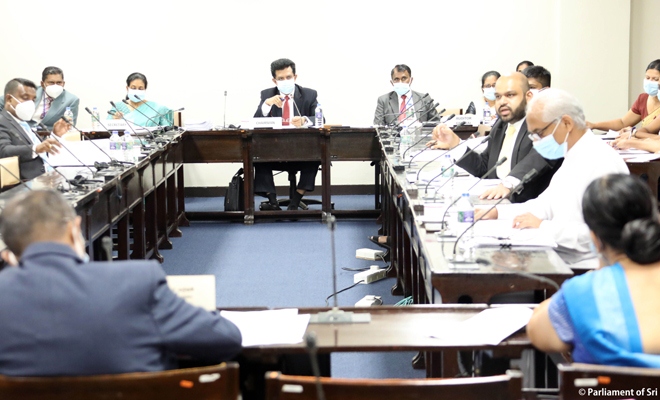
The Chairman of the Committee on Public Enterprises (COPE) Prof. Charitha Herath instructed the relevant authorities of the National Child Protection Authority (NCPA) coming under the Ministry of Education to expedite the implementation of a national policy which is one of the primary responsibilities of the Authority. The Chairman stated the above at the COPE committee meeting held on the 12th of February 2021.
The COPE committee disclosed that the National Child Protection Authority was established in 1998 with the objective of formulating a national policy on the prevention of child abuse and for the protection and for the purpose of treating children who are victims of such abuse.
However, the committee pointed out that the implementation of a national policy has not been carried out accordingly paving way for a delay of 21 years. The Committee emphasized the importance of expediting the implementation of the National Policy which has been already approved.
Members of Parliament Jagath Pushpakumara, Eran Wickramaratne, Premnath C. Dolawaththa, Shanakiyan Rasamanickam and officials representing the Child Protection Authority were present at the occasion.
It was also brought to the committees’ attention that annual reports of the Authority for the years 2016, 2017, 2018 and 2019 have not been submitted to Parliament so far. Expressing displeasure over the matter, the COPE Chairman instructed the Secretary to the Ministry of Education and the Secretary to the Ministry of State to immediately look into the matter and submit the relevant annual reports to Parliament within two months.
It was revealed that Rs. 9 million for consultants for the purpose of creating a database for the Authority has been spent in the years 2016, 2017 and that a grant of Rs. 1.2 million has also been provided by the Department of Computer Studies, University of Colombo in order to develop a software which is has come to a state of being futile. The COPE committee emphasized that although it is important to prepare such a database, there should be a proper methodology in the use of government funds. Thus, the Committee instructed the Secretary to the Ministry to immediately conduct an internal investigation and submit a report on the aforesaid matter.
Although a legal framework and regulations had been identified to regulate the transportation of school children as a measure to prevent child abuse, the COPE committee pointed out that it had not yet been implemented thus far. The Chairman of the Authority said that the requisite standards have been prepared pertaining to the matter and that the authority should take action to fill the vacancies for regulatory purposes. The Committee instructed to expedite this program by employing the newly appointed graduates according based on their qualifications.
The committee also raised concerns over the difficulties faced by the victims as a result of time-consuming process of child abuse cases. Emphasis was placed on the importance of developing a system to minimize the time period affiliated to child abuse cases before children reach the phase of adulthood.
It was revealed that although 3165 school child protection committees have been set up to prevent child abuse, only 2392 committees are active at present. The committee recommended that this should be revived with a more attractive approach in order to popularize it among school children and that it should be included in the institution's active program schedule accordingly.
It was revealed that it is not at all sufficient in terms of conducting activities of the Authority as there are only two persons to serve in the Legal Division of the Authority. Therefore, the Chairman of the Committee recommended the Secretary to the Ministry of State that necessary steps to strengthen the legal sector should be looked into with immediate effect.
It was also revealed that the Authority had received 89,405 complaints during the period between2011-2020 and as at 31.01.2021, the number of unresolved complaints brought forward was 40,668. The committee stated that it is unfortunate to have only one person working in the Law Enforcement Division who handles complaints. Furthermore, the Committee directed that the Law Enforcement Division be strengthened in order to expedite the process of handling complaints accordingly.
The need to investigate and regulate all orphanages in Sri Lanka was also discussed at length. The Chairman recommended that the Authority prepare a new program for this purpose and take immediate action to obtain all the basic data.
Although the National Child Protection Authority has data on complaints, the committee also noted the lack of a national database on child abuse. The Committee directed that steps be taken to develop a more formal database as formal data is essential for future child abuse prevention programs.
It was revealed that there are 548 approved posts in the institute and 206 of them are vacant. The COPE Chairman instructed the authorities to take immediate action as the recruitment process for the approved posts could be done with the approval of the Secretary to the Ministry.
COPE committee Chairman Prof. Herath stressed the importance of resolving these issues of the National Child Protection Authority, which plays a crucial role in the country advocating for abused children. Thus, the Chairman emphasized on the importance of making the institution a strong institution. He also said that the authority would be summoned before the COPE Committee again later this year.

2026-11-21
Details of 72 development projects that were started between 2018 and 2021 but later abandoned have been revealed at the Committee on Public Accounts (COPA).These details were revealed when the Committee met in Parliament recently (Nov. 19), under the Chairmanship of Hon. Member of Parliament Kabir Hashim, to examine the Tri-Annual Reports for the financial years 2021–2023, the Auditor General’s Report for 2024 and the current performance of the Ministry of Education, Higher Education and Vocational Education.It was revealed that approximately Rs. 1,664 million had been spent on these 72 projects. Of these, 35 projects have now been completed, work on 13 projects is ongoing, four projects have been suspended, while 20 projects remain stalled due to contractual issues. Officials informed the Committee that steps are being taken to resolve these issues and restart the stalled projects.Officials also stated that nearly Rs. 1,600 million had been allocated in 2019 for the physical development of selected schools and the purchase of equipment under the programme to establish three National Schools in each Divisional Secretariat Division. However, as a policy decision had been taken not to continue the programme, the Committee instructed officials to submit a report detailing the funds allocated to each school and the development work carried out.Meanwhile, it was revealed that a stock of computers ordered by the Ministry had not been accepted as they did not meet the required technical specifications. No payments had been made for the computers, and the supplier had filed two court cases in this regard.The progress of the National Education Management Information System (NEMIS) was also discussed. Officials stated that priority had been given to entering teacher information and student assessment data into the system. It was further revealed that teacher transfers in several provinces are already being carried out through this system, and plans are underway to expand it to all provinces and National Schools across the country.The Committee was also informed that delays in preparing estimates, a shortage of technical officers and tender-related issues had affected the utilisation of capital allocations. The Committee also inquired about delays in responding to audit queries and instructed officials to take prompt action to resolve these matters.Deputy Ministers Hon. Nalin Hewage and Hon. Major General (Retd.) Aruna Jayasekara, and Hon. Members of Parliament Dr. M. L. A. M. Hisbullah, Hector Appuhamy, Chandana Sooriyaarachchi, Chanaka Madugoda, Ruwanthilaka Jayakody, Oshani Umanga, Manjula Sooriyaarachchi, Sagarika Athawuda, Attorney-at-Law, Dr. Janaka Senaratne, Susantha Kumara Navaratne, Lal Premanath, Thushari Jayasinghe, Attorney-at-Law, T. K. Jayasundara and Sunil Rathnasiri, among others, were also present at the meeting.
2026-11-21
The Women Parliamentarians’ Caucus hosted a two-day international workshop titled ‘Creating a Parliament that Works for All’ on 19 and 20 November 2026, bringing together Sri Lankan Parliamentarians, international Parliamentary representatives, gender equality experts, academics and development partners to explore ways of strengthening Parliamentary institutions to make them more inclusive, representative and responsive to the needs and aspirations of all citizens. The workshop provided a platform for sharing international experiences, examining barriers to equal participation and identifying practical approaches to ensuring that women and other under-represented groups have a meaningful voice in Parliamentary processes and decision-making.The workshop was organized specifically for members of the Women Parliamentarians’ Caucus and was open to all Members of Parliament. It was conducted in partnership with Inter Pares, the European Union’s flagship initiative aimed at strengthening the capacity of parliaments worldwide, implemented by International IDEA under the Women and Youth in Democracy Initiative.The inaugural ceremony was held on 19th under the patronage of the Hon. (Dr.) Jagath Wickramaratne, Speaker of the Parliament of Sri Lanka. The occasion was attended by Hon. (Mrs.) Hemali Weerasekara, the Deputy Chair of the Committees; Hon. Sajith Premadasa, the Leader of the Opposition; Hon. (Mrs.) Saroja Savithri Paulraj, the Minister of Women and Child Affairs and Chairperson of the Women Parliamentarians’ Caucus of the Parliament of Sri Lanka; Mrs. Kushani Rohanadeera, the Secretary General of Parliament; H.E. Ambassador Sylvia Hartleif of the Delegation of the European Union to Sri Lanka and the Maldives; and Ms. Leena Rikkilä Tamang, Director for Asia and the Pacific at International IDEA, together with Members of the Women Parliamentarians’ Caucus and distinguished international delegates.Addressing the gathering, the Hon. Speaker emphasized the importance of ensuring the meaningful participation of women, young people, persons with disabilities and other under-represented communities in democratic processes. He expressed his sincere appreciation to the Women Parliamentarians’ Caucus, the European Union, Inter Pares, International IDEA and all partner institutions for their contribution towards organizing this important initiative.The Speaker also commended the initiatives undertaken by the Women Parliamentarians’ Caucus in areas such as recognizing and strengthening the care economy, establishing the National Commission on Women, and providing assistance to communities affected by disasters.The Hon. (Mrs.) Saroja Savithri Paulraj, Minister of Women and Child Affairs and Chairperson of the Women Parliamentarians’ Caucus, reaffirmed Sri Lanka’s commitment to safeguarding the rights of all citizens, particularly women, children and persons with disabilities, and stressed the importance of strengthening inclusive and equitable participation in parliamentary and democratic processes.The Hon. Sajith Premadasa, Leader of the Opposition, also addressed the inaugural session, highlighting the importance of international exposure and the exchange of knowledge and experiences in strengthening Parliamentary democracy. He expressed his appreciation to all stakeholders and partner organizations for facilitating the workshop.Mrs. Kushani Rohanadeera, the Secretary General of Parliament and the Secretary of the Women Parliamentarians’ Caucus, welcoming the distinguished guests, emphasized the importance of international exposure, knowledge-sharing and the exchange of experiences in strengthening inclusive parliamentary democracy. H.E. Ambassador Sylvia Hartleif of the Delegation of the European Union to Sri Lanka and the Maldives and Ms. Leena Rikkilä Tamang, Director for Asia and the Pacific at International IDEA, reiterated their commitment to supporting inclusive and representative democratic institutions. They underscored the importance of strengthening Parliamentary capacity, promoting gender equality and creating opportunities for women and other under-represented groups to participate meaningfully in political decision-making. They also highlighted the value of international cooperation and the sharing of experiences and good practices in advancing inclusive parliamentary governance.A key focus of the workshop was the role of parliaments in ensuring that women's voices, experiences and perspectives are meaningfully reflected in parliamentary processes, political agendas and national decision-making. Particular attention was given to the barriers faced by women from under-represented communities, including ethnic and religious minorities and women with disabilities.Discussions also focused on practical approaches to gender-responsive budgeting, enabling Parliamentarians to examine how national budgets and public policies can better address the differing needs, priorities and experiences of women and men. These discussions highlighted the important role of Parliamentarians in ensuring that public resources and policy decisions contribute to greater equality and social inclusion. Representatives from the Ministry of Women and Child Affairs and the Ministry of Finance, Planning and Economic Development also participated in these sessions, sharing their perspectives and insights.The workshop also provided an opportunity for Sri Lankan parliamentarians to exchange experiences and good practices with Parliamentary representatives and experts from the European Union and other countries. Distinguished contributors included Senator Alison Comyn, Member of Seanad Éireann and Chair of the Irish Women's Parliamentary Caucus; the Rt. Hon. Alison Johnstone, former Presiding Officer of the Scottish Parliament; the Hon. Dr. Jufitri bin Joha, Senator of Malaysia; Professor Ramona Vijeyarasa of the University of Technology Sydney; and parliamentary researchers and budget specialists from Ireland and Scotland.Female Mayors, Deputy Mayors, social activists and representatives of civil society organizations were also invited to the workshop and actively participated in the two-day programme held at the Parliament of Sri Lanka.
2026-11-21
The Committee on Ways and Means held a lengthy discussion on vehicle imports, tax policies related to vehicle imports, the promotion of electric vehicles and issues arising in the process of clearing imported goods through Customs.The discussion took place when the Committee met in Parliament recently (Nov. 18), under the Chairmanship of Hon. Member of Parliament Wijesiri BasnayakeSpecial attention was given to the number and value of vehicles imported into the country following the relaxation of vehicle import restrictions, as well as the applicable tax system. The Committee discussed the complexities in calculating taxes on vehicle imports, which are based on several factors, including engine capacity, CIF value and excise duty. Issues relating to Customs valuations were also discussed.The Committee also discussed delays in clearing imported goods due to the requirement to obtain approvals from several government institutions in addition to Customs. The lack of a common digital system among relevant institutions, including the Department of Import and Export Control, has led to delays in obtaining approvals and coordination difficulties.Officials pointed out that these delays result in containers being held at ports, causing importers to incur additional costs, including storage charges. The need to strengthen coordination among relevant government institutions and speed up the clearance process was therefore emphasised in the meeting.The Committee also paid special attention to regulatory and environmental issues relating to the import and use of electric vehicles. In particular, the absence of a proper system in the country for the disposal or recycling of used electric vehicle batteries was discussed.Officials highlighted the need to ensure that importers or manufacturers take responsibility for the proper disposal or recycling of electric vehicle batteries once they reach the end of their useful life. The importance of introducing proper quality standards for electric vehicles and their batteries, as well as appropriate HS codes for Customs tax classification, was also discussed.The need to simplify tax policies to promote the use of electric vehicles and make them affordable to the general public was also emphasised. The Committee further discussed the importance of encouraging the use of solar power and battery energy storage systems to reduce the impact of electric vehicle charging on the national electricity grid.Accordingly, the Committee discussed the need to introduce relevant tax concessions and policy incentives for electric vehicle imports and use, update Customs classifications and HS codes in line with international standards, and establish a proper system for the environmentally friendly management of used electric vehicle batteries.Hon. Deputy Ministers Eranga Weeraratne and Nishantha Jayaweera, Hon. Members of Parliament Ashoka Sapumal Ranwala, Dr. Nandana Millagala, and Champika Hettiarachchi, and Officials of Sri Lanka Customs attended the meeting.
2026-11-20
The Sectoral Oversight Committee on Environment, Agriculture and Resource Sustainability urged the Consumer Affairs Authority to ensure that decisions on domestic gas prices do not cause difficulties for consumers.This was discussed when the Sectoral Oversight Committee met in Parliament recently (Nov. 18) under the chairmanship of its Chair, Hon. Member of Parliament Hector Appuhamy.Officials of the Ministry of Trade, Commerce, Food Security and Cooperative Development and the Consumer Affairs Authority were summoned before the Committee to discuss the significant increase in the price of a domestic gas cylinder by a private company distributing gas in Sri Lanka.The Chairman of the Consumer Affairs Authority stated that the Authority had intervened after considering the difficulties faced by consumers due to the price increase. However, he explained that the Authority does not have the power to determine the prices of domestic gas. He further informed the Committee that following discussions with the relevant private company, steps had been taken to reduce the price.The Chairman also explained that the company had informed the Authority that its share of the domestic gas market was relatively small and that it therefore had to purchase gas at a higher price. As a result, the company had increased the price of its gas cylinders in line with the higher purchase cost.However, the Committee stressed the importance of ensuring an uninterrupted supply of domestic gas in the future and taking necessary steps to prevent consumers from being affected by price increases.Hon. Members of Parliament Upul Kithsiri, M.A.C.S. Chathuri Gangani, Susantha Kumara Nawarathna, Sudath Balagalla, Kitnan Selvaraj and, Gnanamuththu Srineshan, were also attended the meeting.